
The Dead Cities of Christian Syria
EGMONT STRIGL / ROBERTHARDING.COM
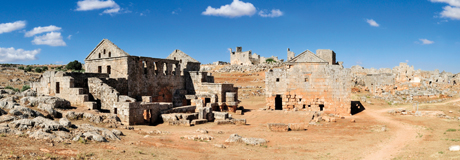
Nestled amid the hills and valleys of the rugged limestone highlands of the Aleppo Plateau in northwest Syria stand the remains of ancient towns and churches built by some of the Middle East’s earliest Christian communities. Howard Crosby Butler, one of the first American archaeologists to explore the plateau, in the early 1900s, understood well the connection of these ruins—often referred to as the “Dead” or “Forgotten Cities”—to early Christian history:
In the deserted mountain country to the east of Antioch, the city in which the followers of Christ were first called Christians …, there are still hundreds of [ancient] churches …, many in so perfect a state of preservation that no conjecture is necessary for a detailed restoration of them to their original estate.1
Butler was clearly amazed by the panoply of religious edifices he encountered, most of which had been built by devout Christians almost 1,500 years before his visit. Indeed, Syria is, without question, the “cradle of Christianity.” Although the most significant events in Jesus’s life took place in Judea and the Galilee, the most consequential events related to the spread of his teachings took place in Roman Syria, which corresponds to lands in modern Syria but also Lebanon, Turkey, and the northern regions of Israel and Jordan.
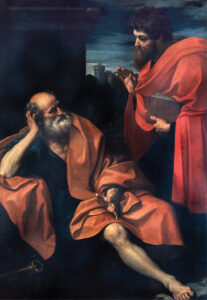
The apostle Paul was born in the Syrian city of Tarsus and was converted on the road to Damascus. He was a frequent visitor to Syrian Antioch, where the followers of Jesus were first called “Christians” (Acts 11:26). In Antioch, Peter and Paul had a strong disagreement over the necessity for converts to Christianity to adhere strictly to Jewish law (Galatians 2:11–19)—an argument that almost tore the nascent religious community apart. Not long thereafter, the Council of Jerusalem (c. 50 CE) determined that, while Jewish Christians could continue to follow the laws of their ancestors, other converts to the new religion would not be required to do so.
Between the time of Peter and Paul and the beginning of the Byzantine Empire in the early fourth century, Syria’s reputation as the first Christian province in the Middle East grew. One of the first popes, Anicetus, was born in Syria, and the early Christian thinker and writer Ignatius preached in Antioch, which was also where John Chrysostom, the renowned church father, developed an early school of Christian theology.a Christians were not as drawn to the plateau during this initial period as they were later but, after the legalization of Christianity in 313, Antioch became one of the Middle East’s most important Christian pilgrimage sites. It was one of several places in the East where the Byzantine emperor Constantine chose to build monumental commemorative churches—the others being in Bethlehem and Jerusalem.b The church in Antioch was completed as early as 327 and it stood for the next two and a half centuries, until an earthquake destroyed it in 588.
GUIDO RENI, PUBLIC DOMAIN, VIA WIKIMEDIA COMMONS
Within a decade after Emperor Theodosius declared Christianity the official religion of the Byzantine Empire (380), Christians made up more than 50 percent of the population of Syria. By the seventh century, they had reached a peak of 80 percent. With the cities of Aleppo to the east, Idlib to the south, and Antioch to the west, the people who settled on the plateau were well positioned to grow, prosper, and practice their faith.
Natural resources, as well as proximity to regional urban centers, ensured that these communities thrived. They grew olive trees, wheat, and grape vines and produced copious quantities of olive oil and wine to consume and export. Lush groves and fields flourished in the soils of the plateau, which also supplied ample stone building material for homes, public buildings, and places of worship, all of them built without mortar using a technique that required great precision in stone cutting and placement.
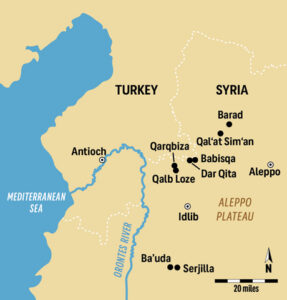
As these communities grew, they attracted some of the most interesting personalities of late antiquity. The famous fifth-century architect Markianos Kyris, priest and master of works, designed and built many churches on the plateau, including those at Babisqa, Ba’uda, and Dar Qita. Kyris and the architect Julianos, whose basilica at Barad was one of the most impressive in the region, were the most prolific ecclesiastical architects of the fourth and fifth centuries.
—–
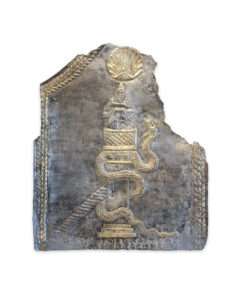
Legendary ascetics also came to the plateau, among them the fifth-century Cilician monk Simeon the Stylite. He spent almost four decades praying on a narrow platform atop a 30-foot-tall pillar. By the time of his death, Simeon was known throughout the Byzantine world. Others were influenced by Simeon, including Theodosius the Cenobiarch, who introduced a more worldly form of religious life to Syria and Palestine. Theodosius would eventually come to espouse communal monasticism as a contrast to the solitary life promoted by earlier holy men. He created havens for monks who wished to express their spirituality through service to neighbors, aid to the poor, providing shelter for wanderers, and peaceful well-regulated communal living.
IMAGEBROKER.COM / ALAMY
Theodosius began an abstemious life after a visit to Simeon the Stylite. He received a rare invitation from Simeon to join him in his aerie and was blessed by the saint, who prophesied that his guest would be a great religious leader. For 30 years thereafter, Theodosius lived in a cave that, according to tradition, was where the three magi stopped to rest before going to Bethlehem to greet the new-born Jesus. He was drawn from his retreat by the ever-increasing numbers of monks who wished to join him there. When the cave grew crowded beyond comfort, he prayed for guidance in finding a place to build his monastery dedicated to performing good works and eventually settled in the Judean Desert far from the mountains of his birth.c
KIM YOUNG TAE / BRIDGEMAN IMAGES
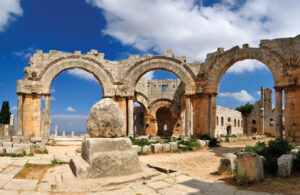
Among the places in Syria dedicated to these saints, the sacred complex of Simeon the Stylite at Qal‘at Sim‘an stands out. Until the Hagia Sophia was built in Constantinople in 537, it was the largest church in the world. Surrounding the pillar of St. Simeon were four basilicas radiating out from a central octagon. The walled complex also included two smaller churches and hostels for pilgrims. The Church of St. Simeon is thought to have been constructed in one program in the late fifth century, but there are suggestions that there was a previous building there during Simeon’s lifetime. The architect is unknown, but it was commissioned by the Byzantine emperor Zeno (r. 474–491), who was born in Cilicia. Part of the basilica’s ground floor is still evident but little remains of Simeon’s pillar, which was for many years the object of much veneration (and vandalism). The final blow was dealt by Russian air strikes during the Syrian Civil War (2011–2024) that severely damaged the entire complex.
DUMBARTON OAKS RESEARCH LIBRARY AND COLLECTION, CC BY-SA 4.0
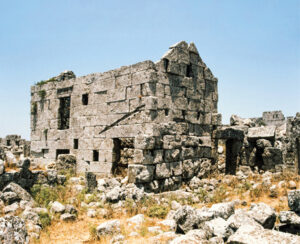
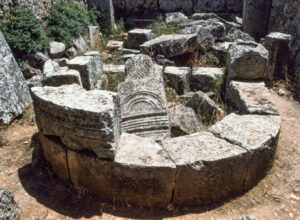
On the southern half of the plateau is the town of Qarqbiza, which may contain one of Syria’s earliest churches. Dating to the fourth century, the Qarqbiza house church gives every appearance of having been built as a standard Roman-style house, the type of private domestic structure where early Christians gathered to worship before the religion was legalized by Constantine. As with other early house churches (such as at Dura-Europos in eastern Syria), several of the building’s internal walls were removed to create a small rectangular assembly hall with a nave and side aisles. Enclosed within the eastern part of the house was a raised semicircular platform (bema) where church leaders would address attendees from a decorated stone lectern. Many of these elements would become standard features of Byzantine church architecture in the fifth and sixth centuries.
DUMBARTON OAKS RESEARCH LIBRARY AND COLLECTION, CC BY-SA 4.0
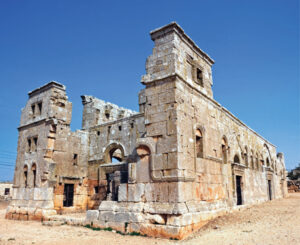
Very close to Qarqbiza is Qalb Loze, which is surrounded by a large Druze village of the same name. Standing guard over the site are the ruins of a fifth-century church with two massive square towers flanking its monumental entrance. The church’s distinctive towers—unique within early Byzantine church architecture—along with a wide, spacious basilica that features soaring arches emerging from short piers led some early Western travelers to suggest that the Qalb Loze church may even have inspired the design of medieval European cathedrals.2 Indeed, renewed speculation about this possibility emerged in 2019 after a fire destroyed parts of Notre Dame Cathedral in Paris, revealing traces of the cathedral’s original architecture that were remarkably similar to the Qalb Loze church. Fanciful or not, this European connection was embraced by the local Christian community and inspired efforts to help restore the church as a source of local pride.
Beyond such picturesque religious architecture, the wealth of Syria’s early Christian communities is amply demonstrated by mansions, villas, public baths, and large well-built storehouses and production centers. Though they were not built in typical Roman style, the bath complexes at Serjilla, Barad, and Babisqa were replete with main halls, caldaria (hot water rooms), and androns (meeting places for men). Considering the resources and effort expended on their design and decoration, the baths were important to the life of the community.
Most public baths in these cities had similar mosaic floors and murals, but all of these have been looted or otherwise damaged over the years so that often very little remains. The public baths at Babisqa, though not as well preserved as those at Serjilla, featured tunnel vaults, piers, and arcades and may have stood as high as three stories. Even monasteries had elaborate bathhouses, such as the one at Barad where the cathedral of Julianos was built. The cities of the plateau also had large stone houses and villas with skillfully carved internal and external embellishments demonstrating the wealth of their owners. Imposing buildings dedicated to the wine and olive oil trade reflect attention to aesthetics as well as utility. A clear expression of the importance of these commodities is the carved decoration in several churches featuring stone crosses intertwined with grape vines and olive leaves.
All this splendor came to an end in the seventh and eighth centuries for reasons that are still not completely understood. Some scholars have speculated that the cities of the plateau were overly dependent on olive oil and wine production, arguing that when this trade declined, the settlements followed suit. But more recent research indicates the local economy was far more diverse and resilient, including local potters who produced wares for export and farmers who raised livestock and planted a variety of crops beyond olives and grapes.
DARIO BAJURIN / ALAMY
Others have assumed the cities were deserted because of the Islamic conquests. Even though the cities of the plateau were not directly in the path of invading armies, some scholars have suggested that trade routes were so disrupted that the region’s inhabitants were forced to give up and move elsewhere. It is now generally accepted, however, that the decline was gradual and caused by multiple factors. Population growth on the plateau had been continuous from the late third century until the middle of the sixth century, when a series of events began to make people’s lives more difficult. By the seventh century, invasions, epidemics, drought, soil depletion, and climate change had decimated the population or forced them out.
For almost 2,000 years, Syrian Christians have populated the cities and towns of the Aleppo Plateau. Before the Syrian Civil War, they lived mostly in peace with their Muslim, Druze, and Alawite neighbors who, like them, welcomed Western travelers, enjoying the attention brought to their land as well as the economic benefits from tourism. Though it seems unlikely that tourism to this war-torn region will be revived any time soon, the people living near these ancient Christian cities have faith that visitors will come again—if the fragile peace is maintained.
Please join the BAS Library or become an All Access member of BAS to gain full access to this article and so much more.
Already a library member? Log in here.
Institution user? Log in with your IP address or Username
Heritage in the Crossfire
By Sandra Scham
DPA PICTURE ALLIANCE / ALAMY
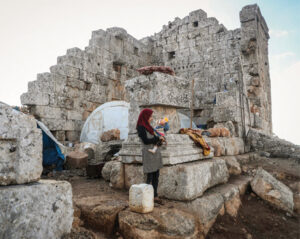
Today, the early Christian sites of the Aleppo Plateau have experienced widespread destruction caused mostly by the ravages of war. Forty of the largest settlements, grouped within eight archaeological parks, were inscribed on the UNESCO World Heritage list in 2011, the year that the Syrian Civil War began. Less than two years later, they were at the top of the watchlist of World Heritage sites in danger. Northwest Syria was the epicenter of some of the most brutal and destructive battles in the conflict, and there was widespread looting and vandalism as well as intentional destruction. Far more tragically, thousands were killed or displaced, including most of the Christian population.
The future of the region is by no means secure, even though the war has been declared over. In northwest Syria, major sites have been damaged and neglected, and the Christian population has fled. Nevertheless, non-Christians who remain in the nearby villages are not disinterested in this heritage, and there was not much sectarian strife here before the war. Regardless of their religion, those who continue to live near these sites want to see them preserved and restored. They hope that the ancient sites will revive tourism, which in turn will increase stability and bring in much-needed resources.
MLA Citation
Footnotes
1. Robert Edwards, “Antioch’s Silent Guardians,” BAR, Summer 2024.
2. Jordan J. Ryan, “The Life of Jesus Written in Stone,” BAR, Winter 2024.
3. Yizhar Hirschfeld, “Spirituality in the Judean Desert,” BAR, September/October 1995.
Endnotes
1. Howard Crosby Butler, Early Churches in Syria: Fourth to Seventh Centuries (Princeton: Princeton Univ. Press, 1929), p. 3.
2. The British explorer and diplomat Gertrude Bell (1868–1926) commented that the church represented “the beginning of a new chapter in the architecture of the world. The fine and simple beauty of Romanesque was born in North Syria.” See G. Bell, Syria: The Desert and the Sown (New York: E.P. Dutton, 1907), p. 306.