
‘Ovesh, Ḥorvat
INTRODUCTION
EXCAVATION RESULTS
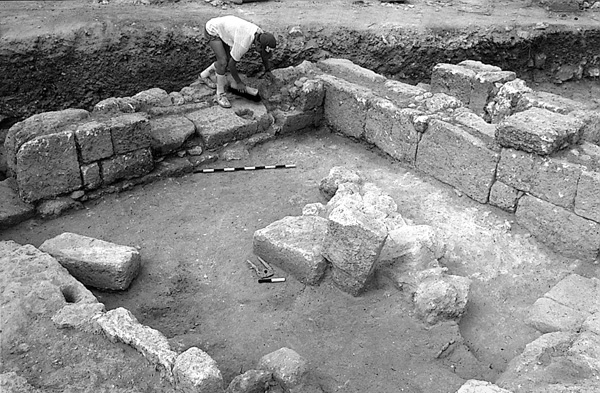
Ashlars, Byzantine sherds, and a group of 19 iron tools were retrieved from debris removed by a bulldozer in 1992. The subsequent excavations uncovered the remains of a structure comprising four rooms, two of which were probably courtyards. Excavation results indicate that the structure was a blacksmith workshop consisting of a fireplace and a workroom. Its walls were constructed of soft limestone ashlars of high quality, laid as alternating headers and stretchers. In one room (A), installations were built in the corners, and in the center of the floor was a large, square stone base that may have supported the large anvil found nearby. Near the stone, a few additional iron tools were found, similar to those recovered in the bulldozer debris prior to excavation. In another room (B), the bottom of a large jar was sunken into the floor. It was found full of ash, and probably functioned as a fireplace. Typical Byzantine ceramics were found in the building together with a few Byzantine coins. This is the first time that a complete blacksmith workshop has been found with the craftsman’s equipment together with some of the products of the workshop. Finds from other parts of the Roman Empire, archaeological remains from Israel, and Jewish rabbinical textual sources can help shed light on the nature of the workshop.
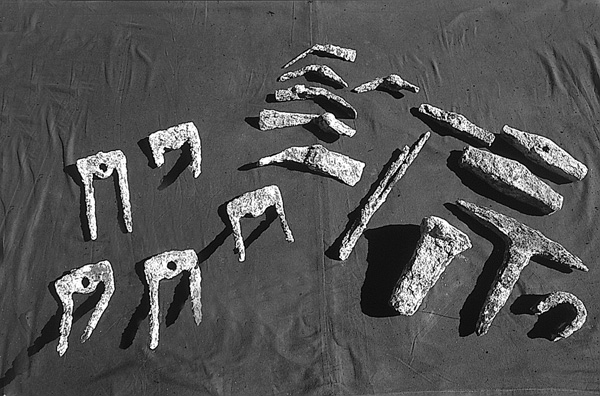
Noteworthy among the blacksmith tools are two hammers (1.3 kg and 2.4 kg) and a sledge-hammer (6 kg, probably to be identified with the talmudic kurnas). There are four types of anvils: a small one in the shape of a horseshoe (1.1 kg), probably used for delicate finishing; a square anvil (9 kg) for heavy work (probably the talmudic sadan); and two T-shaped anvils (2.5 and 5 kg) for shaping the various tools. Also found were six tongs of varying designs (probably the talmudic kliva), used to clasp different objects. Two other tools are a chisel and a punch. Of the farming tools found at the site, apparently products of the blacksmith workshop, seven are different types of ax-adzes (probably the talmudic kardom), and six are bident hoes (probably the talmudic ma‘ader), of a type unknown in the region. All these tools were in use by farmers of the Byzantine period. Based on scenes depicted on Byzantine period mosaic floors, the bident was used in vineyards in particular.
Also retrieved from the bulldozer debris was a 12-cm-high bronze figurine dating to the Late Roman period. The figurine represents a naked male wearing a cloak, leaning on his right leg, his left leg flexed. The figure is holding a cock in one hand and a cluster of grapes in the other, two common attributes of Dionysus.
During the 1996 excavations, structures including olive-oil presses were uncovered north of the smithy. Four strata were identified. The two lower ones date to the Late Roman period and include a collecting vat with two amphorae in it. In the third and main stratum, two olive-oil presses were found, one in the eastern and one in the southwestern room. Both rooms were constructed in the same technique as the blacksmith workshop. Some surfaces were paved with white mosaic. In one of the cisterns, numerous broken jars, amphorae, cooking pots, flasks, and jugs were found, all dating to the Byzantine period. The final stratum dates to the nineteenth–twentieth centuries CE.
In summary,
MORDECHAI AVIAM
INTRODUCTION
EXCAVATION RESULTS
Ashlars, Byzantine sherds, and a group of 19 iron tools were retrieved from debris removed by a bulldozer in 1992. The subsequent excavations uncovered the remains of a structure comprising four rooms, two of which were probably courtyards. Excavation results indicate that the structure was a blacksmith workshop consisting of a fireplace and a workroom. Its walls were constructed of soft limestone ashlars of high quality, laid as alternating headers and stretchers. In one room (A), installations were built in the corners, and in the center of the floor was a large, square stone base that may have supported the large anvil found nearby. Near the stone, a few additional iron tools were found, similar to those recovered in the bulldozer debris prior to excavation. In another room (B), the bottom of a large jar was sunken into the floor. It was found full of ash, and probably functioned as a fireplace. Typical Byzantine ceramics were found in the building together with a few Byzantine coins. This is the first time that a complete blacksmith workshop has been found with the craftsman’s equipment together with some of the products of the workshop. Finds from other parts of the Roman Empire, archaeological remains from Israel, and Jewish rabbinical textual sources can help shed light on the nature of the workshop.