
Te’o, Tel
INTRODUCTION
Tel Te’o is located on the western margin of the
| STRATIGRAPHY OF TEL TE’O | Stratum | Period |
|---|---|---|
| I | Late Ottoman | |
| II | Medieval (?) | |
| III | Early Bronze II | |
| V–IV | Early Bronze IA | |
| VII–VI | Chalcolithic | |
| X–VIII | Pottery Neolithic | |
| XIII–XI | Pre-Pottery Neolithic B–C |
EXCAVATION RESULTS
THE PRE-POTTERY NEOLITHIC PERIOD. Excavation in the lowest stratum (XIII) was in a limited area (12 sq m) and architectural remains were scanty, consisting of two beaten-earth floors, one of which was founded upon the alluvial fan underlying the site. Stratum XII yielded a corner of a rectangular house and a plastered floor, an architectural type well known from Pre-Pottery Neolithic B sites.
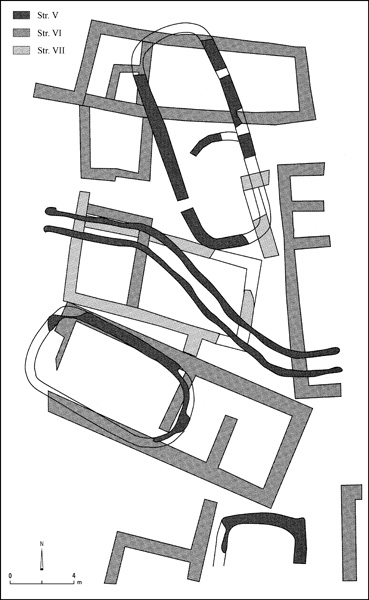
Additional lime-plaster floors were discerned in stratum XI, as was a portion of what appears to have been a corridor house. Its size is much smaller than corridor houses uncovered at Beidha, ‘Ain Ghazal, and
THE POTTERY NEOLITHIC PERIOD. Three distinct Pottery Neolithic strata were revealed, representing an accumulation of 1.2–1.5 m over an area of 100–200 sq m. Despite the relatively large exposure, architectural features were few and poorly preserved. Enough has survived, however, to indicate the presence of rectangular dwellings, their walls built of plano-convex mud bricks on stone foundations. The features most characteristic of these strata are subterranean stone-lined silos, a large number of hearths and trash pits, and human interments—mainly infant jar-burials beneath floors. The pottery indicates a gradual development: the earliest strata contain elements with affinities to earlier Neolithic cultures (Lodian, Jericho IX), while features hinting at Wadi Rabah or later horizons are also extant. The lithics, especially the pressure-flaked sickle blades, appear to be consistent with the pottery traditions exhibited. On this basis, strata X–VIII can be dated to the fifth millennium BCE.
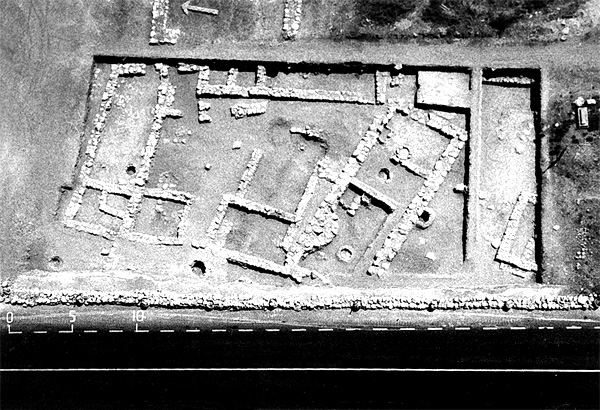
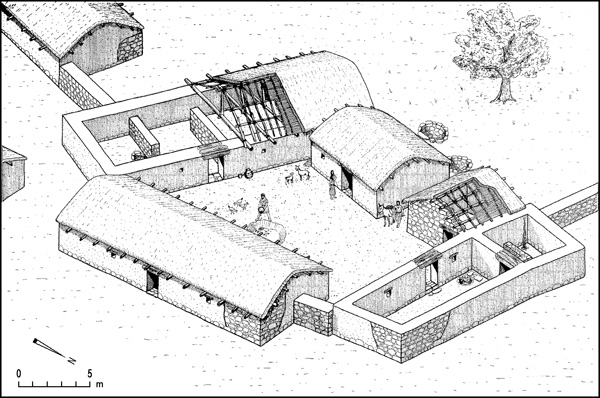
THE CHALCOLITHIC PERIOD. Strata VII–VI represent two consecutive phases of settlement during the Chalcolithic period. The most conspicuous feature of the buildings in these strata is they were built exclusively of stone, and are thus better preserved than those of the earlier Pottery Neolithic strata. The main feature in stratum VII was an enclosed dwelling compound comprised of three buildings sharing a central courtyard. Stratum VI represents a gradual process of expansion and construction in open spaces, as well as reconstruction and replacement of some of the earlier structures, indicative of settlement planning and spatial organization. The principles of construction were based on rectangular broad-houses with sunken floors. The interiors were divided into two or three rooms of unequal size, the main room occupying between one half and three quarters of the entire floor area. Four individuals were interred, without grave goods, beneath the ancillary rooms in the courtyard. Two were found articulated in a flexed position, the other two burials comprised a number of adult bones. Dominant features in these strata were deep and shallow cylindrical silos in both houses and courtyards, providing ample testimony to the principal pursuit of the inhabitants.
The Chalcolithic pottery at Tel Te’o attests to the presence of both Galilean and Golanian traditions, as well as to a unique group of bowls designated as
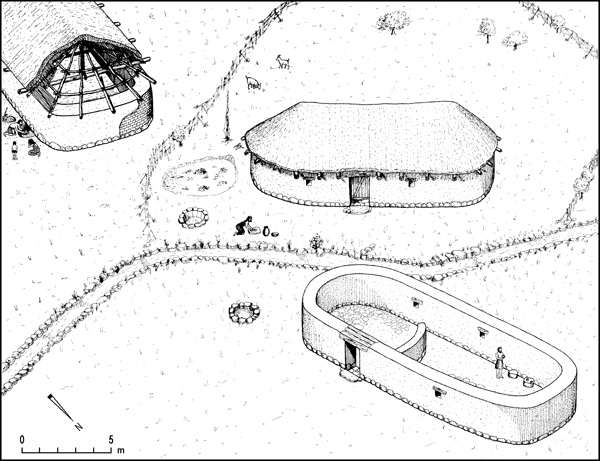
THE EARLY BRONZE AGE I. The settlement of stratum V was built according to an entirely new plan, consisting of three widely spaced, curvilinear structures. The even height of the tops of the stone walls and the debris layers on the floors suggest that the superstructures were made of mud bricks. Floors consisted of beaten earth and were partly paved with flat stones. The longest building was subdivided by a curved partition wall. The entrance to another dwelling was located in the long straight wall and was marked by a door socket and sill giving access to the sunken interior. Beneath these dwellings, three infant jar-burials were found. The open area between the houses functioned as a courtyard and included various installations. The most unusual feature was a stone-lined drainage channel crossing the area, which was necessary to prevent the build-up of flood deposits and the undercutting of the house foundations.
The architectural remains of stratum IV were poorly preserved; however, some curved wall segments are sufficient to indicate that the structures in this stratum, like those of stratum V, were curvilinear.
The ceramic assemblage of strata V–IV is characterized by new forms such as gray burnished ware vessels, ledge and loop handles, and red slips applied in a technique unknown in the preceding Chalcolithic strata. The lithics include a well-defined Canaanean blade technology, used mostly for sickle blades. These observations correspond with the architectural evidence, indicating the arrival of bearers of a new culture unrelated to the earlier occupation. The cultural break between strata VI and V suggests a chronological gap of uncertain length within the second third of the fourth millennium BCE. This new culture marks the beginning of the Early Bronze Age IA.
THE EARLY BRONZE AGE II. No clear architectural remains of stratum III were found, but the Early Bronze Age II presence on the mound was indicated by the ceramic evidence deriving from grave fills in the stratum I cemetery, and primarily from a large sherd-rich refuse pit. Most sherds in the pit belonged to diagnostic vessels of the metallic ware industry of northern Canaan, produced across the
THE MEDIEVAL PERIOD (?). Architectural features assigned to stratum II were located, for the most part, in soundings made in area B, east of the main excavation area. Remains of a large structure were discovered, its foundations built of stone with two dressed faces. Some of the rooms were paved with stone slabs. Ceramics were scarce, the few diagnostic sherds assigned a medieval date.
THE LATE OTTOMAN PERIOD. Stratum I comprises remains of the cemetery where the Muslim population of the village of
EMANUEL EISENBERG
INTRODUCTION
Tel Te’o is located on the western margin of the
| STRATIGRAPHY OF TEL TE’O | Stratum | Period |
|---|---|---|
| I | Late Ottoman | |
| II | Medieval (?) | |
| III | Early Bronze II | |
| V–IV | Early Bronze IA | |
| VII–VI | Chalcolithic | |
| X–VIII | Pottery Neolithic | |
| XIII–XI | Pre-Pottery Neolithic B–C |
EXCAVATION RESULTS
THE PRE-POTTERY NEOLITHIC PERIOD. Excavation in the lowest stratum (XIII) was in a limited area (12 sq m) and architectural remains were scanty, consisting of two beaten-earth floors, one of which was founded upon the alluvial fan underlying the site. Stratum XII yielded a corner of a rectangular house and a plastered floor, an architectural type well known from Pre-Pottery Neolithic B sites.