
Archaeological Views: Jerusalem and Samaria: An Anthropological Tale of Two Cities

In the ninth and eighth centuries B.C.E., Jerusalem was the capital of the southern kingdom of Judah while Samaria was the capital of the northern kingdom of Israel. In some ways these cities were much the same: Each was the capital of a part of the former United Kingdom of Israel that had been ruled by David and his son Solomon. Yet they were also very different—ideologically, economically and politically.
These insights come from the field of urban anthropology, which places cities in their larger social and political contexts. Cities themselves are of course multifaceted entities and are made up of diverse elements—residential, industrial, commercial, religious, etc. Urban anthropologists, however, move beyond this static view of cities and instead view them as organic, dynamic entities in constant negotiation with their societies. A society’s ideological beliefs, economic needs, political structures and social behaviors are woven into the very fabric of its urban centers. At the same time, the cities themselves construct and reinforce relationships and values that influence their societies.
As social entities, cities have a variety of social roles, including ideological, political/administrative and economic. Yet the relative importance of these social functions is not random but rather derives from the strength of both the city’s economy and the controlling state.1 When state power is weak and the urban economy is dependent on rural agriculture, the city’s ideological role dominates and becomes what anthropologists term a “regal-ritual city.” By contrast, when the state is strong but the urban economy is still dependent on farming, the city’s administrative role comes to dominate, and it thus becomes an “administrative city.”
In a regal-ritual city, the primary urban role is ideological. The settlement is usually small, not much larger than a village. The city’s essential components are a royal household and a ceremonial center. This type of city occurs in decentralized societies in which leadership is hereditary and has limited access to wealth and power. The city’s residents are also not qualitatively different from their rural counterparts. They certainly skew to the top rung in terms of wealth, power and prestige, but the differences are in quantity only. The rural inhabitants share in the state’s ideology and flock to the regal-ritual center to celebrate political and religious rituals. It is at such times that the city achieves true population density.
Like the regal-ritual city, the administrative city serves as the residence for the state elite and as a center for political and religious functions. However, major differences arise out of the fact that in this type of city, leadership has access to great wealth and power by dint of its organizational and coordinating activities. The administrative city—serving as a nexus for transportation and communication and a hub for commerce, crafts and other specialties—links together a hierarchy of provincial centers that are controlled by the state. These cities extract the agricultural surplus from the countryside and use it to feed the city’s residents, pay for monumental construction and support the luxurious lifestyle of the leadership, who are qualitatively separate from the rest of the population. The city is a repository of state power but unifies through coercion rather than common ideology.
From the perspective of urban anthropology, Jerusalem clearly fits the paradigm of the regal-ritual city.a It was primarily a sacred city, dominated by an ascribed priesthood administering at a national cult center (the Temple) and by a hereditary kingship (the Davidic dynasty) that was often at the mercy of foreign powers. Jerusalem was not a primary producer of goods, but its small population limited the strain placed on the countryside. The royal family certainly lived better than the average Judahite, but both would have viewed themselves first and foremost as inhabitants of Judah; there was not a distinct urban population that saw itself as Jerusalemite first. And, of course, the social life in Jerusalem revolved around the sacred calendar, divine sacrifices and commemorative events related to the royal household. Three times a year, at Passover, Shavuot and Sukkot, the city’s population would swell as pilgrims arrived to celebrate the festivals.
In contrast, Samaria fits the paradigm of an administrative city. Located in the hills of Ephraim, it headed a hierarchical network of towns and villages. Consistent with its administrative function, the city was established by Omri, who for strategic reasons moved the Israelite capital there from Tirzah in 876 B.C.E. During its 150 years of existence, Samaria was renowned as a place of luxury, where the urban elite enjoyed a life qualitatively different from their brethren in the countryside.b
When the kingdom of Israel was conquered by the Assyrians in the late eighth century B.C.E., no one yearned for the rebuilding of Samaria as an Israelite city, for without the Israelite state it had lost its raison d’etre. In the ensuing centuries, others lived and built at the site, but the Israelite character of Samaria was no longer a unifying force. With the state gone, the city no longer had a purpose.
Contrast this with the reaction following the destruction of Jerusalem by the Babylonians in 586 B.C.E. This city, which never lost its regal-ritual essence, was mourned and remembered as a unique spiritual and national center. The separate functions had been so inextricably linked that to yearn for one was to yearn for the other. When the Jews returned to rebuild Jerusalem under the Persians, it was inconceivable that they would have one without the other. Jerusalem was ultimately refashioned as the center of an independent Yehud (although within Persian constraints) and as the center once again of Jewish spiritual and ritual life.
Archaeological Views: The Chasm Between the Media and Biblical Archaeological Scholarship

Unfortunately, today a seemingly impenetrable divide separates lay studies and sermons, on the one hand, from the academic study of the Bible and archaeology, on the other. To this we may add the yawning gap between what scholars do and what much of the media does. For example, an ABC special that aired last year showing Christiane Amanpour and her son watching the sunrise from Mt. Sinai more or less ignored the state of the archaeological field today. This show could have been produced a generation ago.
I do not think the American public is apathetic or indifferent. On the contrary, as many readers of BAR know, a small cadre of devoted readers pride themselves on staying attuned to the most recent developments in the field of Biblical archaeology. In relation to the larger population of the United States as a whole, however, this is a very small group. When we add the fact that the media is hesitant to take on some of the real current questions that are challenging the field, the situation is even worse.
What we in academia observe is a stubborn refusal by large sectors of the population to accept climate change and global warming as factors to be taken seriously. But cancer research—everyone takes that seriously. The study of religion—and especially the Bible and archaeology—often falls into the former category.
Let me offer a few examples. If a rabbi, priest or minister sermonizes about Biblical Israel or the Exodus, there is almost zero chance of hearing any serious consideration of the complexities of Israel’s ethnogenesis: Did Israel emerge from Egypt as a fully developed people whose singular experience under slavery led to the almost immediate birth of monotheism and Israelite religion as we know it? The maximalist/minimalist debate, now a generation old and the subject of thousands of articles and books, has hardly inspired the Bible-reading public to alter its long-held views. As someone who regularly lectures on these subjects, I am usually nonplussed when people ask me, “Why have I never heard that before?”
Having a more nuanced view of Israel’s origins need not run counter to Biblical faith and might not be so threatening if one were to examine more fully the dynamics of the transition from the Late Bronze Age to the Iron Age. In fact, one might just discover factors that would enhance our understanding of the Biblical record, although in slightly altered ways. For example, perhaps the recollection by a small group of newcomers (or indigenes) recently escaped from enslavement created an environment in which new ways of living could be envisioned in the highlands of Canaan that were different from the more hierarchical norms that dominated the cultures surrounding them. What if King David was not as mighty as the Bible portrays him? What if Jerusalem was not the shining city on the hill before the beginnings of urbanism under King Hezekiah? Perhaps recognition of such history might actually lead us to a greater sensitivity for what the Biblical personae achieved in such short order. And it might also lead us to a more appreciative and faithful reading of the Biblical narrative.
Even touring the Holy Land and its array of Biblical sites and national parks can be misleading. The sign-age is often overtly political, and many of the presentations in films, brochures and websites can be wildly different from what is currently accepted in academia.
How can we change things? We all know that the print medium is in serious decline. Most of us teaching in colleges and universities are aware that the humanities are also in steep decline. That is true for courses in religious studies and the Bible, as well as archaeology, though there are many exceptions. MOOCS (massive open online courses) are becoming more common, and some of the biggest names in higher education are experimenting with them, including Duke and the University of North Carolina at Chapel Hill. But until TV journalism, as well as major magazines and newspapers in print and online, catch up with the field and turn to real experts for advice, the larger public is destined to remain ill-informed.
Outreach education sponsored by seminaries could do a lot more in this area. In my own state of North Carolina, there are nearly 3,000 courses per year in public high schools that teach aspects of the Bible and Biblical history in a variety of settings, and yet there is no resource for those teachers so that they can be up-to-date on Biblical studies.
The Society of Biblical Literature’s new online resource, Bible Odyssey [not yet published], will, one hopes, go a long way to rectify this situation.
Archaeological Views: Biblical Archaeology Through a Victorian Lens

The public presentation of Biblical archaeology has been fundamental to the discipline since its origins in the Victorian era. The explosion in demand for print materials that emerged in the early 19th century and the rise of a literate, urban middle class encouraged the Victorian urge to “improve oneself” through reading and self-education. Of course, this educational content still had to be entertaining, and as BAR readers know, Biblical archaeology can be very entertaining.
Near Eastern archaeological discoveries were widely reported in the press, often in great detail. My favorite example is an issue of The Illustrated London News that printed copies of Assyrian reliefs excavated at Nimrud and then asked readers to help translate the Akkadian.
Since Near Eastern explorations were just beginning in the 19th century, not much was yet known about how these discoveries related to Biblical history. So journalists often covered them by focusing on another topic that was dear to the heart of the Victorian public: technology and technological advancement. These early articles often treat not so much the artifacts or sites themselves, but rather the engineering skills and tools needed to extract artifacts from the ground and bring them back to Europe or the United States. Austen Henry Layard’s excavations in Mesopotamia were pivotal in this respect; much ink was spilled on how he was able to raise the colossal Neo-Assyrian reliefs and statues that had recently been put on display in the British Museum.a
The Victorian interest in technology stemmed from 19th-century understandings of progress and decline. That Britain had the technology to move monumental Assyrian statues was a sign not only of engineering skill but also of moral superiority. Indeed, this supposed moral and cultural superiority was one of the primary justifications for Victorian imperialism.
At the same time, however, the rediscovery of ancient Egypt and Mesopotamia confused these notions of progress and development: If ancient Egyptian and Mesopotamian technology and advanced social structures implied a sort of moral superiority, why had the civilizations died? Even more distressing, if a civilization as grand as pharaonic Egypt could collapse, what did this suggest for Victorian England?
Encounters with lost ancient Near Eastern civilizations were usually described as dramatically as possible. The cultures of Egypt and Mesopotamia were depicted as exotic civilizations with values far different from the Victorians. Much of the art printed with these articles was only loosely based on excavations and emphasized the “otherness” of the places where the discoveries were made. Often these representations reflected male fantasies (such as harem scenes) that had little to do with ancient Egypt or Assyria but much to do with the interests of Victorian men. Many of the 19th-century illustrations portrayed ancient Egyptian men as snake charmers and women as belly dancers.
The Holy Land, however, was described very differently. Popular presentations of Biblical archaeology minimized the “otherness” of the Biblical world. From a Victorian Christian or Jewish perspective, it made sense that Egypt and Mesopotamia should be very different—and immoral, since they are generally the villains of the Bible. But this was problematic for thinking about the Holy Land. To explain why the Holy Land, like Egypt or Mesopotamia, was so “other,” Protestant writers argued that God had purposely limited the development of society in the Holy Land in order to allow future Christians to “see” the culture in which the Bible had been written.
Victorian churchgoers were comfortable with the new picture of the Biblical world that was emerging. Popular in both England and America were traveling Bible shows in which local people dressed up as Bedouin and played out Biblical roles and scenes. Seeing a local politician explain how to grind grain while dressed as Moses or David reinforced British and American claims to Biblical culture.
Today many people tend to think that one of the (perhaps outmoded) concerns of Biblical archaeology is to prove or disprove the Bible’s version of history. Surprisingly, there is not much hint of this approach in the 19th century. Statements that the Bible should be scientifically proven were certainly made at the foundation of the London-based Palestine Exploration Fund in 1865, but there is not much hint that anyone thought that the results could be negative.
In fact, popular presentations of Biblical archaeological discoveries, such as the Mesha Stela and the Black Obelisk of the Assyrian king Shalmaneser III, demanded that readers frame the Bible’s stories in an authentic historical setting rather than in some timeless, imagined world. After reading about these discoveries, people were no longer content to read the Exodus account merely as a conflict between Moses and Pharaoh. Rather, readers wanted to know which pharaoh. Even today, some BAR readers continue to demand these types of answers, even when archaeologists aren’t always able to provide them!
Archaeological Views: Biblical Archaeology in the 21st Century

Archaeology in 2013 bears little resemblance to my first and unforgettable experience as a student volunteer at Tel Dan in 1974—yikes, nearly four decades ago! This was a time when archaeology was still perceived as Israel’s national hobby, closely intertwined with efforts to forge a shared Jewish identity and connection with the Land of Israel. This also predated the identity crisis of “Biblical archaeology” during the last decades of the 20th century, when many archaeologists (and other scholars) still considered the discipline a subfield of Biblical studies.
As an archaeologist digging in Israel in the 21st century, I am especially impressed with the way new technologies have transformed fieldwork, irreversibly changing our approach to how archaeology is practiced and taught. These new technologies have also profoundly expanded our ability to address a wider range of questions about the past.a
Though the excitement of digging is still there, fieldwork at most excavations requires technologies and skills that were unimaginable just a couple of decades ago. Due in part to conservation concerns (as well as budgetary constraints), less exploration is done via excavation. Before a spade hits the ground, many projects conduct extensive surveys that use geophysical prospecting—for example, geomagnetic investigations, electrical resistivity tomography, aerial and satellite images and intensive pedestrian surveys accompanied by small subsurface soundings (pit testing). The emphasis is often on non-intrusive documentation of a site and concomitantly less excavation.
When digging does occur, new questions are being asked of the archaeological remains. Increasingly, efforts are made to extract evidence not readily visible to the naked eye. On-site micro-archaeology, or information that can be documented via a microscope, is one of the more exciting approaches to maximize data collection to address more nuanced questions. While the use of science in archaeological investigations is not new, remarkably it is now possible to conduct scientific analyses in real time in field laboratories set up during the actual excavation. This allows feedback and collaboration between archaeologists and scientists, which often results in refinements in excavation strategy. At Dor, Tell es-Safi/Gath, Megiddo and Tel Akko, scientists from the Weizmann Institute’s Kimmel Center for Archaeological Science (www.weizmann.ac.il/kimmel-arch/) have been working alongside archaeologists during the actual excavation season to harness the power of scientific analyses to address questions that traditional archaeological techniques cannot even begin to explore. In some cases, for example, the discovery of bronze and iron production side-by-side in early Iron II levels at Tell es-Safi/Gath has transformed our understanding of ancient metallurgy.1
Documentation of excavations is now increasingly done in real space, implementing differential Global Positioning Systems (GPS) and total stations that record measurements based on a projected real-world coordinate system using Geographic Information Systems (GIS). Sophisticated digital databases integrate field diaries, photos, drawings and videos. And excavations are now recorded extensively by digital cameras, laser scanners and computers. At Tel Akko, where I codirect excavations with Michal Artzy of the University of Haifa, we have developed a new state-of-the-art 3D documentation system.2 Our approach uses digital cameras, either hand-held or attached to a mast, a helium balloon or remote-controlled miniature helicopter, and PhotoScan, a photogrammetry software program developed by Agisoft. In the field, this technique produces a georeferenced orthophoto, which is used to create a digital plan with sub-centimeter spatial accuracy and a 3D image. All this is a far cry from the laying out of grids using tape measures and dumpy levels that I remember, where human errors are inevitable—especially under the hot summer sun—and are compounded over time.
New imaging technologies are also revolutionizing our ability to document and interpret artifacts. Hand-drawn objects have been the staple of all archaeological reports for more than a century. Recently, however, scientists from the Weizmann Institute and archaeologists at the Hebrew University of Jerusalem have established the Computerized Archaeology Laboratory. Using high-precision scanners, highly accurate drawings and photographs can be produced quickly and affordably. These can then be used to create mathematically based, automated pottery typologies.
By embracing new approaches and technologies of the 21st century, we are opening up previously unexplored frontiers for understanding the world of the Bible and our shared past.
Archaeological Views: The Great Tekhelet Debate—Blue or Purple?

For ancient Israelites, tekhelet was God’s chosen color. It was the color of the sumptuous drapes adorning Solomon’s Temple (2 Chronicles 3:14) as well as the robes worn by Israel’s high priests (Exodus 28:31). Even ordinary Israelites were commanded to tie one string of tekhelet to the corner fringes (Hebrew, tzitzit) of their garments as a constant reminder of their special relationship with God (Numbers 15:38–39).

But how do we know what color the Biblical writers had in mind? While tekhelet-colored fabrics and clothes were widely worn and traded throughout the ancient Mediterranean world, by the Roman period, donning tekhelet and similar colors was the exclusive privilege of the emperor. And so it happened that sometime around the seventh century C.E., probably hastened by the Islamic conquest of the Levant, the source and identity of tekhelet, and knowledge of its manufacture, slipped into obscurity.
About a century ago, as part of his doctoral research on “Hebrew Porphyrology” (the study of purple), Isaac Herzog, who years later became the first chief rabbi of Israel, corresponded with the greatest dye chemist of his day, Paul Friedländer, about possible sources for Biblical tekhelet. Archaeological evidence and an exhaustive survey of the writings of rabbinic scholars and Greek and Roman naturalists had convinced Herzog that tekhelet was a bright sky-blue obtained from the natural secretions of a certain sea snail, the Murex trunculus, known to produce a dark purple dye.a
But the esteemed chemist challenged Herzog’s contention: “I consider it impossible to produce a pure blue from the purple snails that are known to me,” Friedländer said emphatically.1
Unfortunately, neither Herzog nor Friedländer lived to see a 1985 experiment by Otto Elsner, a chemist with the Shenkar College of Fibers in Israel, proving that sky-blue could, in fact, be produced from murex dye. During a specific stage in the dyeing process, exposure to ultraviolet rays (such as those found in sunlight) can cause the molecules that give the dye its natural purple color to transform into pure indigo, thus leaving the dye an unadulterated sky-blue.
Yet the debate surrounding the exact color of tekhelet was not settled. Depending on how long the murex dye is exposed to light and at what stage in the dyeing process, a wide range of colors and shades can result. In addition, some chemists claim that ancient dyers, who created their dyes primarily using bacterial fermentation in covered vats, probably did not know how to adjust colors through exposure to sunlight, so that their dyes would have tended to be a much darker purple. In view of the obvious expertise of ancient dyers, however, this does not seem a convincing supposition.
Furthermore, there is some literary and archaeological evidence that tekhelet may have been more purple than blue. Writing in the 11th century, the great Biblical exegete Rashi defined tekhelet as a deep blue or dark violet, “the color of the sky as it darkens towards evening” (commentary on Numbers 15:38). And at the Herodian fortress of Masada, a small swatch of first-century, violet-colored wool was discovered during Yigael Yadin’s 1960s excavations. A recent analysis of the violet-colored wool by Zvi Koren, an archaeochemist at Shenkar College, found that its violet hue was produced with murex dye.
But Rabbi Herzog, like the overwhelming majority of Jewish scholars since antiquity, had firmly believed that tekhelet was sky-blue, with no purple tinges. Maimonides (1135–1204) had declared unequivocally that tekhelet was “the color of the sky opposite the sun when there is a clear sky” (Mishneh Torah, Laws of Tzitzit 2:1). Nearly a thousand years earlier, the second-century scholar Rabbi Meir declared, “Tekhelet resembles the sea, and the sea resembles the heavens, and the heavens resemble God’s holy throne” (Midrash Sifre, Shelach).
One major piece of evidence in favor of designating tekhelet as sky-blue involves an infamous story of forgery related in the Babylonian Talmud (Baba Metzia 61b). Unscrupulous merchants were substituting a fraudulent, cheaper dye called kala ilan in place of authentic tekhelet. The impostor, a plant-derived indigo, was a dead ringer for the real stuff, and the Talmud claims that only God could tell the difference. If tekhelet looked exactly like kala ilan, it must have been the same color as indigo: sky-blue.
Wayne Horowitz, an Assyriologist at the Hebrew University of Jerusalem, offers further significant linguistic evidence supporting the sky-blue option. In ancient Mesopotamia, there was no word for the color blue in either Sumerian or Akkadian. Hence, Sumerian uqnû, the word for the precious blue gem lapis lazuli, was adopted to mean lapis lazuli-colored, i.e., blue and all its various shades. This term was apparently applied to the sky, and later to blue wool (uqnâtu). When the foreign word takiltu (Hebrew, tekhelet) was adopted into Akkadian, it was rendered with the same cuneiform signs as uqnâtu. This suggests that to Mesopotamian eyes, the colors of lapis lazuli, the sky and tekhelet were equivalent.
So what color was ancient tekhelet? For us, the founders of the Ptil Tekhelet Foundation, this is no mere academic question. We believe the preponderance of evidence—archaeological, linguistic and literary—clearly supports the traditional position and points to sky-blue as the authentic color of tekhelet. Over the past 25 years, we have produced hundreds of thousands of murex-dyed tzitzit strings that hang from prayer shawls around the world, reminding those who wear them of the sea, the sky and God’s holy throne.
Archaeological Views: A Tale of Two Slaves

A highlight of a tour of Turkey that my wife and I went on in June 2012 was a visit to the Lycus valley in ancient Phrygia, home of Colossae, Laodicea and Hierapolis. All three of these cities are mentioned in Paul’s letter to the Colossians (Colossians 4:13). Laodicea is also well known from Revelation as home of the “lukewarm” church (Revelation 3:14–22). But the main attraction for me was the area’s connection with Paul’s Philemon 1. It is from this valley that the slave Onesimus fled, somehow encountered Paul in prison, was converted and eventually returned with the letter we know today as Philemon. After almost 20 years of researching and writing about slavery and the New Testament, it was exhilarating finally to see the place where it had all begun. I had thought a lot about Onesimus over the years; I felt as if I knew him.
What I was not prepared for, however, was getting to know another slave from the region. Fifty-five miles southwest of the Lycus valley sits Aphrodisias, an important Roman-era city well known to BAR readers.a It was here that I was first introduced to Zoilos, a former slave turned wealthy benefactor. Unlike Onesimus, Zoilos is not someone we read about in ancient literature. What we know of him has been pieced together from archaeological evidence. Excavators at Aphrodisias have discovered Zoilos’s name on the dedicatory inscriptions of Aphrodite’s temple, the north portico of the agora and the theater. One inscription refers to him as “savior and benefactor of his country.” For a time archaeologists assumed he was part of a local aristocratic family. But their perspective changed with the discovery of the theater inscription that identifies him as “Gaius Julius Zoilos, freedman of the divine Julius’s son Caesar.” Zoilos was not an aristocrat by birth but a slave.
Zoilos was probably a native of Aphrodisias, kidnapped or captured in war and sold as a slave to Julius Caesar. When Caesar died, Zoilos passed to Octavian, who eventually manumitted, or freed, him. We know Zoilos was close to the emperor because Octavian once wrote in a letter to Stephanus of Laodicea: “You know how fond I am of my Zoilos.”1 He must have been intelligent and resourceful, somehow amassing a great deal of wealth that he later used to benefit his hometown. When he died sometime in the 20s B.C.E., the people of Aphrodisias established a large monument in his honor.
Zoilos’s life is the type of story we enjoy reading about: someone who climbed up from the bottom and ended life on top. And his life in slavery adds the kind of twist to the story we can all appreciate. But his story is unusual. For every Zoilos there were thousands who never escaped slavery, lived a long life or became the wealthy benefactor of an important Roman city. In most cases, we neither know nor remember their names as we do Onesimus and Zoilos.
In the Roman Empire, one was either slave or free, two statuses central to the social and legal fabric of the Roman world. Unlike more recent experiences, however, slavery was not based on race or ethnicity. Anyone could become a slave—a condition that terminated marriages, family ties, business partnerships and any public or private offices held. Slaves could not be debtors or creditors; their testimony was admissible only when gained through torture; and they could be sold or loaned out at the will of the owner. Modern historians sometimes describe slavery as a type of social death, an assessment supported by the comments of one ancient Roman jurist who said: “As far as concerns the civil law, slaves are regarded as not existing … We compare slavery closely with death.”2
How a slave was treated depended on the owner. Some, like Zoilos, seem to have fared reasonably well. Many, however, worked on farms, in mines and in other types of industry where life expectancy was typically short.b Punishment could be cruel because owners faced few restrictions on how they could deal with their human property. Slaves were shackled, flogged, branded and maimed, and sexual abuse was not uncommon.
But slavery was not necessarily a permanent situation. Emancipation was possible, and, if certain requirements were met, those owned by Roman citizens could become citizens. Becoming a freedman meant the possibility of acquiring various advantages. Some remained attached to their masters’ houses and received social, economic and political boosts not normally available to poor free persons.
Newly acquired freedom did have its drawbacks, however, since the master still controlled aspects of a former slave’s life. Along with various social obligations, freedmen were required to work for their former masters for a set number of days each year. In some ways, the freedman was still a slave but without the benefit of the former master’s provision. Even if freed slaves managed to escape most of the negative aspects of their new status, the aristocracy generally considered people like Zoilos to be social climbers causing chaos within the social classes.
While visiting Aphrodisias I couldn’t help but think again about Onesimus, who lived nearby some 80 years after Zoilos. I suspect he knew Zoilos’s story. Like Zoilos he, too, had a friend and benefactor who wrote a letter describing his affection for the slave. But while we remember Onesimus because of Paul’s letter, we have no evidence for his becoming rich. We don’t even know the outcome of that letter. Did Philemon emancipate Onesimus or not? Some identify him with an Onesimus who became bishop of Ephesus, but it’s impossible to say for sure. And for every Onesimus there were thousands more who never had anyone intercede on their behalf. Slavery was a horrible life for most, and their names are long forgotten.
But Zoilos is one who came up from slavery. We are fortunate to know his story and learn about one of those who survived slavery for a better life. He became a generous benefactor to his city and created a legacy that could be recovered for us only through archaeology.
Archaeological Views: Returning to Jezreel


The site of Jezreel, where Queen Jezebel was thrown to the dogs (2 Kings 9:30–37), has already been excavated—and described for BAR readers.a So why are we going back?
The excavation in the early 1990s by David Ussishkin and John Woodhead (of Tel Aviv University and the British School of Archaeology in Jerusalem, respectively) produced exciting results, but we believe that there is much more to be learned. So we are organizing a new excavation.
Although Jezreel is a tell, or mound, it is not like the classic tells, such as Megiddo, Hazor or Rehov with layer upon layer (or strata) from different time periods. Instead, Jezreel is a rocky hilltop site where ancient architectural remains have not been well preserved in most areas. The builders of the Iron Age (Biblical period) enclosure appear to have cleared much of the site prior to construction. And later inhabitants of the site, up to and including the villagers of the nearby Ottoman-period settlement called Zerin (a name with an echo of Jezreel), continually robbed the ancient settlement and reused the stone masonry in their own construction, leaving little if anything on the mound.
But there is more to Jezreel than just this hilltop site. In fact, Jezreel appears to consist of two sites, perhaps not physically connected but almost certainly politically connected. The other site, the Spring of Jezreel (1 Samuel 29:1), also known as Ein el-Meita, or “dead spring” in Arabic, is located a half mile northeast of the summit site and is 1.5 feet below sea level. It was the spring of Jezreel. It was Jezreel’s life blood, a constant source of water that ensured Jezreel’s occupation continuously from the late Neolithic (c. 5000 B.C.E.) to the 20th century C.E.
The spring is dependent on the Gilboa mountain range aquifer, and its flow during various historical times has been irregular, probably giving rise to its Arabic name. In ancient times, however, the spring appears to have had a larger and steadier output, as attested by its prominent role in the Biblical narrative (1 Kings 21; 2 Kings 9).
We intend to explore thoroughly the area of the Spring of Jezreel. But there is still more. Directly below the tell in the north is an unexcavated terrace. This basalt terrace, covered with a deep and fertile alluvial deposit, slopes down gradually, from 130 feet to 30 feet above sea level. It overlooks the Spring of Jezreel, separated from it by an outcrop of large basalt boulders. Half a century ago, a local archaeologist named Nehemiah Zori investigated this area and reported remains from the Neolithic, Chalcolithic, Early Bronze, Iron, Persian, Hellenistic and Byzantine periods.
What was the connection between the spring and terrace, on the one hand, and the tell, on the other? Were they separate sites or was there one large site spread over a wide area? If separate, how did they relate?
To answer questions like this, in February 2012 we commissioned a LiDAR (Light Detection and Ranging) scan over an area of nearly 3 square miles of “greater Jezreel.” The LiDAR scan is aligned and calibrated with a permanent Global Positioning System (GPS) station and provides us with highly accurate location and height data. The LiDAR scan gives us high-resolution digital elevations of the site, revealing the micro-topography otherwise hidden by vegetation. This is a kind of “instant virtual deforestation” that can be examined for historic and natural features. This is the first time that airborne LiDAR has been used by an archaeological project in Israel.
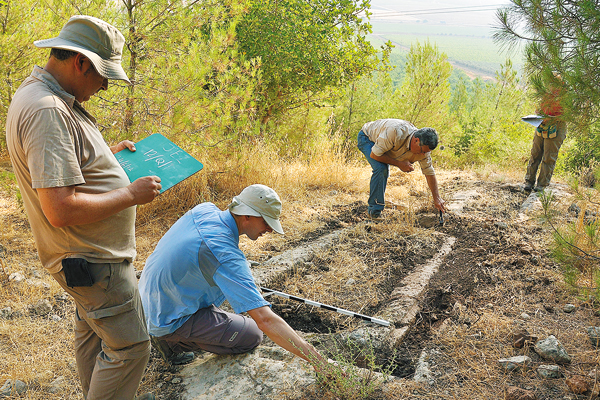
Then in June 2012, armed with a handheld GPS unit, cameras, chalkboards and keen student surveyors, we moved through the thick undergrowth covering the area to explore and record visible features on the ground. Braving barbed-wire fences, cactus thickets, open cisterns and potentially dangerous caves and tombs, we examined areas of “greater Jezreel” that have been neglected in the past, especially the north-facing slope that runs down from the tell to the alluvial terrace and an uncultivated rocky area immediately overlooking the spring.
In just a few weeks we discovered 361 features, the majority of which had never been documented, including 25 cave tombs, 35 rock-cut tombs, 57 agricultural installations, 21 ancient quarries, 94 walls of unknown date, 26 natural caves that had been adapted for animal use, and nearly 100 cisterns.
The rock-cut trough tombs and cave tombs will help us understand the limits of the settlement in different periods, since burials were always extra-mural, or located outside the settlement area. The agricultural installations ranged from small cup marks to large oil and wine presses, including one that may belong to the time of Naboth’s orchard, which Jezreel’s husband Ahab coveted and for which Jezebel had Naboth framed and executed (1 Kings 21).
Our landscape survey has already revealed that Jezreel is much larger than previously understood. And we are just beginning. One intriguing area of further investigation will be the terrace, particularly the area overlooking the spring. Building remains that we could not see on the ground because of the dense overgrowth showed up on the LiDAR scan there, suggesting architectural remains just below the surface.
All this new information taken together already seems to suggest that there was a lower city of Jezreel, in addition to the rather enigmatic Iron Age enclosure exposed in the 1990s dating to the period of Naboth, Ahab and Jezebel.
What was the lower city like? And when was it inhabited? And how far did it extend? Stay tuned. Or, better yet, join us at the dig.
Archaeological Views: Israelite Life Before the Kings

BAR editor Hershel Shanks called me because he was curious why my book published in 2005, on the Israelite settlement, would, at a publisher’s suggestion, be republished with a new preface1; perhaps there was something particularly relevant that justified a republication.
Indeed, there was. It’s not about the minimalist/maximalist debate over the existence of the Israelite monarchy in the tenth century B.C.E. but about the earlier period, between 1200 and 1000, when the Israelite tribes were settling down in what was to become the Land of Israel. What was life like for the Israelite tribes in this period before statehood? (I am not concerned with the issue of the Israelite conquest. I think most scholars are agreed that the conquest did not occur as the Bible describes it, although Hazor may have been conquered by the Israelites, as excavator Amnon Ben-Tor powerfully argues.)
Anyway, what I wanted to do—and what makes the book worth republishing—was present the archaeological evidence that tells us what life was like in this early period when Israel was coalescing. This is what I will describe here, but first a word about the evidence I provide to prove my case. My evidence comes from two sources: archaeological survey data and excavations. The area I focus on—the highland Israelite settlement in the northern West Bank—was archaeologically surveyed in its entirety in the 1980s and 1990s, primarily by Adam Zertal and Israel Finkelstein. I supplemented this with some surveying of my own in 1997–1998. Survey data can be very useful in anthropological interpretation; the arrangement of sites, their sizes and arable land can be statistically analyzed using methods geographers have devised for identifying economic and political systems. Excavation data, both from recent excavations (Shiloh, for example) and from digs long past (such as Bethel), give evidence of the society’s wealth, warfare, housing and so on. If you want the detailed evidence, you’ll have to buy the book, but the portrait that emerges for early Israel is as follows:
In the days before the monarchy, the Israelite villages were on the hilltops. They were quite small, possibly 400 people in the largest of these—Shiloh or Gibeon, for instance. These towns were mostly unwalled; for defense, the builders just clustered the houses together. The Israelites had no domesticated horses or camels, nor did they have iron. They were using flint and bronze tools and weapons, especially slings. All of this was in contrast to their Canaanite neighbors, who had iron, horses and walled towns.
Israelites lived in nuclear households, often with their relatives in clusters of houses around a common courtyard. The average family had two or three children who lived past infancy. Houses were made of mudbrick with a stone foundation and perhaps a second story of wood—poplar, tamarisk or palm. The living space of the houses consisted of three or four rooms, often with sleeping space on the roof or in a covered roof loft. One of the first-floor rooms was probably a courtyard for domestic animals.
These animals were mostly sheep and goats, used for dairy products, not meat. The boys of the village could take the animals out in the morning to graze up to 5 or 6 miles away from the village. But the hills at that time were densely overgrown, covered with a thick scrub of pine, oak and terebinth trees no more than 13 feet high. And it was often too rocky for the sheep, so animals were never foremost in the economy. Instead, the Israelites would burn off some of the brush, terrace the hillsides within an hour’s walk of the village, and plant grain, primarily wheat. From wheat, they could make bread, pasta-like foods, beer, mulch for gardens, fodder for the animals, and straw for baskets and mats. Other lesser crops included lentils, garbanzo beans, barley and millet. They had orchards on these terraces as well. Olives grew wild and were easily domesticated, so olive and grape orchards were prevalent.
Each town had its rich and poor—perhaps a ruling family of town elders or a chief and his family. These had a separate neighborhood in the village—usually in the northwest so the prevailing winds kept unpleasant smells away. Their houses were larger than the rest, and some had walled yards or paved courtyards. The elders or chiefs likely wore jewelry of silver or gold or gems like carnelian, and possessed luxury items such as mirrors, iron tools and weapons, all of which have turned up in the excavations of their neighborhoods.
The villages belonged to larger political units or regional chiefdoms. The villages within a given region were subject to the major town of the area. Some of these chiefdoms were large. The one centered around Shechem, likely that over which Abimelek was the chief (Judges 9), was about 20 miles across. But in the land of Benjamin farther south, they were smaller—a chiefdom of 5-mile radius around Gibeah, another the same size around Bethel, and so on. It is in these regional centers that we find imports from the Philistines and Phoenicians on the coast: jewelry, iron and Mediterranean fish.
There are many things that archaeology cannot yet tell us and that my book leaves out. Religion is one of them. The Book of Judges suggests religion was very confused in those days. No large temples have been found from that period, although there are some small ones. There are no idols except for small hand-held figurines—if that is what these are. That’s about all one can say at this point. It’s an area I hope to be able to say more about in the years to come!
Archaeological Views: Jerusalem in Her Own Words

One of the richest and most variegated epigraphic troves from antiquity is finally being given the scholarly attention it deserves. During the nearly 200 years of modern exploration in the Holy Land, thousands of inscriptions in different ancient languages have been found on stone, mosaic, ceramic, metal and painted cave walls, amounting to a riot of writing, ranging from a single word or name to complex texts of many lines. Many of these inscriptions have already been carefully published, but many others have been published poorly or not at all.
Several years ago, a team of scholars from Israel and Germany, compelled by the need to preserve this invaluable historical resource, founded the Corpus Inscriptionum Iudaeae/Palaestinae (CIIP), a multi-lingual, scientific edition of all epigraphic texts found in the modern State of Israel, from the Galilee to the Negev, dating to the period bounded by the conquests of Alexander (fourth century B.C.E.) and Muhammad (seventh century C.E.). The first three volumes of the CIIP, containing 2,160 inscriptions from Jerusalem and the northern coast of Israel, have now been published, and more volumes are on the way. It is estimated that when the project is completed, in the year 2017, the CIIP will contain some 12,000 inscriptions in more than ten languages, including Greek, Latin, Hebrew, several dialects of Aramaic, Armenian, Georgian, proto-Arabic and Arabic itself.
The CIIP is arranged topographically (by geographical area), so that once the corpus is fully assembled and edited, we will have an epigraphic picture of the many cultures and languages that existed side by side in the region, as well as an inscriptional record of the empires that ruled there.
The inscriptions are of many types, including funerary epitaphs (which comprise the bulk), dedications of buildings and statues, records of donations, votive texts, imperial orders, graffiti of various kinds, weights, ostraca, curse tablets, other personal objects (amulets, rings), boundary stones and milestones, and on and on (but not scrolls or inscriptions on coins).
The information preserved in these texts is crucial to different areas of study, including the political and military history of the Roman Empire, the history of Judaism and Christianity, pagan cults in the Near East, social history (such as family structures, community titles, etc.), the dynamics of multilingualism and onomastics.
To get an idea of the importance and variety of the material, take a brief look at the first two volumes of the CIIP, presenting the 1,120 inscriptions surviving solely from Jerusalem. The first volume, containing 704 texts dating from the fourth century B.C.E. to the end of the first century C.E., includes the many well-known inscriptions from the Temple Mount, which were thrown down when the Romans systematically destroyed the Temple in 70 C.E.: the famous warning in Greek prohibiting Gentiles from crossing into the inner court surrounding the Temple, the Hebrew direction sign “to the place of trumpeting” to announce the Sabbath, a Greek dedication of part of the pavement by a Rhodian visitor, fragments of inscribed stone vessels and other objects. These are random, practically miraculous survivals of the thorough Roman destruction and the repeated devastations of Jerusalem in later periods.
In the streets of the city below were a greater variety and number of inscriptions, especially from the second century on, when the city was no longer predominantly Jewish. The sole surviving pre-Destruction synagogue inscription is a splendidly preserved dedication by a certain priest and archisynagogos (synagogue president) named Theodotus, found just south of the Temple Mount. The inscription states that Theodotus “built the synagogue for the reading of the Law and teaching of the commandments, and the guest-house and (other) rooms and water installations(?) for the lodging of those who are in need of it from abroad.” This text is a unique survival, but its very existence indicates that there were more like it, perhaps many more, which haven’t survived. The New Testament (Acts 6:9, 24:12, etc.) and the Talmud mention synagogues in Jerusalem, and if these references are to real buildings, it is likely that they, too, had inscriptions on display.
By far the largest group of surviving inscriptions from pre-Destruction Jerusalem comes from the huge 2.5-mile band of burial caves around the city. These caves, of which about 900 have been found to date, have yielded more than 2,000 limestone ossuaries of which about 600 are inscribed. These inscriptions often consist of no more than a name, since their function (unlike most funerary inscriptions) was not for public display but merely to label burials—the caves were dark and sealed with heavy stones. But the taciturn ossuary inscriptions yield much valuable information. First of all, they preserve the memory of hundreds of people who would otherwise have been lost to the oblivion of history. Famous names, such as high priests, appear on the ossuaries, but the unknown ones hold a peculiar interest. Second and equally important, the number of ossuary inscriptions is large enough to suggest meaningful patterns, such as family structure, language frequency and onomastic customs. No other historical source preserves information of this nature and quality for the social history of Jerusalem in the first centuries B.C.E. and C.E., the relatively brief period in which the ossuaries were used.
Strikingly, but not surprisingly, Jewish inscriptions in Jerusalem come to an abrupt end in the first century C.E. The epigraphic record of Jerusalem markedly shifts at this point: The Roman army and administration, as well as a growing Christian population, were now the ones primarily documenting themselves through inscriptions. Their epigraphic remains include epitaphs, dedications to Roman emperors and officers, dedications in pagan temples and votive objects, and of course, from the fourth century on, when the city was predominantly Christian, many different types of church inscriptions. These texts, too, contain information not preserved in any other written source, and are thus essential for writing the political, social and religious history of Jerusalem.
The volumes of the CIIP are bringing order to chaos. Inscriptions that had been published in myriad places, or not published at all, are being presented in coherent, scientifically edited volumes. Students of ancient Judaism, Christianity and the Roman Empire, will benefit immeasurably.
Archaeological Views: At the Interface of Archaeology and Texts

In his First Person column in the July/August 2011 issue of BAR, Hershel Shanks responded to a critique that Ronny Reich had leveled against Eilat Mazar’s proposal that the structural remains she had exposed in her excavations at the City of David should be identified as remains of the palace of King David.a According to Reich, Mazar’s archaeological conclusions were predetermined by her prior interpretation of Biblical texts and as such are methodologically unsound. Shanks defended Mazar’s approach, arguing that archaeologists ought to make use of the Bible to formulate hypotheses that can then be tested through archaeological investigation. In his Archaeological Views column in the recent September/October 2012 issue of BAR, Kevin McGeough joined in the debate, arguing that instead of using archaeology and texts to “prove” or “disprove” one another, we should rather view the two kinds of evidence as complementary sources of information about the past, and try to understand how the differences and similarities in the evidence can make sense together.b
The issue is really a pressing example of a larger subject of recent scholarly discourse surrounding the potential opportunities and constraints inherent in any quest for meaningful correlation between archaeology and texts—Biblical or otherwise. This methodological introspection has taken place in practically every field where archaeological remains have been found in contexts for which we have access to contemporaneous written material.
McGeough was certainly on the mark in highlighting the fact that archaeology and texts provide fundamentally different kinds of information. By nature, all texts are authored from a particular viewpoint and are written with the intent of conveying certain information. Archaeological finds, on the other hand, generally reflect the unintentional material by-product of human behavior, and as such can be viewed as essentially unbiased and without agenda. Frequently, archaeology can be used together with texts to shed light on different aspects of the past, thus providing a richer, more multifaceted view of earlier times. This, however, is by no means the only way in which archaeology can be used productively together with texts.
As Shanks argued, archaeological data can and should be used to test hypotheses formulated through textual analysis—and vice versa. Since the past is beyond the limits of our immediate experience, we require evidence, whether textual or archaeological, to support any claims we wish to make about the past. Such evidence must be shown to be both reliable and accurate; no evidence for claims about the past is above the need for accountability.
Since archaeology and texts tend to report on different types of information, using data conveyed through different types of mechanisms, evidence culled from one field can serve as an independent accounting claim for evidence from the other. An example that illustrates the point is the often-raised question regarding the accuracy of various details found in the historical writings of Josephus Flavius. Archaeological excavations at first-century C.E. sites such as Jerusalem, Masada, Jotapata (Yodfat) and Gamla have provided important material evidence that corroborates, and in some cases discredits, Josephus’s textual evidence.
Another important way that archaeology can be used together with texts relates to our interpretation of the evidence. While both texts and archaeological finds provide evidence about the past, the meaning of this evidence is not always self-evident. Questions regarding how a certain artifact was once used or what a specific settlement pattern represents from a sociohistorical perspective are not uncommon in archaeology. Texts as well are seldom immune from ambiguity, as any reader of the Bible and its myriad commentaries knows only too well. Texts can be invaluable in the interpretation of archaeological finds, and archaeological material often provides vital information for the proper interpretation of texts.
I can share an example of this from my own work on archaeological finds relating to the observance of Jewish ritual purity laws during the late Second Temple period. Beginning in the second half of the first century B.C.E., various types of vessels made of chalkstone were in widespread use at Jewish sites throughout Judea and Galilee, as demonstrated in the archaeological record. These stone vessels served as both domestic tableware and storage containers for food and liquid, supplementing the usual ceramic vessels.c This was a uniquely Jewish phenomenon; remains of chalkstone vessels are conspicuously absent from contemporary non-Jewish sites. These vessels almost completely disappear from the archaeological record after the failure of the Bar-Kokhba Revolt in 135 C.E. Why did Jews during this period choose to produce vessels made of chalkstone, which were undoubtedly more unwieldy and costlier to produce than pottery? Textual sources provide the only satisfactory explanation. Ancient Jewish law, as related in early rabbinic literature, considered stone to be a material immune to ritual impurity. According to these sources, vessels made of stone were used on various occasions when ritual purity was to be ensured. This practice appears to lie behind the Gospel of John’s explanation that the stone water jars featured in the wedding at Cana narrative were associated with “the purity (laws) of the Jews” (John 2:6). Here texts have provided the medium that allow the “mute” stones to speak.
Admittedly, potential methodological pitfalls lie in the path of any attempt to correlate artifacts and texts. Scholars are sometimes too quick in trying to find intersections between archaeology and texts where in fact none exists. Archaeological finds should never be forced into the straitjacket of textual sources. A careful approach, which seeks to take advantage of the many and varied mutual benefits to be found at the interface between archaeology and text, can only bring us closer to a fuller and more accurate understanding of the past.