
Biblical Views: The Multiple Truths of Myths

What if the creation stories in Genesis were not intended to be taken literally?
Consider for a moment that we might not have been the audience Biblical writers had in mind more than 2,300 years ago.1 Theirs was a world in which children could be sold into debt slavery, hosts welcomed strangers into their homes by bathing their feet and the blood of sacrificial animals was daubed on the high priest’s earlobe and big toe. Ours is a world of Google books, YouTube, Ashley Madison, space flight and lactose-free soy-based ice cream. Among other things, this means that Biblical creation stories may not have functioned in the same way that modern creation stories do.
Today, one may subscribe to accounts of the Big Bang, Intelligent Design or Xenu and the Wall of Fire. Modern creation stories—whether based on belief in scientific evidence, the inerrancy of Scripture or the secret revelations of a mid-20th-century science fiction writer—assume an “either/or” approach. That is, either the Big Bang, or Intelligent Design or Xenu is responsible for the origin of the world. It is not conceivable that all three stories can peaceably coexist. This is not the case for stories arising within the ancient Near Eastern genre of mythology.
Culturally we use the word “myth” as a synonym for falsehood. Psychology Today lists 15 “Myths of Aging” to debunk common assumptions.2 But as a literary genre, myths are not tales defined by being untrue. Myths are stories that convey and reinforce important aspects of a culture’s worldview: many truths.
In the Mesopotamian myth Atrahasis, the god Ea instructs the goddess Mami on how to form humans from a mixture of clay and divine blood. In Enuma Elish, Marduk’s plan for the creation of humans is executed by Ea, and in the Creation of the Pickaxe, Enlil separates heaven and earth so that humans can sprout up like plants. In ancient Egypt, we find even more differences among creation stories. In one Atum creates by spitting (or alternatively, ejaculating). In another Ptah fashions or speaks the world into being and gives birth to it, and in yet another, Khnum forms everything on his potter’s wheel.
My students ask, which one is true? Which one did they actually believe happened? For the Mesopotamians, was Enlil the creator? Mami? Or Marduk? Which Egyptians believed that Ptah was the creator, which Khnum and which Atum? Culturally we find it very difficult to have a variety of equally valid explanations for creation—to have multiple truths instead of one Truth. We want to pick one and defend it, or we try to synthesize the versions available to show their underlying singularity.
Like other ancient peoples, the Israelites told multiple creation stories. The Bible gives us three (and who knows how many others were recounted but not preserved?). Genesis 1 differs from Genesis 2–3, and both diverge from a third version alluded to elsewhere in the Bible, a myth of the primordial battle between God and the forces of chaos known as Leviathan (e.g., Psalm 74), Rahab (Psalm 89) or the dragon (Isaiah 27, 51). This battle that preceded creation has the Mesopotamian Enuma Elish as its closest analogue. In Enuma Elish, the god Marduk defeats the chaotic waters in the form of the dragon Tiamat and recycles her corpse to create the earth.
What did they think happened in the beginning? I think they thought any of these was possible. Any—or all—of these stories could answer this question, depending on who was asking the question and for what reason.
The most famous version of Enuma Elish features the ascendancy of the god Marduk, a god virtually unknown from other ancient Near Eastern creation stories. But he happens to have been the chief god of Babylon. When Babylon became the center of a new empire in the seventh century B.C.E., they started to tell this version of the epic of creation that culminated in the ascendancy of Marduk over all of the other gods in heaven. We might call this political propaganda. Marduk’s pre-eminence becomes a central component of their creation myth, telling the audience that the rule of Babylon over the rest of the ancient world was reflecting events in heaven. But in the myth, the ascendancy of Marduk happens at creation. So they are collapsing the concept of time in order to understand their world in their present. And that’s what the genre of mythology does.
Biblical myths do the same thing. The Eden story seeks to answer “present” questions: why people wear clothes, why men have to work hard to produce food from the earth, and why women have pain in childbirth and are dominated by their husbands.a In Isaiah 27, God’s primordial slaying of the chaos monster is recast as a day of rebirth and renewal for Israel after their period of exile and expiation. Answers to present questions are retrojected back into the order established at creation, in the same way Enuma Elish explains the ascendancy of Babylon in the seventh century by retrojecting Marduk’s rise back into the order established at creation.
We tend to focus on the apparent contradiction of which god was creator instead of appreciating the variety and nuances provided in the versions: concepts of creation as an art (the potter) or as an extension of the divine body, the inevitability of strife in life, and the continued need to maintain order and keep chaos at bay. These are complex ideas, and different stories exist to emphasize different truths.
This means that reading the creation stories in the Bible is neither likely to answer the question of what happened at the beginning of time—nor to even answer the question of what ancient Israelites believed happened at the beginning of time. But the myths do give us rich sources of information about the kinds of fears, values and principles with which the authors grappled, espoused and reinforced to audiences in their own day. Rather than one Truth, ancient myths manifest many truths about the cultures that composed and disseminated them.
Biblical Views: A Crisis of Faith in the Wake of the Temple’s Destruction?

There can be little doubt that the Roman destruction of Jerusalem and the Temple in 70 C.E. wreaked havoc on the Jews of that time and place. There must have been great loss of life, limb, property and pride. Surely many were slaughtered, and the survivors—particularly women and children—must have suffered terribly.
The one witness to these events whose testimony has come down to us—the Jewish historian Josephus—speaks at length about the horror. This suffering began, he claims, even before the Temple burned: The besieged city starved to such an extent that a woman was driven to cannibalize her own young son (Jewish War 6.201–213). As the Temple burned, Josephus tells us, “No pity was shown for age, no reverence for rank; children and greybeards, laity and priests, alike were massacred” (6.271). As for numbers, Josephus says 97,000 were taken prisoner, and more than 1.1 million died (6.420).
Josephus’s reliability is notoriously questionable. How did he come by these numbers? Josephus was a Jewish priest and rebel who later switched allegiances. Readers may surely wonder if his intent was to maximize Jewish suffering in order to highlight Roman power. On the other hand, the account of cannibalism is taken right out of the Hebrew Bible: Lamentations 4:10, for instance, mourns a similar scenario, following the destruction of the First Temple in 586 B.C.E.
Perhaps none of this really matters: It stands to reason that the suffering was catastrophic. Whatever the numbers, and with or without familial cannibalism, surely the suffering was widespread. Most historians of ancient Judaism describe the event as calamitous indeed.
But there is an interesting trope that appears in some scholarly descriptions of Jewish reactions to 70 C.E., a seemingly sensible surmise: the assertion that, in the wake of the Temple’s destruction, large numbers of Jews would have been driven to abandon Judaism altogether.1
In response to claims of post-destruction mass desertion, I say this: Name two.
Of course, the fact that we can’t name any such apostates doesn’t—on its own—prove anything. It illustrates the larger problem we face: We just don’t know how the surviving Jews reacted to their trauma. The closest thing we have to a survivor’s testimony is Josephus, but he didn’t suffer the worst of it, for he was safely on the Roman side before the siege of Jerusalem. Yet he was on the Roman side only to a point: By all accounts, Josephus did not abandon Judaism. Josephus’s magnum opus, a massive history of Judaism from creation to his own day titled Antiquities of the Jews, begins and ends with assertions of God’s just care for the world and, in return, Jewish obligations back to God (1.1–23; 20.268). Even toward the end of his life, Josephus’s final completed work was an extended defense of Judaism—its beliefs and practices—against the calumnies of his Roman contemporaries (Against Apion). So we have the account of just one bona-fide survivor, and he didn’t lose faith.
Josephus’s loyalty does not prove that most surviving Jews remained committed to Jewish practice, belief or peoplehood. But it does point to the disparity between claims of mass apostasy and the lack of evidence to support such a claim. So the question isn’t really whether there was or wasn’t mass apostasy—for this cannot be known. The question is really why modern scholars suppose there must have been mass apostasy, even though we lack concrete evidence.
The reason for this is, I think, clear enough: Scholars who write about mass apostasy in 70 C.E. also speak of a modern crisis of faith, asking, “How to believe in God after such a catastrophe?” And it would not be incorrect to suppose—though we can’t always know for sure—that when modern Jewish scholars are thinking of a crisis of faith in the past, they are thinking of a crisis of faith in the present: the well-known presumption, held by many, that it remains a challenge for thinking people to believe in God after Auschwitz.
This is too big a question for a short column. It is, in fact, too big a question for a long column. But we don’t have to address this question head on. We can just wonder whether the modern predicament is at all relevant to an understanding of the ancient past.
How would ancient Jews have reacted to the destruction of the Second Temple in 70 C.E.? The question, so phrased, answers itself: just as they did to the destruction of the First Temple. The modern theological crisis—for those who have one—is usually based on the idea that the events of the mid-20th century were so uniquely gruesome that the old paradigms can no longer hold. Perhaps that is true (though it should be said that plenty of people continue to believe in God nevertheless). But my point is this: There’s little reason to believe that ancient Jews thought the events of 70 C.E. were theologically inexplicable. Ancient Jews had a ready-made theological explanation for the destruction of the Second Temple, as Biblical as that cannibalism motif: God was angry with the Jews, and so the Temple was destroyed. As the traditional Jewish liturgy puts it, “For the sake of our sins, we were exiled from our land.” This is precisely how Josephus explains the destruction. It is precisely how the rabbis later explain the destruction. And it is precisely how the Hebrew Bible explains the destruction of the First Temple in 586 B.C.E.
I do not want to be misunderstood. My raising doubts about a theological crisis is not meant to minimize the extent of real suffering in the aftermath of 70 C.E. I just want to counteract these assertions of mass apostasy and theological crisis. Both of these are modern projections—and odd ones to boot. Is it really the way of the world that the defeated just give up their past and embrace the religion of those who conquered them? Aren’t ethno-religious conflicts intractable precisely because this is what doesn’t generally happen? Survivors of defeat don’t simply line up with their oppressors. To the contrary, they take comfort in the very fact of their survival—perceived, perhaps, as miraculous—and look forward to the day when the tables will turn once again in their favor. Modern rationalists may well assume that facts (such as a military defeat) would shatter a person’s religious faith or ethnic identity. But look around: We have plenty of reason to wonder whether this kind of rationalism is much in play even today. It was probably less so in 70 C.E.
Of course, this doesn’t prove there wasn’t mass apostasy after 70 C.E. But when we remember that we can’t even name two apostates, perhaps we should think again before presuming a mass flight from Judaism at that time.
Biblical Views: Paul, Jesus and the Rolling Stone

Every now and then I read something in the apostle Paul’s letters that trips me up—where he makes a claim or statement without offering any explanation and then moves on. For instance, while arguing why women should cover their heads during worship, he throws in the line “because of the angels” (1 Corinthians 11:10), but Paul never explains what he means. He just keeps writing and ignores the mental train wreck behind him as readers are left asking: “Wait, what about the angels?” And since nature and scholarship both abhor a vacuum, numerous explanations have been offered as to what Paul might have meant. Alas, we don’t know if any of the proposed solutions is in fact what Paul had in mind since he never tells us.
Another tricky passage is 1 Corinthians 10:4. There Paul recounts the story of Israel’s Exodus from Egypt and period of wandering in the wilderness. As he narrates how God led them through the Red Sea and fed and watered them in the desert, he makes the incredible claim: “For they drank from the spiritual rock that followed them, and the rock was Christ.” If one isn’t reading carefully, it’s easy to miss Paul’s claim that the rock Moses struck to give the Israelites water followed them around the desert. But compare Paul’s claim with the Hebrew Bible, which nowhere states that the rock followed Israel around the desert—much less that Jesus was present in the shape of a rock. One is left wondering if Paul knew what he was talking about.
It would be easy to dismiss this as another example of a Pauline throwaway line, except that Paul is not the only person to suggest it. In another first-century C.E. document known as Pseudo-Philo’s Biblical Antiquities, we read: “But as for his own people, he led them forth into the wilderness: Forty years did he rain bread from heaven for them, and he brought them quails from the sea, and a well of water following them” (10.7).
While there are some differences between Paul and Pseudo-Philo (a rock vs. a well), the parallels are striking. Both authors believe that a movable water source followed Israel in the desert during their wanderings. But how did they arrive at this interpretation?
The key seems to be something ancient interpreters observed in Israel’s Exodus story. Twice God miraculously provided Israel with water from a rock, once near Rephidim at the beginning of their wandering period (Exodus 17:1–7) and again at Kadesh toward the end (Numbers 20:1–14). Ancient interpreters may have asked the question: “What, then, did they drink in between?” What they seem to have concluded is that since Moses named both the rock at Rephidim (Exodus 17:7) and the one at Kadesh (Numbers 20:13) “Meribah,” the logical conclusion was that both were one and the same rock and that it, therefore, must have accompanied Israel on their journey. Adding possible weight to this exegesis is Psalm 105:41, which states: “He opened the rock, and water gushed out; it went [Hebrew: klh] through the desert like a river” (author’s translation).
The “it” here is ambiguous. Did the rock travel through the desert or the water? Once again, some interpreters concluded that it was the rock that followed them.
With Paul and Pseudo-Philo we have two first-century sources that provide the earliest evidence for this interpretive tradition. The difference between identifying the water source as a well rather than a rock can probably be explained by the presence of a song in Numbers 21:16–20, where we read how Israel arrived at a well in Beer where God promised to “give (Hebrew: ntn) water to them.” Israel responds by singing about the well (21:17–18).1 The song is followed by a list of places on their itinerary: Mattanah, Nahaliel, Bamoth and a valley in Moab.
Some interpreters didn’t read “Mattanah” as the first stop on the itinerary but as a form of the Hebrew verb ntn (“it was given”). This led them to understand the itinerary as being that of the well rather than Israel.2 One place where the popularity of this interpretive tradition is evidenced is the Aramaic Targumim.3 One of the more developed and humorous versions of this tradition depicts the well as delivering water door-to-door: “And because it (the well) was given to them as a gift, it turned to ascend the high mountains with them and from the high mountains it descended with them to the valleys, going around the entire camp of Israel and giving them drink, each and every one of them at the door of his tent” (Targum Pseudo-Jonathon Numbers 21:19).
Nonetheless, the apostle Paul identifies the water source as a rock, not a well. It’s possible he was unaware of the moving-well tradition found in sources such as Pseudo-Philo and the Targumim. But his retention of the moving rock tradition may be for practicable and theological reasons.
First, Exodus, Numbers and Psalm 105 all indicate that it was a rock, not a well, by which the Lord gave Israel water. Second, the rock was more relevant than the well for identifying Jesus as the water source that followed Israel. Paul may be reading Exodus 17:1–5 and Numbers 20:1–13 in conjunction with Psalm 118:22, which reads: “The stone that the builders rejected has become the chief cornerstone.” The “stone” in this psalm was interpreted by several early Christian interpreters as referring to Jesus (Matthew 21:42; Acts 4:11; 1 Peter 2:7). Thus, when Paul read the story of the water from a rock in Exodus and Numbers, he may have done so through the identification of Jesus with the stone in Psalm 118:22. By combining both of these interpretations, he concluded that Jesus was the rock that followed Israel around the desert providing them with water.
At the end of the day it’s unclear whether Paul really thought the rock followed Israel in the desert. Most ancient and modern commentators assume that Paul is reading Israel’s story typologically rather than suggesting that Jesus was present with Israel in the wilderness in the form of a movable water source. But the off-handed way in which he makes the comment demonstrates that it was a well-known interpretation in his day. A statement that creates a mental stumbling block for modern readers was probably taken in stride by those in Paul’s first audience who were familiar with Jewish methods of interpreting the Bible. And so in this case, Paul really does know what he’s talking about.
Biblical Views: Speaking in the Tongues of Men or Angels?

One of the most interesting, and most debated, narratives in the New Testament is the account in Acts 2, where we hear about the Spirit inspiring a large number of Jesus’ disciples, including Peter, to speak “in other tongues.” In classic Pentecostal theology (i.e., the theology of the Pentecostal churches), this story has been taken to be evidence of the beginning of the phenomenon known as glossolalia, or speaking in angelic tongues (see 1 Corinthians 13:1). The problem with that assumption is that the Greek text of Acts 2 doesn’t in fact support such a view.
The story tells us about a wide variety of Diaspora Jews present in Jerusalem for the one-day festival, and when the disciples of Jesus begin to share the Good News with them, “each one heard them speaking in the native language of each … Parthians, Medes, Elamites, [etc.]” (Acts 2:6‒9). When you hear a phrase like “speaking in other languages,” one naturally has to ask—other than what? What is the point of comparison? In this story, the point of comparison is with the native language of Galileans, namely Aramaic. The audience heard the disciples speaking in human languages other than their own native tongue.
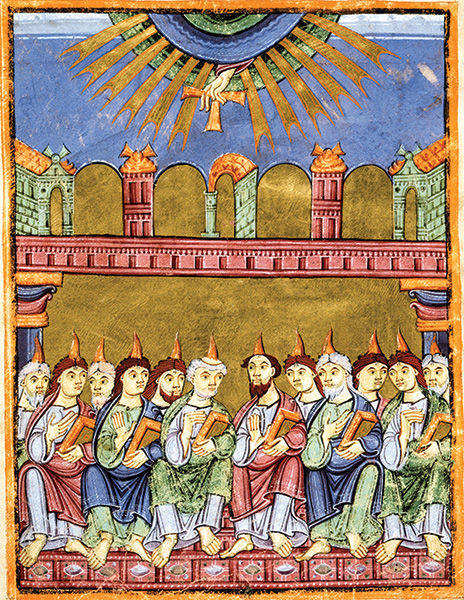
Sometimes the issue has been muddied by the suggestion that there were two miracles involved—the disciples spoke in angelic tongues, but each person heard it in their native human languages. Alas, the Greek grammar is against this suggestion. The phrase “in their native language” modifies the verb “speaking” in verse 6, not the verb “hearing.” So there is exactly one miracle of speech at Pentecost—a miracle my Greek students regularly pray for, namely, the ability to suddenly speak a foreign language without further study! In short, the Pentecost story is not about glossolalia, despite the name of the modern Protestant denomination. If you want to find a story about glossolalia in a story about conversion in Acts, then you should turn to the story of Cornelius in Acts 10.
The larger context of the story that Luke is presenting also supports this interpretation of the text. You will remember the incident of the Tower of Babel, a story in which God confused the languages of humankind so they would not join together to commit more idolatry (Genesis 11:1‒9). The narrative begins, “Now the whole world had one language and a common speech.” At Pentecost the multiple languages problem and language barrier is not resolved, but the Good News overcomes the problem by being shared in all the various languages of the persons present there. While Pentecost doesn’t reverse the effect of God’s confusing the languages at Babel, it overcomes the problem for the sake of the salvation of the nations.
Finally, there may be one other echo that the Pentecost story has. There was an early Jewish tradition that the revelation of the Ten Commandments to Moses on Sinai came in all the languages of the world—since it was God’s Word not just for Hebrew-speaking Jews. Here is a closer parallel to the Pentecost story, and it may be that Luke in Acts was suggesting that God had indeed done at Pentecost what the rabbis had suggested once happened at Sinai (see Philo, Decalogue 46), namely, shared his saving Word in all human languages. The proof we are on the right track is that the one-day festival of Pentecost had come to be the day when Jews celebrated the giving of the Law at Sinai. Luke’s presentation of what actually happened at Pentecost reflects and echoes these earlier traditions.1
Biblical Views: Punch Thy Neighbor

Nothing says “Love thy neighbor” like a punch to the face. Christian cage fighting is a trendy new phenomenon among some evangelical churches, which are organizing teams and forming leagues. At the website jesusdidnttap.com, one can find upcoming fights, buy logo apparel and check out a gallery of fighters in action, beating their opponents into submission.
In a UFC-style cage fight, men exchange brutal punches and kicks to the legs, torso or head until one or the other “taps out,” that is, begs for mercy. There is no head-butting, eye-gouging or biting, and no grabbing the other guy’s shorts. What appeals to the men who watch these fights is the total domination achieved at the end, often with the loser on his back, legs spread and clasped around the torso of the winner, shielding himself from the blows. To describe the scene as pornographic would be more than a little obvious. It looks like rape.
Ancients knew all about male-on-male domination, and often it took on this same sexualized aspect. It is said that every Roman emperor, save Claudius, was thought to have had anal intercourse with other men.1 They weren’t all gay. Male penetration of another man was the quintessential act of domination—think imperial “prison sex,” not gay sex. The image of an erect male penis was recognized everywhere for its apotropaic powers. If you have ever strolled through the ruins of an ancient Mediterranean city, you will have seen it sculpted on city gates, graphitized on walls and scratched on door lintels. The message of these talismans is clear: If you mess with us, we’ll mess with you.
That was the lesson the men of Sodom thought to teach the strangers lodging in Lot’s home (in Genesis 19). They aren’t randy homosexuals out looking for a good time. They simply intend to put the outsiders in their proper place.
In her book The Reign of the Phallus, Eva Keuls shows that this ubiquitous image of the male penis in fifth-century B.C.E. Athens was part of a culture of “phallicism,” that is, “a combination of male supremacy and the cult of power and violence.”2 She goes on to argue that in 415 B.C.E. the women of Athens became fed up with this “phallocracy” and went about the city knocking the testicles off all the Herms—those small square columns bearing the bust of a man atop and nothing else, save a complete set of genitalia at about groin-height. The Athenians accused Alcibiades of perpetrating this act of impiety, but Keuls blames, or, rather, credits the women of Athens with the “castration of the Herms,” still one of the great unsolved mysteries of antiquity.
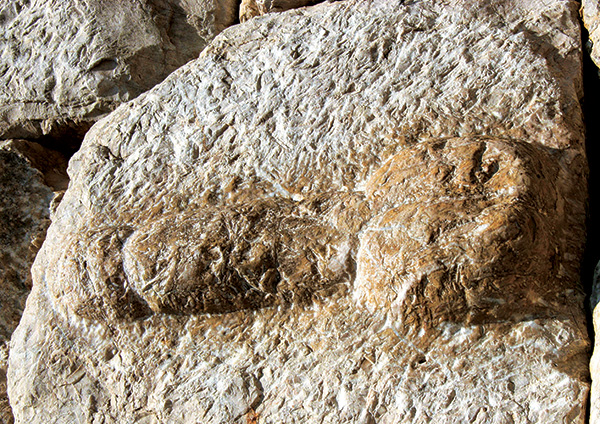
In the Gospel of Matthew we hear of a strange, early Christian practice that indicates perhaps that the followers of Jesus contemplated this world of phallo-dominance with a critical eye. Matthew 19:11–12 reads as follows: “And he said to them, ‘Not everyone can receive this saying, but those to whom it has been given: For there are eunuchs who were born that way, and eunuchs who have been castrated by people, and there are eunuchs who have castrated themselves for the sake of the kingdom of Heaven. Let anyone who can receive this, receive it.’”
Scholars squeamish at the thought of Christian castrati have sometimes insisted that this passage must be referring metaphorically to celibacy. But that is nonsense. If Matthew’s author had meant to speak of celibates (parthenoi), he knew perfectly well how to do that. In a religious context, eunuch had to mean eunuch, else he would simply have confused his audience. In the Book of Matthew, Jesus advises men (who can) to emasculate themselves!
Who were these Matthean eunuchs for the kingdom? They were men who believed that following Jesus had nothing to do with masculine dominance and power. Eunuchs in a religious context were the opposite of manly men.
Most people would have known about eunuchs in the various cults of the Roman east. Mostly they served the Mother Goddess as feminized male priests, no longer male, but more female, like the deity they served.3
Matthew’s eunuchs were not the only early Christians who gave thought to breaking down the patterns of male dominance in antiquity. One of the earliest Christian creedal statements declares that in Christ “there is no longer male and female” (Galatians 3:28), and in Corinth the apostle Paul felt compelled to oppose a practice whereby male prophets were beginning to wear their hair long and flowing, so that one could not easily distinguish between male and female cult leaders (1 Corinthians 11:2–16). Paul liked his men and women to look like men and women, but his Corinthian protégés had taken “no longer male and female” to heart.
Matthew’s eunuchs were clearly the most extreme form of this conviction. Here were men who, in the eyes of their peers, “became women” in the most graphic and demonstrative way imaginable. They emasculated themselves, removing the thing that ancients most associated with male power and dominance. This is how they chose to embody the kingdom of heaven on earth.
Every generation or so Christian men complain that the church has become too “feminized” to appeal to the man’s man. The cure for this used to be a men’s breakfast on Saturday morning or an annual camping trip. In today’s hypermasculinized culture, the old ways apparently don’t quite scratch that itch. So modern manly men have taken it up a notch—cage fighting for Christ.
But back when gladiators still did battle and emperors banged senators just to show them who was boss, some Christians actually took it down a notch. Real men, they said, don’t “grow a pair.” They cut them off.
Biblical Views: Theology Versus Law in Ancient Judaism

Years ago, I was sitting with a group of young married couples, most of whom were Jewish. One of the non-Jewish spouses in the group said something to the effect that he had considered converting to Judaism but decided he could not. Someone asked, “Why not?” To which he replied, “Oh, I can’t convert to Judaism. I don’t believe in God.” Someone else present immediately slammed his hand on the table in objection, “And what does that have to do with it?”
I don’t remember anything else about the conversation, but what I’ve related here suffices to illustrate an important and common view about Judaism: that it’s primarily about what one does—not what one believes. (This of course is in contrast to one common understanding of Christianity—that it is primarily about what one believes.) Whether true or not (and for the record, I am not so sure), this view is widely held among contemporary Jewish intellectuals and can be traced back to one of the greatest modern Jewish intellectuals of all time, the German-Jewish philosopher Moses Mendelssohn (1729–1786). For him, Judaism is a religion of revealed law. It is for this reason that Jews have expended much more effort delineating practices, producing works like the Mishnah and the Shulkhan Arukh, and comparatively less time developing fixed creeds—which have indeed been a priority for many Christians.
What does any of this have to do with the Bible? Well, it happens that a quasi-Mendelssohnian perspective reigns supreme in the modern study of ancient Judaism: A common scholarly presumption is that Jews of the Second Temple period—including Pharisees, Sadducees and Essenes—were not all that concerned with theological matters but were primarily (if not exclusively) focused on laws and practices—just as many modern Jews are (or at least are perceived to be).
To be sure, there can be little doubt that ancient Jews did disagree about matters of law and practice. Among the Dead Sea Scrolls, for instance, we find rather strong evidence for disputes with other Jews on matters including calendar, diet, purity rules and sacrificial procedures. The New Testament confirms that the Pharisees held distinctive (and controversial) views about hand washing, purity and vows (Mark 7:1–23). And Rabbinic literature too testifies to the general Jewish interest in legal matters and adds to the evidence suggesting that the Pharisees and Sadducees in particular debated about these matters during the Second Temple period.
So what’s the problem? While we can be confident that matters of law were of importance to many ancient Jews, that only represents half of the picture. Many of our sources also testify that matters of belief were also of great importance to ancient Jews.
According to Josephus, the Pharisees and Sadducees disagreed on questions concerning the afterlife and fate (The Jewish War 2.162–166). The Pharisee-Sadducee debate on the afterlife is attested also in the New Testament (Mark 12:18–27; Acts 23:6–10) and rabbinic literature (Avot de-Rabbi Natan A5). The deterministic approach to fate attributed to the Essenes by Josephus (Antiquities of the Jews 13.172) is paralleled in many Dead Sea Scrolls, especially the Community Rule III:13–IV:26. Even for those who continue to deny that the Scrolls can be associated with the Essenes, the Scrolls nevertheless confirm that some Jews did in fact hold the view that Josephus attributes to the Essenes. Similarly, the Wisdom of Ben Sira (also known as the book of Ecclesiasticus) includes an extended discussion of the fate and free-will problem (Ben Sira 15:11–20). Ben Sira denies that God could ever preordain a human being to commit evil, so he falls squarely on the side of free will, just like what Josephus says about the later Sadducees (The Jewish War 2.164). This is virtually the opposite of what we find in Qumran’s Community Rule, where the human Sons of Darkness and their evil deeds are under the coercive powers of a divinely appointed heavenly Prince of Darkness. The basic contours of the ancient theological debates described by Josephus are therefore verifiable.
If we know that ancient Jews differed on matters of theology as well as law, then two important caveats follow. First, we cannot continue to assume that ancient Jewish sectarian disputes were primarily (let alone exclusively) legal in nature. Beliefs mattered too. Second, we cannot discount the possibility that matters of belief were, at least at times, the prime cause of some such disputes.
I have nothing against the modern academic rationalism Moses Mendelssohn represents. In fact, I am a modern academic rationalist—at least most of the time. But I also believe that our job as scholars is to resist the temptation to project ourselves back into the ancient sources in front of us.
It’s not up to me to decide whether my table-slapping acquaintance is correct about the relative unimportance of belief to modern Jews. But I have come to believe that an overwhelming amount of evidence contradicts any one-sided understanding of ancient Judaism. Far be it from me to downplay the importance of purity or the Temple for ancient Jews, but why do so many downplay the importance of theology for ancient Jews? Neither baby should be thrown out with any bathwater here. There’s plenty of room in our discussions of ancient Judaism for both theology and law.
Biblical Views: A Rolling Stone That Was Hard to Roll

The image of the tomb of Jesus that generally leaps into people’s minds is of a rock-cut tomb closed by a large rolling stone. Yet archaeologists tell us this was probably not the case. According to Amos Kloner, who has examined more than 900 tombs in the vicinity of Jerusalem, there are only four tombs from the late Second Temple period that have rolling stones.a The first is the tomb of the Queen Helena of Adiabene located up Nablus Road from the Damascus Gate.b The second is the Tomb of Herod’s Family in west Jerusalem, not far from the King David Hotel.c The third is another tomb close by the Tomb of Herod’s Family. The fourth is a tomb located in the upper Kidron Valley.
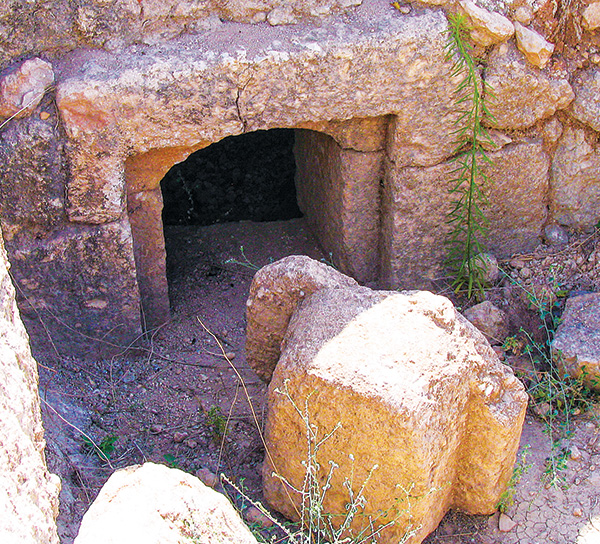
The more common form of closure for a rock-cut tomb was something like a mushroom cap or a champagne cork on its side. In other words, one part of the stone was shaped in such a way as to provide a close fit within the doorway of the tomb. The majority of rock-cut tombs had small openings, and then inside the tomb they had a standing pit cut out so that visitors could stand upright once inside. The part of the rock designed to close the tomb entrance fit into the opening. The remainder of the rock had a flange so it would rest against the outside surface of the tomb and surround the opening. Any small openings or crevasses around this stone could then be filled with smaller pebbles and mortar to prevent entry by vermin.
But what about the tomb of Jesus? Some would argue that the tomb of Jesus having a rolling stone was a kind of divine fulfillment of the fact that, to all believers, Jesus was indeed a king, and this type of stone closure witnessed to it. Among the difficulties this theory faces is the fact that it was a borrowed tomb (Matthew 27:57–60; John 19:38–42), and, so, since it was constructed for a more ordinary person, it would not have been fitted with a rolling stone.
Others would say that although the tomb where Jesus was buried was a rock-cut tomb and therefore belonged to a family of some means, there is no indication that it was designed to be among the “top four” tombs in Jerusalem!
What do the Biblical texts say? Do they indicate what sort of stone was used to close the tomb of Jesus? The focus of our interest here is the verb used to describe the placement or removal of the stone from the entrance to the tomb.
Mark refers to the closure stone in two places in his account: once in the scene of the burial (Mark 15:46) and again in the scene on the morning of the first day (Mark 16:3). The burial is described: “And having bought a wrapping and having taken him down, he [Joseph of Arimathea] wrapped him in the garment and placed him in a tomb that was cut from rock and rolled a stone up against the door of the tomb” (author’s translation). The verb “having rolled” in Greek is proskulisas. This is a combination of pros (meaning “toward”) and the past participle of kulio (meaning “to roll or roll along”).
On the morning of the resurrection, “the women said to themselves, ‘Who will roll away the stone from the door of the tomb?’ And looking up, they see the stone was rolled away; for it was very large.” The Greek here for “roll away” is apekulisen. This is a combination of ap’ (meaning “away”) and … yes, kulio (meaning “to roll”).
According to Matthew 27:60, we read that, after the death of Jesus, “he [Joseph of Arimathea] placed it [the body] in his new tomb that he hewed in the rock and, having rolled a large rock up to the door of the tomb, he went away.” The verb here is the same as the one in Mark, proskulio. The text further reads that on the morning of the resurrection, “behold, there was a great earthquake, for an angel of the Lord, having come down from heaven and coming forward, rolled the stone away and sat on it.” Once again, the compound form of apo (“away”) and kulio (“roll”) appears.
The only part of the Lucan account mentioning the stone is Luke 24:2, which describes what the women found on the morning of the first day of the week when they came to the tomb: “They found the stone rolled away from the tomb.” Here, too, the verb for “roll away” is the same as in the other accounts.
What are we to make of this? In his article on the type of tomb closure used for the tomb of Jesus, Amos Kloner states that the Greek verb kulio means “to roll,” but it can also mean “dislodge” or “move.” I would disagree with this for two reasons: First, I at least cannot find any dictionary articles (including the largest, the Liddle-Scott-Jones) that give this other meaning. Second, as I pointed out above, almost all instances of the verb in the gospel texts are compounds of kulio, either pros-kulio (“roll up to”) or apo-kulio (“to roll away”). These are verbs of motion “toward” or “away from.”
As a result, I do not think Kloner’s explanation is adequate.
So, am I saying the Synoptic Gospels don’t have a clue about what actually took place? I think that would be going too far. It is not that these accounts are necessarily wrong. But they do give the wrong impression. It may very well be that people rolled the “cork-shaped” stones away from the tomb. Once you see the size of a “stopper” stone, it is easy to see that, however one gets the stone out of the doorway, chances are you are going to roll it the rest of the way.
But what about the account in the Gospel of John? In the account of the actual burial of Jesus, there is no reference to the stone. But in the scene at the tomb on the first day of the week, it says: “On the first day of the week, Mary from Magdala came to the tomb while it was still dark and saw that the stone had been taken away from the tomb” (John 20:1). The Greek verb for “taken away” is hairo, which means, well, “take away.” Nothing about “rolling.” Why did John say what he did? Because he knew the Jewish burial practice, and his wording reflects this practice much more accurately than any of the other gospels. He has given us a detail none of the other gospels have.
So archaeology does help us to understand the text more precisely: Without archaeology that bit of John’s knowledge would go unrecognized.
Biblical Views: Wrestling with Faith

For years I’ve been pondering the relationship of Biblical studies, faith and feminism. The pondering returns me to childhood, when every week I memorized one or more scriptural verses. Chosen by teachers, these verses offered proclamation, guidance and assurance—for example, John 14:27, “Peace I leave with you; my peace I give to you. I do not give to you as the world gives. Do not let your hearts be troubled, and do not let them be afraid,” and Psalm 23:1–3:
The Lord is my shepherd, I shall not want.
He makes me lie down in green pastures;
he leads me beside still waters;
he restores my soul.
He leads me in right paths
for his name’s sake.
A comforting faith they provided—no disturbing texts.
After childhood, my readings of the Bible moved from that comfort zone to critical study with existential ramifications. Such study highlighted ambiguities, perplexities and terrors. It exposed androcentric biases. It brought difficult problems. In blunt language, as a well-known feminist once told me, “You may teach the Bible as an academic subject, but you can give no allegiance to it if you are a feminist.” In other words, I must choose whom I serve. Yet I knew then, as now, that I could not and would not make that choice. Two affirmations held firm: I love the Bible. I am a feminist.
As I began to reconcile this seeming rhetoric of impossibility, a Biblical story came to my aid—the familiar yet alien story of Jacob at the Jabbok: “The same night he got up and took his two wives, his two maids, and his eleven children, and crossed the ford of the Jabbok. He took them and sent them across the stream, and likewise everything he had” (Genesis 32:22–23). Why this particular story rose to the occasion, I know not. After all, it features an all-male cast in an agonistic entanglement—surely not a compelling picture for a feminist.
The story comes embedded in a context. The character Jacob is a scoundrel and thief who flees from his twin brother, Esau, to find refuge in the old country with his uncle, Laban. But in Laban he meets his match. After episodes of contention and trickery, including marriages and disputes about flocks, Jacob begins a journey home. Upon learning that Esau is approaching him with 400 men (not exactly a welcoming committee), Jacob protects himself. He uses his servants, wives and multiple children as buffers, sending them ahead, across the stream of the Jabbok River, while he stays on the other side.
Night descends; our story begins. Overall, it is a handsomely constructed narrative of little more than a hundred Hebrew words. Words of the storyteller surround words of two characters. All the words slip and slide, with gaps (silences) between them compounding the ambiguities. Three words, artfully arranged with Jacob in the middle of aloneness, introduce the story. They carry an ominous message: “Alone Jacob by-himself.” Immediately, out of nowhere, emerges a character of aggressive action. “And wrestled (‘bq) a man (‘is) with him.” Who is the attacker? Is he an angel or messenger as Hosea claims (12:4–5)? Or Esau as rabbis hold? Or a night demon or river demon as folklorists contend? Or Jacob himself as therapists propose? Or God as theologians (and later, Jacob) detect?
Whoever this “man,” he appears not all powerful, for the coming of dawn restrains his physical aggression. He is not prevailing. So he resorts to an obscene tactic, striking Jacob at his manhood. The result: Jacob’s thigh is wrenched or dislocated. The attacker’s power begins to wane; he implores Jacob to let him go. Defiantly Jacob answers: “I will not let you go unless you bless me.” A power struggle ensues, relating to names. The stranger gives Jacob (whose name in folk etymology suggests a grasper, schemer or conniver) the new name Israel (“God rules”). But it does not erase the old name. Jacob remains true to Jacob, seeking to manipulate and control by asking the name of the stranger. The ploy fails. Surprisingly, however, the stranger blesses Jacob before disappearing. Whatever the blessing, it does not come on Jacob’s terms. Nor does it restore his body to wholeness. Alone (as in the beginning) Jacob limps away.
Moving this haunting story to my predicament at the boundary of faith and feminism, I pluck from it two memorable lines, one from Jacob and one from the storyteller. First, Jacob’s defiant words to the stranger I take as a challenge to the Bible itself. “I will not let you go unless you bless me.” I will not let go of this book unless it blesses me. I will struggle with it. I will not turn it over to my enemies that it curse me. Neither will I turn over to my friends who wish to curse it. No, over against the cursing from either Bible-thumpers or Bible-bashers, I shall hold fast for blessing. But I am under no illusion that blessing, if it comes, will be on my terms—that I will not be changed in the process. Indeed, the second line I pluck from the story undercuts that illusion: The storyteller reports: “The sun rose upon him [Jacob] … limping because of his hip.” Through this ancient story, appropriated anew, Biblical studies, faith and feminism converge for me. Wrestling with the words, to the light I limp.
Biblical Views: Noah, Enoch and the Flood: The Bible Meets Hollywood

There’s been a lot of buzz lately about Noah—not the Biblical patriarch, but the new $125 million Hollywood epic Noah, featuring Russell Crowe as Noah and Anthony Hopkins as Methuselah. It’s an action-packed movie with a slew of special effects, including the flood, meteor showers, gory battles and giant six-armed rock-angels called the Watchers. It’s great eye-candy, with some surprising twists.
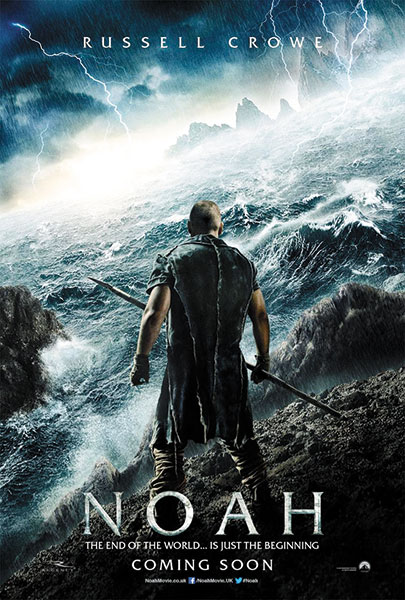
Even before its release, the movie raised controversy. Some conservative Christian groups have complained that the movie’s approach is not an accurate depiction of the Biblical story. The movie certainly does take liberties with Genesis and even includes an environmental subtext. Noah, says the director, was “the first environmentalist.” I assume this is because he saved a boatload of animals from extinction. But the movie also uses the flood as a symbolic warning of the imminent destruction of the earth due to human violence against the environment. In this sense the movie reinterprets the flood story. The flood is not just a past event; it carries secret significance as a harbinger of the future global apocalypse.
The movie’s critics say that it is irresponsible to interpret the flood story in a way that deviates from Genesis. According to a recent survey about the movie, evangelical Christians are “unsatisfied with a Bible-themed movie which strays from the Biblical message.”
Some of this is just the usual culture war, which pits cultural conservatives against liberal Hollywood. But I think there’s a deeper issue here that the critics are missing: The flood story has always involved conflicting interpretations. The modern controversy is, in this respect, a recapitulation of previous moments in the life of the Genesis Flood story. Let me explain.
First, the Genesis Flood story consists of two different interpretations of the flood. BAR readers will recognize the names of two of the Pentateuchal sources: the Yahwist (J) and the Priestly source (P).a Genesis 6–9 is a compilation of two accounts of the flood, from J and P. These two stories disagree with each other in numerous details—including the name of God (Yahweh vs. Elohim), the duration of the flood (40 days vs. 150 days) and the number of animals on the ark (one pair of each unclean animal plus seven pairs of each clean animal vs. a pair of each animal). Even the reason for the flood is different in the two sources. Whereas in J the problem is human evil, in P the problem is violence that has corrupted the earth. So Genesis contains slightly different concepts of the flood. There is no single “Biblical message” here; it was always plural.
But there’s an even more profound way in which the message of the Biblical Flood gets complicated. There are many early interpretations that depart in some respects from Genesis but which found a home in Judaism and Christianity. Probably the most influential is the Book of Enoch, its earliest parts dating to the third century B.C.E. This book, which didn’t make it into the Bible, features a remarkable reinterpretation of the flood. Enoch—who is Noah’s great-great-grandfather—announces the coming of a great destruction, which will wipe out all the evil of the world. This great destruction is the flood. But the flood is also a prophetic symbol of the apocalyptic end time when God will finally destroy all the wicked. Enoch proclaims in his vision:
Behold, He comes with the myriads of his holy ones
to execute judgment on all,
and to destroy the wicked,
and to convict all humanity
for all the wicked deeds that they have done,
and the proud and hard words that wicked sinners spoke against Him.1
The apocryphal Book of Enoch reimagines the flood as the prophetic symbol of the future apocalypse when God will destroy the wicked and reward the faithful. It is a nonbiblical interpretation of the flood, which conflicts with the Genesis story since Genesis says that God will never again destroy humankind because of their wickedness (Genesis 8:22). But for Enoch, the flood carries secret significance as a harbinger of the future global apocalypse—just like in the movie!
The New Testament quotes Enoch’s prophecy even though it is not a canonical book. The passage above is found in the Letter of Jude 14–15 and attributed to “Enoch, in the seventh generation from Adam.” This means that the apocalyptic reimagining of the flood in the Book of Enoch is a part of Christianity, even though it deviates from the story of the flood in Genesis.
Is this an interpretation of the flood that modern Christians should abhor? Of course not—it’s in the New Testament. Does this have implications for modern reinterpretations of the flood? Well, I think so. We shouldn’t reject interpretations of the flood just because they deviate from Genesis. Such interpretations are in the lifeblood of both Judaism and Christianity. Enoch is a strange book, but it was highly regarded by many Jews and Christians, including the compilers of the New Testament. Stories that deviate from the Bible are still part of the Bible—and have always been a part of Biblical religions. So people who revere the Bible can’t dismiss them without pulling up the floor beneath their feet.
So is the new flood movie unbiblical? Well, yes and no. In some important ways it is doing what Jews and Christians have always done—interpret the Bible in ways that resonate with concerns in the present. Is it unbiblical to say that the flood is a symbolic harbinger of the future apocalypse? Well, you be the judge—but don’t forget that the life of Genesis has taken many curious turns, both inside and outside the Bible.
By the way, those giant Watchers in the new flood movie? They’re also from the Book of Enoch and are mentioned in the New Testament (Jude 6). The life of the flood story does not end with Genesis. It’s just the beginning.2
Biblical Views: Did Cain Get Away with Murder?

Was Cain punished for killing Abel, or did God let him get away with murder? Most readers of the Bible would identify Cain’s punishment as being cursed and exiled from the ground (Genesis 4:11–16). But while this sentence seems to have satisfied God, not everyone was content. Readers often noticed that a significant detail was missing in the Genesis 4 narrative. At no point do we read how or when Cain died. We are told about Abel, and the deaths of Adam and Seth are both recorded (Genesis 5:3–8)—but not Cain’s. While there are many people in the Bible whose deaths are not mentioned, the silence over Cain’s death might suggest that he lived a long life and died naturally. Not only does Cain escape capital punishment, but he is even able to marry, raise children and build a city. Unlike Abel, Cain’s story has a happier ending, which seems wholly unjust.
Modern readers of the Bible might note the absence of Cain’s death and even wonder about the justice of God, but they are not likely to change the story to fit their sense of justice. Ancient interpreters did, however. Unsatisfied with the story’s ending, they looked for ways to ensure it finished with Cain’s death. One early suggestion was that Cain died in the flood. This was a logical conclusion since the list of those on Noah’s ark does not mention Cain (Genesis 8:18; 9:18). Interpreters assumed that Cain must have lived until the time of the flood and died with the other wicked people.1
The flood narrative certainly provides a cleaner ending to the story, but there is another, more creative solution. This version ends with Cain being killed by his great, great grandson, Lamech. How did this new ending come about? The clue was found in something Lamech said to his wives:
Adah and Zillah, listen to me;
wives of Lamech, hear my words.
I have killed a man for wounding me,
a young man for injuring me.
If Cain is avenged seven times,
then Lamech seventy-seven times.
(Genesis 4:23–24, NIV)
Although modern readers might gloss over Lamech’s statement, ancient interpreters discovered a key to the riddle surrounding Cain’s death. They noted that the Hebrew term ’ish (“man”—Hebrew:
But this ending was based on more than just the repetition of a simple word. Lamech’s appeal to the vengeance associated with Cain in Genesis 4:24 provided more support. In Genesis 4:15 God promises Cain that anyone who kills him will suffer seven vengeances. But the meaning of this sentence is ambiguous in Hebrew. It’s not clear if Cain or his killer is the recipient of the vengeance. The Septuagint (LXX) translator(s), however, aware of the ambiguity and perhaps unsatisfied with the way the story ended, translated Genesis 4:15 into Greek so that the sentence no longer reads “everyone who kills Cain will suffer sevenfold vengeance,” but instead “everyone who kills Cain will loose seven penalties.” The translation of Lamech’s words in Genesis 4:24 was also altered to read “because vengeance has been extracted seven times from Cain.” The result of these translations is that it was now clear that Cain was the recipient of the seven vengeances, not his killer. Lamech’s killing of Cain was the comeuppance for Cain’s act of fratricide.
The Lamech legend was very popular in late antiquity through the Middle Ages and came to include details far beyond anything found in Genesis 4. In these later versions Lamech is a blind—but skilled—hunter who hunts with the help of his son Tubal-Cain, who directs his father’s bow toward the game. One day, however, the young boy mistakes a sound in the bushes for a wild animal. Lamech, with his son’s assistance, shoots the animal and then sends him to see what they have caught. When Tubal-Cain reaches the spot, he realizes that they have killed Cain. Lamech becomes distressed to the point that he blindly claps his hands together and accidently kills his son as well.2 While this ending certainly adds more tragedy to the tale of Cain and Abel, it also achieves some key results. First, it ensures that Cain finally pays the ultimate price for his murder of Abel (cf. Genesis 9:6; Exodus 21:12–14, 24). Second, the description of Lamech as a blind man frees him from being accused of the same crime as Cain. Cain’s death is an accident, which makes Lamech innocent of premeditated murder, which wasn’t the case when Cain murdered Abel. At the same time, any apparent besmirching of God’s justice toward Abel is removed.3
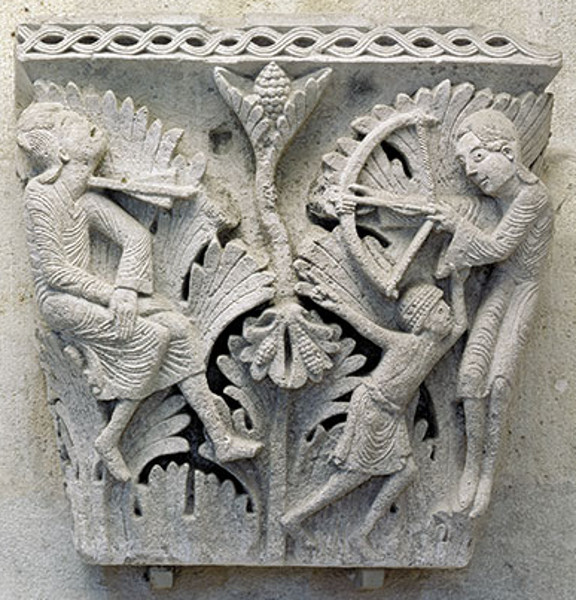
While most modern readers of the Bible are unfamiliar with the Lamech legend, it was well known in the past. Its popularity is evidenced, for instance, in the way it was displayed on a column capital in the Cathedral of Saint-Lazare in France (c. 1146, shown on p. 24). Variations of the legend also appear in the façade of the Modena Cathedral in Italy (c. 1180) and in several illuminated manuscripts including the Egerton Genesis Picture Book (c. 1360), the Holkham Bible Picture Book (c. 1325) and Le Livre de bonnes moeurs by Jacques Legrand (c. 1490). Knowing the ending to the Cain and Abel story was not just an academic question for scholars; it was important to the common people as well. Since much of the population couldn’t read, the stories of the Bible were told through the visual arts. The various depictions of Cain’s death demonstrate that generations of people familiar with the story were interested in knowing that Cain’s life did not have the happy ending that Genesis seems to allow. Rather than accept an ending to the story that seemed unjust, they preferred a version with a more satisfactory conclusion. It was important that God not let Cain get away with murder, even if it meant changing the details to protect the innocent while punishing the guilty.