
Biblical Views: Text Archaeology: The Finding of Lightfoot’s Lost Manuscripts

When we think of archaeology, we think of digging in the ground—of trowels, spades, measuring lines and the like. We think of hot sweaty work in the sun during the summer digging season. While this image is certainly a prevalent and correct one up to a point, at its core archaeology is about studying ancient cultures by what they have left behind. This brings me to the subject of text archaeology—the study of unknown, lost or missing texts.
Texts, like the famous Codex Sinaiticus, are often discovered in existing buildings. The Codex Sinaiticus was discovered in St. Catherine’s Monastery in the Sinai desert. No digging was required, just sorting through a pile of papyri.
This brings me to J.B. Lightfoot, without much dispute the most famous New Testament scholar in the English-speaking world in the 19th century. Lightfoot was especially well known for his commentaries on St. Paul’s Epistles and on the Apostolic Fathers.
Almost 40 years ago, as an eager young doctoral student looking for interesting manuscripts, I was at Durham Cathedral in England. One day in 1978 in the Monk’s Dormitory of the cathedral, I was looking at display cases with manuscripts in them. In one them was a manuscript from about 1855 containing Lightfoot’s detailed exegetical notes on Acts 15, perhaps the most disputed of all passages in the Acts of the Apostles. The manuscript was in an ancient notebook, so I concluded that there had to be many more such manuscripts. I reported this to my doctoral supervisor, Professor C.K. Barrett, and we talked of doing a proper search, but nothing came of it.
When I returned to Durham in the 1980s to conduct more research, I told Professor James D.G. Dunn, the Lightfoot Professor of New Testament, about the possibility that there may be more of Lightfoot’s manuscripts. Still, it was not investigated until sometime in the late 1980s when scholars Geoffrey Treloar and Bruce Kaye apparently looked through some of the manuscripts and used some of the neglected material to produce a monograph about Lightfoot as a historian. Nothing was said or done about the hundreds and hundreds of pages of commentary materials in storage in the Monk’s Dormitory.
In the spring of 2013, I was on sabbatical at St. John’s College at Durham University. While it was not my sabbatical project, I was determined to get to the bottom of what exactly still remained in the Lightfoot cabinet in Durham Cathedral. What I discovered was an absolute gold mine of unpublished (but also unfinished) Biblical commentaries by Lightfoot—one on Acts, one on 2 Corinthians, one on 1 Peter, one on the Gospel of John and many other valuable unpublished essays on the New Testament.
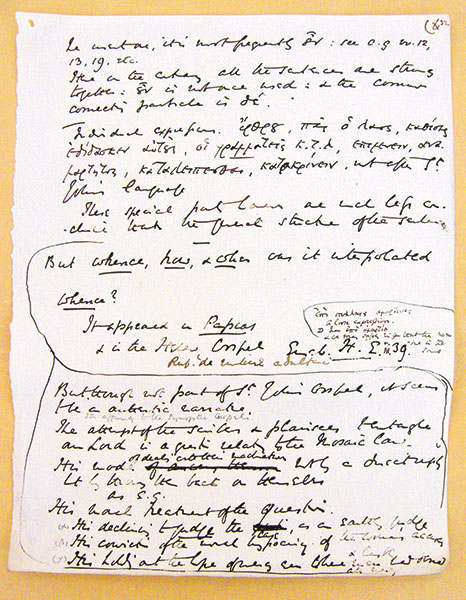
Lightfoot was a once-in-a-century scholar. As a language expert, he knew the whole corpus of ancient Greek, Hebrew and Latin literature. He was also the greatest historian of the New Testament and early Christian era. Furthermore, he was an expert in the Greek and Latin Classics. In addition to all of that, he was the greatest text critic of his era. When it came to figuring out what the earliest and most authentic readings were for this or that verse, Lightfoot had no equals. He wanted a total revision of the Authorized Version (King James Version) because it was so full of later readings, not the exact words of the original authors.
This is a story not just about discovery—but a story with a happy ending. All too often, when a great discovery is made, a full and accurate reporting of the data shows up only much later (think of the Dead Sea Scrolls) and only in technical journals, not readily accessible to the general public. Happily, beginning in the fall of 2014, InterVarsity Press has agreed to publish three hardback volumes of some 1,500 pages of Lightfoot’s manuscripts. The volumes will include pictures of the original handwritten manuscripts I have spent all year deciphering. We are calling the volumes The Lightfoot Legacy.
These volumes do not merely recover lost interpretations of the Bible that might be of purely historical interest. What they show is that Lightfoot was at least a century ahead of his time in terms of text criticism, historiography, the use of epigraphic and inscriptional evidence to derive the meaning of words, and pure language skills. He provided a devastating critique of radical German criticism of the Bible. Furthermore, more than a hundred years before the discovery of the Dead Sea Scrolls, Lightfoot was talking about the influence of the Essenes on early Christianity. Stay tuned, more light on Lightfoot is dawning.
Biblical Views: Jesus’ Birthplace and Jesus’ Home

According to the Gospels, Jesus was born in Bethlehem but lived in Nazareth. While there has been a lot of scholarly discussion about whether or not he was actually born in Bethlehem,a both places are useful for teaching about the historical Jesus—regardless of any perceived conflict—and inspire us to take a deeper look at how Jesus was influenced by his environment.
The Biblical towns of Bethlehem and Nazareth are strikingly different from each other in many ways; at the same time they figure prominently in the life and ministry of Jesus. The issue to be discussed is the birthplace of Jesus. It seems clear from the infancy narratives in the Gospels that Bethlehem was the place of Jesus’ birth: “In the time of King Herod, after Jesus was born in Bethlehem of Judea, wise men from the East came to Jerusalem, asking, ‘Where is the child who has been born king of the Jews?’” (Matthew 2:1–2); “Joseph also went from the town of Nazareth in Galilee to Judea, to the city of David called Bethlehem … He went to be registered with Mary, to whom he was engaged and who was expecting a child. While they were there, the time came for her to deliver her child. And she gave birth to her firstborn son” (Luke 2:4–7).
The infancy narratives in the Gospels give no indication that Jesus was born elsewhere.
The Gospel of John also attests that the birth of Jesus took place in Bethlehem: “Has not the scripture said that the Messiah is descended from David and comes from Bethlehem, the village where David lived?” (John 7:42).
Micah, one of the four great prophets of the eighth century B.C.E., is responsible for the classic messianic poem wherein a new David shall arise from Bethlehem, the birthplace of David, to rule in a future age: “But you, O Bethlehem of Ephrathah, who are one of the little clans of Judah, from you shall come forth for me one who is to rule in Israel, whose origin is from of old, from ancient days” (Micah 5:2). The New Testament interprets this poem as a reference to Jesus’ birth.
The family of David was closely associated with Bethlehem. The Lord sent Samuel to Bethlehem to find a replacement for King Saul from among the sons of Jesse. When David was presented, the Lord said, “Rise and anoint him; for this is the one” (1 Samuel 16:12). Then Samuel anointed David in the presence of his brothers, and the spirit of the Lord descended upon David from that day on. The name Bethlehem first occurs in 1 Samuel 16:4.
Nazareth, an obscure agricultural village in Southern Galilee, is not mentioned in the Hebrew Scriptures (Old Testament), in the Talmud or by the historian Josephus. Joseph may have settled in Nazareth because of its proximity to Sepphorisb where opportunities for work were readily available when Herod Antipas was reconstructing his capital there. Jesus and his family probably spent a significant amount of time at Nazareth. Luke’s Gospel is a valuable source of information about Jesus’ childhood. For example, Luke relates that Jesus and his parents were still living at Nazareth when Jesus was 12 years old. Every year Jesus and his parents went to Jerusalem to celebrate the Passover festival and then returned to Nazareth. Luke relates that on one particular year Jesus stayed behind in Jerusalem, unbeknownst to Mary and Joseph, to engage in discussion with the teachers in the Temple. Subsequently, he went with his parents and came to Nazareth and was obedient to them (Luke 2:41–51).
During his public life, Jesus visited Nazareth infrequently because he had not been received cordially there; according to Luke 4:16–27, quite the contrary occurred: “When they heard this, all in the [Nazareth] synagogue were filled with rage. They got up, drove him out of the town, and led him to the brow of the hill on which their town was built, so that they might hurl him off the cliff” (Luke 4:28–29). What sparked this outrage was that in the synagogue of Nazareth Jesus had declared himself the fulfillment of prophecy (Luke 4:21). The Temple in Jerusalem manifested an aversion to everything foreign—not so the synagogue.
It is obvious from the foregoing that Nazareth derives its importance entirely from its relationship to the life and teaching of Jesus.
The term “Nazarene” (the Greek word has two different spellings [see below, Matthew 2:23], both understood as references to Nazareth) is applied to Jesus in all four of the Gospels and in Acts. Otherwise the derivation and meaning of this word are surrounded by conjecture. It may be a play on Isaiah’s prophecy that “A shoot shall come out from the stump of Jesse [that is, from the family of David’s father], and a branch [historical king; Hebrew netzer] shall grow out of his roots” (Isaiah 11:1). This passage projects into the future the expectation of an ideal king.
“After being warned in a dream, he [Joseph] went away to the district of Galilee. There he made his home in a town called Nazareth, so that what had been spoken through the prophets might be fulfilled, ‘He will be called a Nazorean’” (Matthew 2:22–23). The source of this citation is unknown.
When evaluating Biblical literature some readers are disappointed to learn what they had been reading is not fact but fiction. If the material is not a blow-by-blow description of a person or event, its value in their estimation has been compromised. For those who have been trained in mathematical precision, the presumption is that anything less is devalued. Just the facts, they say; anything less is watered down. For them this narrow approach will produce an end product that is both bland and vapid.
On the other hand, literature that is the product of creativity and imagination is rich and vibrant. It is the difference between prose and poetry.
All of us should be enriched by our environment—not untouched by it. So too in the time of Jesus. My purpose in this column is to illustrate how both Nazareth and Bethlehem influenced Jesus.
Biblical Views: Sacred Meat

Income inequality. As a commentator from the radio show Marketplace declares, it’s “not the sexiest of subjects.” But it’s a topic that interests the many who watched a six-minute video-gone-viral about wealth and income inequality in the United States (www.marketplace.org/topics/wealth-poverty/surprise-viral-hit-income-inequality-movie).
Income inequality existed in the Roman world, too. Roman economic historians debate whether 99 percent or 96 percent lived at or below subsistence level—that is, their lives were “dominated by the struggle for physical survival,” and they spent their lives primarily concerned with obtaining “the minimum food, shelter and clothing necessary to sustain life.”1
Did the communities to which Paul wrote, the earliest Christ followers (we can’t even call them Christians yet since the term “Christian” emerges around 50 years later) care about income inequality or slavery? Didn’t they think that the end of the world was coming? If so, why care about wealth or hunger or humans being bought and sold? Why bother messing with a tragically broken, even evil, age that was about to pass away, with Jesus coming in the clouds (1 Thessalonians 4:14–17)?
Paul’s letters, the earliest texts in the New Testament, show that these communities—and Paul himself—were deeply concerned with wealth and poverty. For example, in two fund-raising letters (2 Corinthians 8 and 9), Paul identifies one of the goals of fund-raising as the relief of extreme poverty. Paul even uses the image of Jesus’ divesting himself of wealth (2 Corinthians 8:9) to bring home a very real and material message: Even out of your poverty, give.
In 1 Corinthians 11:22 Paul suggests that humiliating “those who have nothing” is equivalent to despising “the church of God.”2 Hunger and access to food are concrete, material issues—and this brings us to Corinth’s marketplace or meat market (makellon in Greek) referred to in 1 Corinthians 10:25.
Those who lived in first-century C.E. Roman Corinth were thinking about the marketplace and about markets. In 146 B.C.E. the Roman general Mummius had largely destroyed this ancient Greek city. When Julius Caesar established a Roman colony here in 44 B.C.E., it was populated not by Roman veterans but by freedpersons—former slaves. Caesar allowed them to hold civic office. Many of them probably took on the role of businessmen, negotiatores. From a city that stood between two important ports, Lechaion and Kenchreai, they engaged in commerce for themselves and likely on behalf of their wealthy former masters, who did not engage directly in commerce.
“Eat whatever is sold in the makellon,” write Paul and Sosthenes, “without questioning anything on account of conscience” (1 Corinthians 10:25). But they also go on to say, “If someone should tell you: This is hierothyton [sacrificial meat], do not eat on account of the one who told you and on account of conscience” (10:28). What might Corinthians have known about meat markets?
Archaeological evidence from Corinth doesn’t tell us much about the makellon there, although a fragmentary early first-century inscription lets us know that there was one. Archaeological evidence elsewhere shows that many populous cities in the Roman Empire had a purpose-built market; these sometimes contained areas for butchery and often contained a small temple to a god, often Mercury or Hermes, the god of commerce.3 Meat and religion were linked.
The Corinthians would have known that meat was expensive, and there are indications that sacrificed meat was even more expensive. Literary references and isotopic analyses of ancient bones indicate that the majority of people subsisted on grains and legumes. By looking at physical evidence from the Roman world, we recognize that, unlike our grocery stores, the markets of the ancient world combined food sale and religion; like our grocery stores, some kinds of food were unaffordable for some people. The new community in Christ had to think carefully about eating. They had to consider how to eat when they and/or others in their community had limited access to food, how to eat when participation at a table might offend another and how eating and religious life were inextricably connected.
First Corinthians not only brings the populace into the meat market but also into the slave market. Twice in 1 Corinthians Paul tells those in the Corinthian ekklēsia (church), “You were bought with a price” (1 Corinthians 6:20a; 7:23a). In 1 Corinthians 7:22–23 we also find the only use in the New Testament of the technical Greek word for a freed slave, a freedperson (apeleutheros): “For he who was called in the Lord as a slave is a freedperson of the Lord. Likewise he who was free when called is a slave of Christ. Were you bought with a price? Do not become slaves of humans.”
Corinth was a colony largely founded by former slaves; I don’t think the appearance of the term in this letter is coincidental. We can wonder: Would slaves within the community at Corinth have been offended or pleased at Paul’s words? What about masters? What about those who remembered the cost—literally—of buying their emancipation, something that we know from manumission inscriptions at Delphi to have been increasingly expensive?4
Ancient cities probably didn’t have buildings erected or renovated specifically for selling slaves, as there were in antebellum New Orleans or the Ottoman-era slave markets of Istanbul.5 In the case of Roman Corinth, neither the location of the makellon nor of the slave trade is clear. If we turn to the city of Ephesus, however, from which Paul likely wrote 1 Corinthians, we find a statue base that honored the proconsul of Asia (42/43 C.E.), C. Sallustius Crispus Passienus, for his role as “a patron of those who do business in the slave market.” This statue base was found in the vicinity of the Tetragonos Agora, the prime shopping location linked to the harbor by a road that ran north-south and lay to the east of the Arkadian way. In around 100 C.E., the Ephesians also honored Tiberius Claudius Secundus, a slave-trader who was himself a former slave.6 In Ephesus, slaves were in the market and were on the market.
While interpreters of 1 Corinthians usually conclude that we should interpret references to the market and what one can eat in 1 Corinthians literally, often the words “slavery” and “freedom” are read as metaphorical. When we think about the archaeological context of 1 Corinthians, and when we think of the real material conditions in which many in Roman Corinth lived, we are reminded that people were bought, sold and owned, including people who would have made up the earliest ekklēsia at Corinth. Whether slaves, free or freedpersons, the hearers of this letter are provoked to consider their monetary value, to think about themselves as things or commodities that God has purchased in the market.7 So too we’re reminded that the market of Roman Corinth was a space in which religion was present, and income inequality was also evident in what you could or couldn’t afford.
We can well imagine that different people in the ekklēsia at Corinth may have had different reactions to Paul’s complex and sometimes unclear comments on market food and on slavery. What is clear is that they, perhaps like us, were thinking about their place as commodities and as consumers, as implicated in the market.
Biblical Views: Who Did Cain Marry?

Who was Cain’s wife? The Bible reports only that after killing Abel, “Cain went away from the presence of the Lord, and settled in the land of Nod, east of Eden. Cain knew his wife, and she conceived and bore Enoch” (Genesis 4:16–17). Since the Enlightenment this question has repeatedly come up in rhetoric against Biblical inerrancy.1 It is a good question. After all, Cain and Abel are apparently the only children of creation’s first couple, so where did this unnamed woman whom Cain marries in the land of Nod come from? And for that matter, if Adam, Eve and Cain are the only people yet living on the earth, why is Cain afraid that in his wanderings “anyone who meets me may kill me” (Genesis 4:14)? Who is out there at the moment to threaten him? Taking the Biblical text at face value, the first couple had no children prior to their expulsion from Eden, even if John Milton’s Paradise Lost (influenced by the Christian theologian Augustine) extols the perfection of Adam and Eve’s sexual relations in Eden before the fall.2
The question in fact predates the Enlightenment by centuries. The early rabbis had to wrestle with it, as did Christians who needed credible responses to questions like this one from pagans who thought the Bible laughably crude. And there are venerable Jewish and Christian answers. In both cases, based on the principle that all humans on earth necessarily descended solely from Adam and Eve, the first humans God created, Cain’s wife had to be his sister.
Thus, in the Genesis Rabbah (a midrash3 collection of the fifth century C.E.): “Cain was a twin, for with him was born a girl, and Abel was one of three, for with him came two girls” (22:2). The Genesis Rabbah says that Cain married one of Abel’s twin sisters (in fact, Cain killed Abel in a fight over this sister). Early Christians similarly explained that Cain married his sister, pointing simply to Genesis 5:3–4: “When Adam had lived one hundred thirty years, he became the father of a son in his likeness, according to his image, and named him Seth …and he had other sons and daughters.” After years of wandering, Cain married one of Adam’s many other daughters.4
However, when my students ask about Cain’s wife, I offer a different explanation. I warn them that modern scholarship is not as diverting as the traditional Jewish and Christian ones. I tell them about how in recent years sociologists and anthropologists have called attention to the fact that traditionally as humans we have tended to give ourselves group identities in opposition to the “other”: “We” are who “we” are because we don’t do what “they” do. A Biblical example is the Israelite use of “uncircumcised” to identify the Philistines.a The implication is that a “proper” human being (i.e., an Israelite) would be circumcised, and that it is humanly abnormal—repulsive—to be otherwise. In essence, “we” are fully and “normally” human, and anyone who is “not us” is at best less human and, at worst, not human at all. Egyptologist Gerald Moers has observed that in ancient Egypt, the word for “Egyptian” was also the word for “human.” Foreigners/outsiders were inhuman or subhuman and represented injustice and chaos: Non-Egyptians were “barbaric …[with] monstrous bodies …animal-like,” and a proper pharaoh kept them firmly under his foot.5
A similar mind-set explains where Cain’s wife came from. There were, no doubt, other people “out there” when God created Adam and Eve, but they didn’t count, as far as the Israelite storyteller was concerned. They weren’t fully human in the sense that Adam and Eve were. It was, in fact, appropriate that Cain married one of these “other” foreign people because his sin had literally diminished his full humanity and separated him not only from God but also from his properly human mother and father.
Geography is relevant here, too. In the premodern world, to paraphrase former Speaker of the House, Tip O’Neill, “all religion was local.” People seldom traveled far from home, and people who lived outside their own geographical purview did not figure in their thinking. This was the operational factor in ancient Israel’s thinking about God and the world. In the oldest strata of the Biblical text, Israel was assigned to Yahweh and other nations to other gods:
When the Most High apportioned the nations, when he divided humankind,
he fixed the boundaries of the peoples according to the number of the gods;b
the Lord’s own portion was his people, Jacob his allotted share.
Deuteronomy 32:8–9 (NRSV)
This changed with the exile to Babylon in 586 B.C.E. The exiles’ experience of living far from their Judean homeland expanded their awareness of the wider world and their perception of God’s domain.c The anonymous prophet in Babylon known as Second Isaiah portrays Yahweh not as the national deity of a single ancient Near Eastern people but as lord of the universe. In Isaiah 45:5–6, Yahweh informs King Cyrus of Persia:
I arm you, though you do not know me,
so that they may know, from the rising of the sun
and from the west, that there is no one besides me;
I am the Lord, and there is no other.
Even more to the point, the Priestly authors of the creation story in Genesis 1–2:4 were likely writing in Babylon, and their systematic account of creation in six days arises out of their widened perception of God’s power. The placement of this more modern “creation of the universe” story before that of the Adam and Eve story (attributed to the earlier Yahwist source, usually abbreviated J) reset the context of the older story so that questions like “Who was Cain’s wife?” now seemed logical.
Biblical Views: Reaching Across the Great Divide

The letters to the editor make clear that many of BAR’s subscribers have a religious connection to the Bible and are curious about how scholarly, historical perspectives may relate to their religious readings and may even enhance their religious beliefs. Religious communities and leaders do not address adequately these issues in a fair and representative, nonpolemical fashion. Within Judaism, for example, the study of rabbinic rather than Biblical literature has become paramount, and many fear the scholarly world and its findings. At the same time, academic scholars are trained to ignore the religious sensitivities and commitments of their students, who, like many BAR readers, are not interested in the Bible as a “pure” academic text but rather feel that the Bible is, or might be, an important part of their life. Yet many instructors teach the Bible as a dry, arcane, ancient Near Eastern text that has little to offer to contemporary life. Shakespeare may be taught for what he teaches us about being human, but it is taboo to teach the Bible in the same way.
As a result of my engagement with these issues, I have worked on several “popular” books over the past decade (The Jewish Study Bible, The Jewish Annotated New Testament, How to Read the Jewish Bible, The Bible and the Believer). About half a year ago, I received a surprising email from David Steinberg, a rabbi in New Jersey, who expressed his pain about the absence of rabbis and Jewish organizations that publicly acknowledge how modern Biblical scholarship can be integrated into Judaism. As a result, David and I founded Torah and Academic Biblical Scholarship (TABS), with its affiliated website thetorah.com; we use “Torah” in one of its Jewish senses as not just the first five books of the Bible but the entire Hebrew Bible. Not by coincidence, this site went live just before Shavuot (Pentecost), which according to early post-Biblical Jewish tradition commemorates the giving of the Torah to the Israelites at Mt. Sinai. Through our organization, we hope to teach the broader public more about the historical and contextual interpretation of the Bible and to show how the Bible, understood using contemporary academic methods, may enhance religious life.
We aim to attract people who follow the weekly reading cycle of the Torah and read commentaries on the Torah portion. Many such commentaries, homiletical in nature, are available online, but none shows how the insights of modern Biblical scholarship may connect to the modern Jewish believer. We have commissioned weekly divrei torah, brief comments on the weekly Torah portion, from leading academic scholars. In addition, we are collecting and producing material that discusses in broad terms how the academic and religious perspectives are consistent, and how, contrary to what many people believe, academic views of the Bible may further religious insight and observance.
Although the main focus of the website is the Jewish perspective on how scholarly study of the Bible may intersect positively with religion, it is of potential benefit to readers of all religions. As I learned from coauthoring The Bible and the Believer, many of the perceived problems and solutions concerning the Bible and religious belief are shared by Jewish, Protestant and Catholic communities, and we would do well to talk to, and learn from, each other.
Let me offer one example of the intersection between traditional practices and academic insights. I will spend this September 5 and 6 celebrating Rosh Hashanah, literally “the New Year.” As a Biblical scholar, however, I know that this is historically problematic. The Bible suggests that each year began in the spring, as made clear in Exodus 12:2: “This month [Nissan—the early spring month in which Passover falls] shall mark for you the beginning of the months; it shall be the first of the months of the year for you.” This is why all the festival calendars in the Bible list Passover first. In fact, Leviticus 23:24, talking about what is later called Rosh Hashanah, reads: “In the seventh month, on the first day of the month, you shall observe complete rest, a sacred occasion commemorated with loud blasts.” Perhaps even more striking is the very end of Nehemiah 7 (“When the seventh month arrived”) and Nehemiah 8, which detail events that transpired on Rosh Hashanah—but they look nothing like the holiday that I celebrate!
All religions change over time. For me, understanding these changes that reflect the dynamic nature of Judaism—even knowing that I am not commemorating the Jewish new year in the same way as my ancestors—adds to my religious appreciation rather than taking away from it. I see and appreciate what embryonic elements of the Leviticus 23 festival I still observe and how the festival has been transformed over time. And the same is true of ideas that are core to my Judaism: These are enhanced by my understanding, provided by academic Biblical scholarship, of how what I believe now is related to various earlier theologies (note the plural!) found in the Bible. For after all, one of the most important contributions of Biblical scholarship is the idea that the Bible is a multifaceted, multivocal book. Different generations emphasize one Biblical tradition over another, and offer ever-fresh interpretations to this central text. We would all do well to remember this, which explains, in part, why different religions, and different groups within each religion, understand God and what God might expect from us in such different ways.
I am very appreciative that BAR has offered me the opportunity to write this column, thereby recognizing that many of its readers are interested in the religious issues raised by academic Biblical study, including archaeological finds that draw attention to serious questions about the veracity of the Bible as a historical text. I would like to offer some encouragement and resources through this column and the website thetorah.org for the many BAR readers who, like me, believe that scholarly and religious approaches to the Bible may be complementary.
Biblical Views: The Pharisees—Good Guys with Bad Press

Nearly everybody seems to know enough about the Pharisees to label someone else’s behaviour as “pharisaic,” but nobody ever claims to be a Pharisee himself. Pharisees are, almost always, the “bad guys.” They are hypocrites whose outside appearance does not match their true inner nature. If you order a “Pharisäer” in a coffee shop in northern Germany, you will get a strong black coffee topped with whipped cream and a lot of sugar. Nothing special at first glance. But after the first sip you know why it is called a “Pharisäer”: Hidden under the cream and mixed into the coffee is a generous serving of very strong rum.a Legend has it that this recipe was conjured up on the small northern Frisian island of Nordstrand to hide alcohol consumption at weddings from the local pastor who strongly opposed it. On one occasion he was offered the wrong cup of coffee and, detecting the cover-up, commented simply, “You Pharisees!”
The best-known accusation against the Pharisees in the New Testament is that they tell others what to do “but they themselves are unwilling to lift a finger to do it” (Matthew 23:3–4). Their religious practice is regarded as mere show for bystanders who would admire their piety and call them “teacher” or “rabbi” (Matthew 23:5–7). The parable of the tax-collector and the Pharisee praying in the Temple (Luke 18:9–14) is the iconic description of Pharisaic self-righteousness. It looks like coffee, it smells like coffee, but it is rum. The Pharisees look like they do God’s will, they teach how to do God’s will, but in the end it is all about something else: themselves. This remains the popular perception of the Pharisees. Without a doubt certain New Testament texts—Matthew 23 prominent among them1—are responsible for this lasting negative image of the Pharisees. To make matters worse, they were often taken as the “typical Jew” in the history of the church. Whenever I ask students what they initially associate with the Pharisees, it is inevitably the term “hypocrites.” But the New Testament authors are not solely to be blamed: Josephus occasionally also described the Pharisees in very negative terms. Even a few rabbinic traditions present the perushim—often understood as a reference to the Pharisees before 70 C.E.—in connection with hypocrisy.2 How is it, then, that the Pharisees are described as the people’s party in the New Testament as well as in Josephus? Why would the people follow their example if they were nothing but hypocrites, eager to burden others with heavy halakhic [ legal] bundles?
The main problem is that scholars and laypeople alike too often ignore the fact that polemical texts cannot be taken at face value for historical information. They mistake the polemical stance of the New Testament against the Pharisees as an objective description of the Pharisees, and this is as much in evidence today as it has been in the history of the church. To be sure, polemics can serve as a source for historical understanding, and polemics only work when they contain some truth. But it is also true that polemics have a purpose and quite often point to a more deeply rooted conflict in another sphere. This is clear in Matthew’s gospel. He accuses the Pharisees of all kind of things, but underlying these accusations is the extent of the Pharisees’ influence on the Jewish people (in Matthew’s terminology, “the crowds”).3 In Matthew’s eyes, the Pharisees are mainly responsible for the failure of Jesus’ mission among his own people.
This brings us back to the question of why the “hypocritical” Pharisees had such influence in the first place. The answer I propose here is that they cared for the people. They had a vision for them and actively helped the people of Israel to do what they thought God expected of his chosen people. This can be established from one of the accusations brought forward in Matthew 23:25–26, according to which the Pharisees declare the outside of a vessel clean, whereas the inside is full of wrongdoings (see also Luke 11:39–41; Mark 7:4b; Gospel of Thomas 89:1). This short saying is quite inconsistent—which works for a polemical argument but not for social history. The first half presents a halakhic decision known from the rabbinic literature about the differentiation between inside and outside with regard to the purity of pottery vessels. The second half of the verse does not continue the halakhic rule but mocks it: The Pharisees declare the outside clean but have nothing to say about the moral impurity inside (now no longer inside the vessel but the person). It’s a turn from halakhic purity to moral impurity.
Leaving aside the polemic, one can learn from this verse something about halakhic decision-making. What might seem like another example of a pharisaic legalistic burden for the people who listen to their teaching is in fact a halakhic alleviation that makes it more practicable to follow the requirement described in Leviticus 11:33: “And if any of [the swarming creatures] falls into any earthen vessel, all that is in it shall be unclean, and you shall break the vessel” (see also, m. Kelim 1.1). The Greek verb
This is where the Pharisees came in with their ideal for all Israel to be holy—not just the priests and the Temple. Since purity is a prerequisite for holiness, purity needed to be made practicable for as many within Israel as possible. Therefore, the Pharisees declared the outside to be clean: One can touch the vessel and handle it from the outside even in a state of impurity; the Biblical rule about contamination applies only if the impurity enters the inner space of the vessel, which can be more easily avoided. The Pharisees are the only known Jewish group (at least until this idea was perhaps taken over by followers of Jesus as well) that was willing to “compromise” the Biblical law in such a way that it become practicable for as many people as possible. They accepted that farmers, craftsmen and shopkeepers needed to be able to follow their daily routine even if they became impure. The extremist Qumranites labeled the Pharisees “seekers after smooth things” (dorshe ha-halaqot instead of dorshe ha-halakhot, “seekers after the law”). The Pharisees made the keeping of the law easier so that more people could achieve holiness. I believe this is what made the Pharisees popular. What they sought to achieve with their rather lenient interpretation of the law was the sanctification and holiness of the whole nation.
So far this argument is based solely on textual interpretation. But there is also an archaeological aspect to it. Yonatan Adler recently discussed the “Interface of Archaeology and Texts” in BAR.b He took the Jewish stone vessels used in the land of Israel (and only there) from the time of Herod until Bar Kokhba (and only during this time) as a key example of the way in which texts can provide a more accurate understanding of archaeological finds from the same time. Archaeology alone can only describe the sudden appearance of stone vessels in the first century B.C.E. (with the nearly parallel spread of Jewish ritual baths, synagogues and other changes within the material culture). Texts such as John 2:6 and rabbinic discussions help us understand these finds as related to Jewish ritual purity. But what caused the Jewish people suddenly to change their attitude toward purity? The available textual evidence mentions the Pharisees as a new group gaining influence at that time who, together with their scribes, taught the people of Israel how to live a life that pleases God. They were concerned with pots and pans and the tithing of kitchen herbs (see Matthew 23:23) not to make life in conformity with the Torah harder, but to make it more widely accessible. They pursued a halakhic praxis that allowed all of Israel to participate in obedience to the law for the benefit of all. This is why stone vessels became so prominent for a short while. The Pharisees encouraged their use, and the people liked what they had to say. In those days, the Pharisees were the “good guys.”
Biblical Views: Left-Handed Sons of Right-Handers


One of the most colorful stories in the Bible relates how Ehud, the left-handed Israelite judge from the tribe of Benjamin, freed Israel from Moabite domination (Judges 3:12–30). When Ehud delivered Israel’s annual tribute to the Moabites, he assassinated the fat Moabite king by using a double-edged dagger he had hidden on his right thigh. The story is famous for its gory detail (“the fat closed over the blade … and the dung came out … ‘Surely he is relieving himself’ ”) but also for its hero who succeeds, in part, because he is left-handed.1
This mention of left-handed Ehud is one of only three places in the Bible involving left-handed people. All of these left-handers appear in military contexts,2 and all, curiously, come from the tribe of Benjamin. In addition to the left-handed Benjamite Ehud, Judges 20:16 refers to 700 Benjamites who could use the sling with great accuracy (“Every one could sling a stone at a hair and not miss”; see illustration), and all were left-handed. Finally, 1 Chronicles 12:2 states that some of the Israelites who came to support David when he ruled in Hebron included some two dozen ambidextrous warriors who could use either the bow or the sling “with either the right or the left hand; they were Benjamites.”
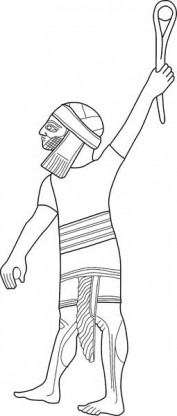
This consistent intersection of left-handedness and the tribe of Benjamin raises a question: Did this one particular tribe produce an unusually high number of left-handers? If so, why? Could it have been because of some genetic or social factor, or perhaps both? Might modern genetic studies give us some insight into this curious case of the left-handed Benjamites? Perhaps it can.
The factors that influence handedness have been studied for years,3 although there is still no clear understanding of all the determinants. Current research suggests that handedness is influenced by a complex interplay of both environmental and genetic factors. Studies of twins suggest that genetic effects account for 25 percent of the variation of handedness, and unique environmental influences account for the remainder.5 Some proposed environmental effects on handedness are societal, such as modeling handedness, forced handedness and stigmatization.6
Other studies based on prenatal ultrasounds show that handedness formation occurs prenatally, before societal influences on handedness are present.7 Familial aggregation of handedness is also consistent with a genetic component: In one study, it was found that two left-handed parents have a 26 percent chance of having a left-handed child, while the prevalence is 20 percent with one left-handed and one right-handed parent, and 10 percent with two right-handed parents.8 Most recently, genetic mapping studies provide support for a genetic basis of handedness. Several genes and chromosomal locations are associated with being left-handed.9 It appears that there is a genetic component to handedness, but it is a very complex interaction between multiple genes that is influenced heavily by environmental factors.
Thus, it seems quite possible that the tribe of Benjamin produced more left-handed people than did other Israelite tribes. Perhaps they were genetically inclined to left-handedness, and the tribe may also have encouraged it. The Hebrew term for “left-handed” in Judges 3:15 and 20:16 literally means “restricted (’iṭṭēr) in his right hand.” Did the Benjamites bind the right arms of their sons to their sides to encourage use of the left hand?10 The phrase “restricted in his right hand” seems to allow for the possibility, although it may just as easily mean something like “can’t use his right hand like normal.”
Some authors suggest that Benjamites and others may have encouraged left-handedness because it would be advantageous in combat.11 Since soldiers would be less apt to confront a left-hander (as with Ehud), left-handed warriors may well have had an advantage in fighting hand-to-hand. In addition, ancient city gates were often built with a right-hand turn in order further to expose right-handed attackers, suggesting another possible benefit for left-handed troops.
However, the idea that left-handedness was militarily advantageous loses some of its force since the references to units of left-handed Benjamites describe slingers and archers (Judges 20:16; 1 Chronicles 12:2). Such troops used long-distance weapons, where the advantage of using the less common hand is difficult to see.
So did the tribe of Benjamin produce more left-handers, as the three Biblical passages suggest? Perhaps the Benjamites were more genetically inclined to produce left-handed people, and perhaps they also encouraged left-handedness, possibly as a mark of tribal distinction and pride.
It’s also possible that the Biblical authors merely noted left-handed Benjamites because of the irony of the handedness in the meaning of their name: Ben-jamin means “son of (my) right hand” in Hebrew, making these lefties “left-handed right-handers.”
Whatever the reason for the link of left-handers just to the tribe of Benjamin, the connection makes for a curious case, on which modern genetic studies may shed some light.12
Biblical Views: Images of Crucifixion: Fresh Evidence

The Easter season is a time of year when Christians reflect on the death, burial, resurrection and post-mortem appearances of Jesus. Good Friday, as it is called, focuses specifically on the death of Jesus, which in my view likely transpired during the Passover season in April 30 A.D. Much of how Christians view, and think about, the crucifixion of Jesus comes from the iconography and representation of the event in later Christian art, none of which dates to the first century of the Christian era.
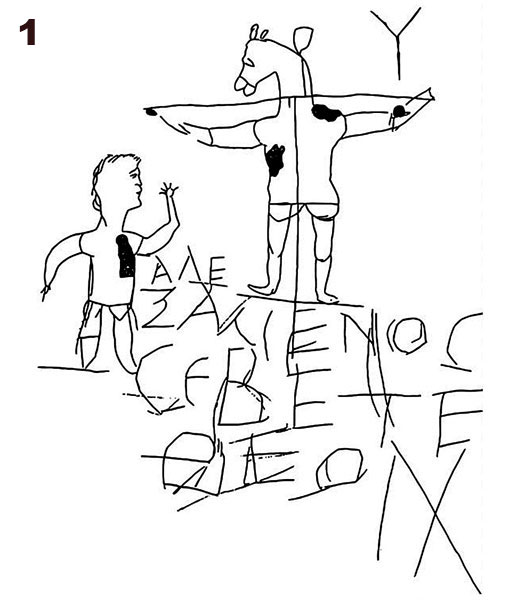
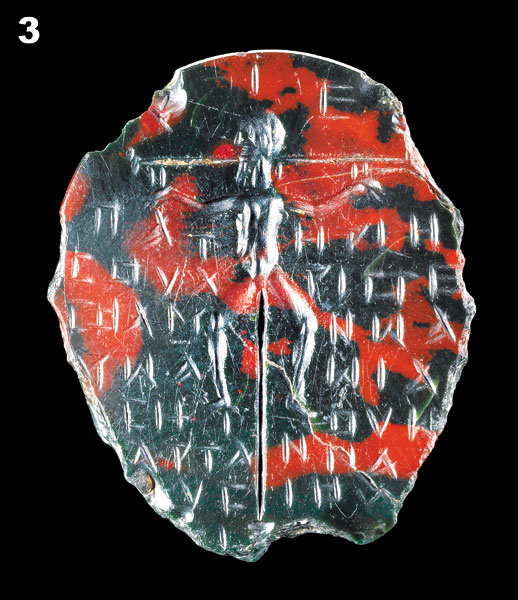
There are, however, three known images of crucifixion roughly contemporary with when Jesus lived. The first two are in the form of graffiti: one ridicules the notion of a crucified god (and so provides an early critique of Christian belief); the other is a simple depiction of a flayed and crucified man. The third image is inscribed on a gem that may have been used for magic rites.
The most familiar image is called the Alexamenos graffito. It was found on a plaster wall near the Palatine Hill in Rome. The inscription either reads “Alexamenos worships god” or is an imperative, “Alexamenos—worship god!” The crucified figure has the head of a donkey, satirizing the worship of Alexamenos; the notion of a crucified god was seen as ridiculous. Of interest is the way the crucified figure is depicted: (1) on a T or tau-shaped cross, (2) with feet spread apart, not nailed together. There is no clear consensus of the date of this graffito, but it has been suggested by scholars that it comes from somewhere between the late first century and the mid-third century A.D.
The second image of crucifixion is far less well known, having been found fairly recently at a dig in Puteoli, Italy.

Once again the man is depicted with his head facing to one side, on a tau-shaped cross, with legs apparently nailed separately on either side of the upright portion of the cross. He has also been badly whipped or flayed. In both of these examples the man has been crucified in the nude, which may explain the choice of posterior rather than frontal images.
This second image was found in 1959 in a taberna (guest house) in Puteoli and probably dates to the second century A.D.1 This graffito may reflect, as Professor Harley-McGowan of Melbourne University suggests, that the graffiti artist had actually witnessed a crucifixion at the famous arena in nearby Cumae. In that case, we have here a first-hand description of how the crucifixion of someone like Jesus appeared to a bystander.
Though it is likely from a slightly later period (perhaps the fourth century), a striking gemstone confirms what we have already noted: the feet are nailed separately; the image may be from the back side (possibly showing flaying); and, more clearly, the cross is the shape of a capital T, or tau.
In addition to the three depictions mentioned above, there is also the famous ossified foot with the nail through it found at Givat ha Mivtar, a neighborhood in northern Jerusalem, proving that crucifixion with nails was known in antiquity in Jerusalem.a
How is all of this relevant to the crucifixion of the historical Jesus? First, crucifixion was a form not merely of execution but of public shaming. Such persons were often crucified in the nude. It can be debated whether this was the case with Jesus. The Romans might have avoided the practice, understanding that public nudity would offend Jewish sentiments, especially during the Passover season. On the other hand, there is nothing in the accounts of the New Testament to suggest that Jesus was wearing a loin cloth (or anything else) when he was on the cross. All we are told is that his clothes were the property of the soldiers.
Second, if Jesus was crucified in the same manner as we see in the above examples, then the image on the Shroud of Turin of a man crucified with one nail through both feet (positioned one on top of the other) may not reflect the first-century Roman practice.b But nails likely were used in the case of Jesus. The point of using nails was to ensure that no one would come at night and take the executed man down from the cross. In fact, various persons in the early Christian era did survive crucifixion with just such help.2
Third, precisely because the point of such a bloody public execution was to humiliate the person in question and deter others from committing his crimes (crucifixion normally being the punishment only for treason or slave revolt3), crucifixion seems to have been regularly accompanied by flaying or flogging, presumably before the person was nailed to the cross. The Gospels suggest that Jesus endured such a punishment, though they do not emphasize this aspect of his suffering, barely mentioning it in some cases. The earliest account (in Mark 15:15) mentions flogging in passing, as do Matthew 27:26 and John 19:1. Luke 23:22 speaks of flogging and then releasing Jesus, which suggests a light flogging (the flogging itself is not recorded).
Without question, crucifixion was horrific, but we don’t need the later gruesome depictions of Jesus’ death to deduce that fact. It is important for those who are interested in the historical event of the crucifixion to stick to the facts we have about the event itself—both as recorded in the Gospels and as found in the archaeological evidence, however slender.
Biblical Views: Biblical Widows—Groveling Grannies or Teaching Tools?

Widows. Are they not just an elderly, cranky, lonely and poverty-plagued group in the Bible always clamoring for justice? Well, sometimes. But they’re not all wizened whiners. And at least two—Abigail and Judith—are beautiful, financially secure and sexually desirable.
Throughout the Biblical text, widowhood signals a new season, a new time in a woman’s life. Lacking the protective care of husbands and grouped together with the fatherless, poor and resident alien, widows come under God’s protective care (Deuteronomy 24:17, 21; Ezekiel 22:7; James 1:27). Significantly, God commands that they not be oppressed (Zechariah 7:10). Jesus rebukes teachers of the law specifically for devouring widows’ houses (Mark 12:38, 40), a striking condemnation of the premeditated, predatory greed that targets this vulnerable group. Indeed, the poet of the Book of Lamentations captures this sense of vulnerability by using the word “widow” to describe Jerusalem after Nebuchadnezzar razed the city. Gone is her resemblance to a queen; vanished are her protectors, lovers, friends. Slavery, affliction and harsh labor await her in exile (Lamentations 1:1–3).
The Biblical authors recognize that widowhood usually presents incredible needs and a diminished ability to meet them. Widows, therefore, may serve as textual markers to alert savvy readers and listeners that something significant is about to be presented, such as a miracle in response to a need, a theological insight or a rebuke from God.
Consider three miracles, all of which concern widows, that show how needs are met. A prophet’s widow cries to the prophet Elisha for help because her sons are going to be sold as slaves to pay her husband’s debts. Elisha asks what she has in the house. A little oil, she replies. He commands her to gather vessels from her neighbors and to start pouring. A miracle of abundant oil occurs, thereby meeting her present and ongoing financial needs (2 Kings 4:1–7). The dead son of the widow of Zarephath is restored to life after Elijah, who has received the widow’s hospitality and lodges in the upper room of her house, complains to God for bringing this tragedy upon her (1 Kings 17:17–24). A funeral cortege in Nain suddenly becomes a jubilant, aborted procession when Jesus, seeing the tears of the widowed mother and feeling compassion for her, touches the coffin and commands her son to arise (Luke 7:11–17).
Sons ordinarily represent a woman’s provision in old age. But one of the delights of the Biblical text is its unexpected twists. For instance, Naomi enters the story as both a widow and a mother who has lost her sons—such an ominous set of misfortunes that she describes herself as bitter and afflicted by the Lord (Ruth 1:1–5, 20–21). Yet over four chapters, Naomi changes. Once home in Bethlehem and pampered with regular meals, she becomes her old self and even seeks long-term security for her widowed daughter-in-law Ruth, a Moabitess. Ruth provides for them by gleaning. Thanks to a combination of Naomi’s matchmaking skills and Ruth’s boldness, Ruth marries Boaz, Naomi’s wealthy kinsman. With the birth of their son Obed, Naomi’s neighbors remind her that her daughter-in-law is better to her “than seven sons” (Ruth 2–4, 4:15).
Throughout the Biblical text, widowhood invariably offers new opportunities. A widow suddenly becomes free to choose her own lifestyle because she is no longer supervised by a husband or father. But her choices can lead to shame or honor. Seizing the throne at her son’s death, Athaliah, the dowager queen of Judah, kills the royal family (except for one, a baby grandson who is saved and hidden), seizes power for six years and is herself deposed in a coup and slain (2 Kings 11). Fleeing the Temple, Athaliah is caught at the place where horses enter the palace grounds, a place no doubt associated with dung (2 Kings 11:16). On the other end of the spectrum is Anna the prophetess, who lives in the Temple or its environs (Luke 2:36–38) and uses her widowhood to serve the Lord. Married for only seven years, Anna has been a widow up to age 84 (or for 84 years; the Lucan text is ambiguous). Long a Temple fixture, she worships God day and night by praying and fasting. God seemingly acknowledges her decades of devotion. Grouped with Simeon, Elizabeth and Zechariah, three other elderly, devout and righteous members in the Birth Narrative (Luke 1–2:40), Anna meets Mary, Joseph and Jesus at their purification and speaks of the child Jesus to those “looking forward to the redemption of Jerusalem” (Luke 2:22, 38).
And what about those beauties, Abigail and Judith? Well, as widows they also face opportunities. Abigail, very recently widowed from the surly and mean Nabal, accepts David’s marriage proposal. Joining him and his band in the wilderness and taking with her five maids, Abigail embraces adventure (1 Samuel 25:2–3, 1 Samuel 25:39–42). Judith, presented with an opportunity to save her people from destruction by the Assyrians, seizes it.a Using her beauty and charm as bait, Judith murders Holofernes, the Assyrian general besieging her town, thereby rescuing her nation and becoming “the glory of Jerusalem” (Judith 15:9–10).b Declining all remarriage offers and remaining chaste, this widow becomes more and more acclaimed throughout her long life and dies at age 105 (Judith 16:21–23).
Biblical Views: God Save the Queen: The Political Origins of Salvation

The summer of 2012 marked the 60th anniversary celebration of Queen Elizabeth II’s accession to the British throne. The pomp and pageantry of her diamond julibee captivated not only her royal subjects but also people around world. Even journalists and broadcasters from the United States covering the festivities seemed enchanted by the rousing chords of “God Save the Queen.”a
It’s a basic interpretive principle that words and texts only have meaning in context, literally that which is “with the text.” Often, we unconsciously import our own social, political and religious contexts, values and assumptions. When we encounter language of “salvation” and “redemption” in religious context, we often understand these words as referring to an individual’s spiritual status, but that is not how the words were used in the Biblical period. In the context of the British Commonwealth, we immediately recognize the strains of “God Save the Queen” as a celebration of British patriotism, a plea to protect the monarchy and preserve the political order, not a call for her conversion or spiritual salvation. Similarly in ancient Israel, talk of salvation and redemption had a physical/political meaning rather than a spiritual one.
In the Hebrew Bible, words related to “redeem” (root:
Likewise in early Jewish literature, “salvation” usually referred to escape from physical danger, including the dangers of battle, along with political liberation.2 In 1 Maccabees, for example, the narrator summarizes a Jewish victory in battle with the phrase “and there was a great salvation for Israel on that day” (1 Maccabees 4:25).3 In 1 Maccabees the military victory of the Jews is referred to by “salvation” (5:62) and Judas Maccabeus is mourned as “the savior of Israel” (1 Maccabees 9:21). In 2 Maccabees, God’s acts of political liberation are celebrated, especially the success of Judas Maccabeus: “God (is the one who) has saved all his people and has given back the inheritance to all, and the kingdom, and the priesthood, and sanctuary, as he promised through the law” (2:17–18; see also 2 Maccabees 1:11, 25).
Josephus, writing in the second half of the first century C.E., consistently used the words “redemption” or “redemption-money” to refer to the money offered to free political and war prisoners.4 In the Septuagint, the Greek word for “redeem” often translates forms of the Hebrew word
Many of us living in the United States have not experienced life under the rule of a monarch. Nor do we understand what it is like to live as a colony oppressed by an empire. This, however, was precisely the social and political context of Jesus and his earliest followers. For many Jews, living under the subjugation of the Roman Empire was not ideal; they wanted to have their own divinely appointed king. During the first century, political tensions were on the rise in Israel, culminating in the Jewish revolts against the Romans in 66–70 C.E and then again in 132–135 C.E., both of which were squashed by the Roman army. Facing the disappointment of the failed Jewish revolts, the early Christian community postponed their expectations of political redemption and salvation until the second coming of the Son of Man (as demonstrated in Jesus’ speeches in Luke 21 and Acts 1:6–11) and focused on more spiritual matters.