
Biblical Views: How the Mother God Got Spayed

Is God gendered as a male in the Bible? What about Jesus’ words in John 4:23–24 where he says that “God is spirit”? In the same passage, however, Jesus calls God “Father.” Does he do so in reference to an actual masculinity of God? Is this a manifestation of male domination and patriarchy? Ben Witherington doesn’t think so.a According to him, Jesus calls God “Father” and not “Mother” only because he did not have a human father, while he did have a human mother. Witherington thinks that, at least in the New Testament, God is not perceived to be male, but a genderless divine essence. He says that we are too quick to read into the Bible our own over-sexed and gender-language-sensitive culture.
But are we? Or are we trying to apologize for the misogyny in the Bible because of our religious belief in the sacred nature of the Bible? How could Scripture, which is the Word of God to so many Christians, be the product of patriarchy and its over-sexed values that are grounded in the perpetuation of male domination and the degradation of the female? How could Jesus in the Gospel of John, for example, be portrayed as someone who valued God as a male spiritual being, a God who relates to human beings as a dominant father would do to his subordinate children (John 4:23–24)?
To begin with, humans—whether ancient or modern—think within gender categories. And whether we admit it or not, gender never has been neutral. Power is always involved. In the ancient world, the female body was believed to be subhuman, imperfect—a deficient body because it lacked the male genitalia. The male body was the perfect body. So the male body dominated the scene, including the Bible, Christian theology and Christian ecclesiology. In other words, the Bible came into being within a cultural matrix where the female body by definition was substandard and dehumanized. This dehumanization of the female body affected virtually every storyline of the Bible.
In some forms of early Christianity, women could be leaders of churches only when they remade themselves into “males.” This wasn’t perceived by them to be just a metaphor. This was real. We have records of women like Thecla and Mygonia who chopped off their hair and dressed as men in order to preach and baptize.1 We have records of hermit women like Mary of Egypt who fasted to the point that their bodies stopped menstruating and pilgrims believed them to be holy men.2 What a surprise when these women died and their bodies were revealed as female! Early Catholic Christians refused to allow women into the pulpit at all because of their obviously deficient yet seductive bodies.3 The second–third-century church father Tertullian explains that women have no recourse: They cannot transcend their naturally deficient and sexualized bodies through baptism, fasting or cross-dressing. Once a woman, always a woman, he says.4 This same kind of argument continues to be used by Catholic authorities to keep women out of the priesthood.
This misogynist view of the female body affected the way in which the ancient people created their theologies and engaged in worship. This is not to say that all ancient Jews and early Christians perceived God only as a male Father God. Indeed, worship of the Mother God in conjunction with the Father God can be demonstrated to have occurred within ancient Israel. Both the Bible and archaeology confirm this.5 So it isn’t that the Mother God was absent from their worship. Rather she was consciously eradicated from worship by the religious authorities. The ancient Israelites used to worship the Queen of Heaven even in the Temple in Jerusalem because she kept famine away (Jeremiah 44:15–19). But once the Babylonians conquered the Jews, the exiled priests blamed their plight on the worship of the Goddess.6 When they wrote the narrative that would become the basis for the Hebrew Bible, the worship of the Queen of Heaven was recast in brazen sexual terms. Her worship was not just idolatrous, it was adulterous and justified the physical abuse of Israel. What was once legitimate worship was recast as illegitimate idolatry. The exiled Israelite priests demanded the sole worship of the male deity YHWH from that time forth.
Much the same story can be traced in early Christianity. We have records that demonstrate that the Holy Spirit was perceived by the first Christians to be not only female, but also Jesus’ Mother. In the noncanonical Gospel of the Hebrews, Jesus calls the Holy Spirit his Mother.7 The Gospel of Thomas records the same thing.8 We even have evidence that some Christians thought it was hilarious that Jesus was conceived by the Holy Spirit. What a joke! “How could a woman ever become pregnant by a woman?” they asked.9 In the Syrian Christian tradition well into the third century, the Holy Spirit as the “Compassionate Mother” was called upon in the baptismal prayers to come and instruct her newly born children.
So what happened to the Mother Spirit in Christianity? She was neutered (or spayed, if you prefer) as the language shifted from Aramaic into Greek, where “spirit” lost her female coding. In Hebrew and Aramaic, “spirit” is a feminine word. In Greek, it is a neuter word. In Latin, it is a masculine word. This erosion of the female Spirit was hurried along by the development of the doctrine of the Trinity, which perceived of the Father, Son and Holy Spirit as “consubstantial,” or of the same substance. The female could never be consubstantial with the male in the ancient mind because the female body was not the same as the male body. It was deficient. So the female Mother Spirit was refashioned into a quasi-male or male that proceeded from the Father and Son, and the Mother was erased from the Godhead. To this day Christians do not perceive of the Holy Spirit as female or as Mother; those who do are heretics. But the Spirit’s femaleness was an original feature among early Christians and has eroded over time. The early Catholic Christians gradually repressed the female aspect of the Christian Godhead, and a bogus story developed that she was never there to begin with. It is this storyline that we are most familiar with and have bought into for 2,000 years.
Because the dehumanization of the female body was considered to be part of the natural order of the world in antiquity, her subordination and marginalization was perceived by the Biblical authors to be part of the divine order as well. Rather than accepting this perspective as prescriptive for our own world today, or conveniently ignoring it as if it did not exist or doesn’t matter, or apologizing for it through convoluted theological explanations, I think the time has come for us to confront head on the fact that misogyny is the real serpent in the Garden and we must stop listening to its lies.
Biblical Views: Critical Biblical Scholarship—What’s the Use?

I was surprised to learn recently that the mainstream of contemporary Christian philosophy has little use for critical Biblical scholarship. Alvin Plantinga, probably the most eminent member of the guild of Christian philosophers, writes:
There is no compelling or even reasonably decent argument for supposing that the procedures and assumptions of [historical Biblical criticism] are to be preferred to those of traditional Biblical commentary.1
He believes that interpreting the Bible by means of historical Biblical criticism is like “trying to mow your lawn with a nail scissors or paint your house with a toothbrush; it might be an interesting experiment if you have time on your hands.”2 But it’s basically a waste of time and effort.
Why would a professor of philosophy disparage critical Biblical scholarship? Is it not an academic field with well-honed methods and criteria comparable to his own? Well, apparently not. Plantinga is an evangelical Calvinist speaking for those for whom the Bible is inerrant and thus immune from reasoned inquiry. He holds that “Scripture is inerrant: the Lord makes no mistakes; what he proposes for our belief is what we ought to believe.”3 The right way to read the Bible, he believes, is by the inspiration of the Holy Spirit, which teaches one how to comprehend the Bible’s inerrant teaching. All well and good, but this is a matter of faith, not reasoning. It starts with the answer, not with the question.
I have no qualm with anyone’s faith, but I think it’s important to stress that critical Biblical scholarship does not operate by the inspiration of the Holy Spirit. This is what the term “critical” means. The word comes from Greek krinein, which means “to judge, decide, discriminate.” A critical scholar is one who is able to make distinctions based on careful study of the evidence and by appeal to reasonable arguments and criteria.
One of the key strategies of critical scholarship is methodological doubt. A critical scholar does not accept the conclusions of authorities or tradition but rather submits them to doubt. Only a position that survives the scrutiny of methodological doubt can be regarded as reliable, and even then it is subject to future testing. In this fashion, critical knowledge builds up reliable knowledge, which remains forever corrigible. This strategy was elegantly formulated by an early modern advocate of science, Francis Bacon: “If we begin with certainties, we shall end in doubts; but if we begin with doubts, and are patient in them, we shall end in certainties.”4
This process—beginning with doubt and ending with reliable knowledge about the Bible—differs from Plantinga’s philosophy, which begins with a commitment to Biblical inerrancy. For him, the inspiration of the Holy Spirit is the starting point, not methodological doubt. As John Calvin stated: “The testimony of the Spirit is more excellent than all reason.”5 The inward testimony of the Holy Spirit (as interpreted by religious authorities like Calvin) is what counts.
Yet, interestingly, Calvin did not think that the Bible is inerrant. And he had a high opinion of reason and common sense. He had no trouble admitting where the Bible is incorrect or doesn’t make sense according to the historical and scientific knowledge of his time. As Church historian Roland Bainton observes, for Calvin, Luther and other Reformers, “inspiration did not mean inerrancy or impeccability.”6 Calvin pointed out where Biblical passages reflect the erroneous views of “the humble and unlearned.”7 And Luther remarked that such errors “do not bother me particularly.”8 So why do such errors bother Plantinga?
I don’t know the answer to this question. But I do know that this difficulty makes a difference. Many evangelicals who agree with Plantinga regard critical Biblical scholarship as a waste of time. But if inerrancy is itself a relatively recent position—motivated by the anti-modernism of late-19th and early-20th-century fundamentalists—then perhaps more people should be open to the usefulness of critical Biblical scholarship. Some evangelical Biblical scholars are actively promoting this option.9 For them, critical Biblical scholarship is an important tool, more like my beloved hand-propelled reel mower than a nail scissors. It takes work and practice, but it gets results. As Calvin and Luther would agree, there’s no good reason to be hostile toward good scholarship.
Biblical Views: Spirited Discourse About God Language in the New Testament

In his discussion with the Samaritan woman in John 4, Jesus has some profound things to say about the nature of worship, as well as the nature of God: “The hour is coming and is now here, when the true worshipers will worship the Father in spirit and truth, for the Father seeks such as these to worship him. God is spirit, and those who worship him must worship in spirit and truth” (John 4:23–24).
Start with Jesus’ observation about God: God in the divine essence is, by definition, spirit not flesh, not a material being. And yet in the same breath Jesus is perfectly happy to call God “Father.” In our over-sexed and gender-language-sensitive culture, it is understandable that the juxtaposition of “God is spirit” with “God is Father” might seem like an oxymoron. Doesn’t father imply male, and doesn’t maleness require flesh and gender? In fact, as the New Testament shows, the answer to this question, when it comes to God, is no. God is not male, God in the divine essence does not have a gendered identity, and yet God is the Father of Jesus and by extension the Father of all his adopted children as well. How so?

In this same Fourth Gospel we hear that Jesus is the only begotten Son of God (John 3:16). This is meant to convey the notion that while the rest of us, by God’s grace, may become the adopted children of God (see John 1:12–13), the relationship between Jesus and the Father is one of direct kinship. Jesus and the Father are one, such that those who have seen the Son have seen the Father, according to the gospel.
This doesn’t mean that the Son was literally begotten by the Father, only that they had a unique, distinctive, even exclusive family relationship to one another. The language of Father and Son implies intimacy, deep kinship, sharing of a nature (in this case a divine nature) and the like. It is relational language, not gender language. Similarly, calling believers “sons and daughters of God” is not gender language either. They have not been begotten in any literal sense by God. The new birth doesn’t involve sex or intercourse, or gender for that matter. Here, too, it is relational language.
Thus the attempt to treat the “Father” language used of God as either a bad manifestation of a male-dominated patriarchal culture or a clue to the actual masculinity of God is wrong on both counts. It also ignores an important fact. The reason Jesus did not call God “Mother” is not just because God is never prayed to or directly addressed that way in the Bible, but also because Jesus had an actual human mother. He did not wish to dishonor her by using language appropriate only of his relationship with her, of the one he called Abba.
Part of the reason for many misreadings of the New Testament’s God language is ironically because English is not a gendered language (unlike Hebrew and Greek, in which nouns, even inanimate ones, have a gender). When we see male or female nouns or pronouns, we assume they must imply or entail gender. This is false. The Greek word for wisdom, for example, is Sophia and in Hebrew, Hokhmah. They are both feminine nouns. In neither case are they used to say something specific or exclusive about women. There is no connection between gendered language and gender identity in such cases. Our cultural biases have led to the overly sexualized reading of the God language of the Bible.
Biblical Views: The Bible Divide

Not long ago, Bible scholar Michael Coogan was interviewed for the alumni magazine of Stonehill College about his new book God and Sex.1 Coogan was characteristically articulate, striking a mild “just the facts” tone regarding the Bible’s historical background and what the Bible actually has to say about sex. Not surprisingly, the next issue carried a slew of letters from alums, quite a few expressing outrage that such a “godless” man could be teaching Religion in a Catholic college.
Accusations of godlessness and worse are a familiar hazard for professors of Biblical Studies (and for BAR), and these letters were pretty standard fare. Reading them, I was led to reflect on two issues in particular: first, the general ignorance, even among academics, that there is a difference between “Religious Studies” and “Theology”; and second, the responsibility that rigorously trained Biblical scholars have to educate the wider public about the difference, especially as the most religious nation in the world, the United States of America, is growing increasingly polarized.
Many people are unaware that Religious Studies and Theology are not synonymous. Generally, the difference can be understood as the difference between the university and the seminary; in other words, a difference of perspective—the view from the outside or from the inside. The study of Religion has historically allied itself with science and reason as an interdisciplinary field using the methodologies of History, Linguistics, Anthropology—including Archaeology—and other university disciplines. One of its basic “rules” is that the scholar investigates religions of the contemporary world or of the past (such as ancient Israel) as a neutral observer and reporter with no religious agenda (even if we know no one can be fully impartial). I tell my students to imagine scholars of Religion as Martians, newly landed on earth with no preconceived notions about religion. Scholars of Religion do not aim to tell people what to believe or how to live.
By contrast, a Theologian studies her own religion as a believer—as a Jew or a Christian, for example—allied with faith and authority. What she discovers about, say, the influence of ancient Mesopotamian law on the Ten Commandments (Exodus 20:1–17; Deuteronomy 5:6–21), she will seek to reconcile with existing Christian or Jewish belief. What is problematic is that the border between the two disciplines can very easily overlap, especially in the subfield of Religious Studies that is Biblical Studies.
Let me try to use some BAR contributors to demonstrate this difference, although I expect that one or more of them might dispute what follows precisely because of the overlap I mentioned. New Testament expert Bart Ehrman is an avowed atheist, but this is no bar to his being a Biblical scholar in “Religious Studies.” Conversely, as long as they do not prescribe religious behavior, there is no regulation against “believing” Religious Studies scholars. Amy-Jill Levine is Jewish and a leading New Testament scholar. On the other hand, both Luke Timothy Johnson and John Dominic Crossan are highly respected Bible scholars and avowed Christians (although with differing Christian outlooks) who openly incorporate the results of their scholarly work into their Christian theology.
Of course, discoveries in Religious Studies, like discoveries in other “scientific” fields, can, and often do, present challenges to Theology. However, this doesn’t mean the two cannot coexist. I find illuminating the comment made by evangelical theologian Daniel B. Wallace, “I hold in limbo my own theological views about the [New Testament] as I work through it; it makes for an interesting time! In one respect I have an existential crisis every time I come to the text, and that’s fine because the core of my theology is not the Bible, it’s Christ.”2
In the increasingly polarized country in which we live, there’s not just the fierce “red state/blue state” divide. There’s also a lot of mutual suspicion, not to say scorn, between highly educated Americans and much of the population who view higher education, particularly in Biblical Studies, as an insidious force devoted to destroying their social and religious values. The disconnect has only been growing in the decade since Robert Putnam published Bowling Alone: The Collapse and Revival of American Community,3 in which he warned that Americans are restricting their social interactions to people who share their political and religious views and thereby miss out on the intellectual challenges and enlightening consequences of having to relate civilly with “different” people. The Internet reinforces this isolation; it’s significant that the expression “to surf” the Internet suggests recreation and fun, so we tend to visit sites that make us feel good, not ones that challenge or disturb us.
Despite the divide, the Bible matters to a lot of people, even if polls suggest they are often ignorant of its contents. They want to know what’s in the Bible and how to read it mindfully. Although Wikipedia warns that no reliable figures exist, the Bible continues to be a bestseller. Amazon.com provides a dedicated Bible Store with hundreds of offerings, enough to serve the entire spectrum of readers. Religious-sponsored sites such as BibleGateway.com offer Bible translations in an amazing array of languages in addition to English.4
The challenge for Biblical scholars is to find ways to share their expertise with the larger public in a manner that respects and speaks to the anxieties that critical Biblical scholarship can beget in believers. BAR has always been one such venue. I’d like to see more opportunities for respectful conversation between the “academy” and the public. Some of my colleagues in the academy have expressed misgivings at what they fear is a loosening of the scholarly standard for papers presented at the annual meeting of the Society of Biblical Literature.a The charge is that some papers are crossing the line into Theology. Perhaps a more optimistic view would be that SBL is now in a position to create opportunities for just the sort of positive and productive discourse that is needed between the academy and the greater public to bridge the Bible Divide.
Biblical Views: The Many Faces of the Good Samaritan—Most Wrong

The Parable of the Good Samaritan is a favorite of both children and adults. The story is told in Luke 10:29–37: A man going from Jerusalem to Jericho is attacked by robbers who strip him and beat him. A priest and a Levite pass by without helping him. But a Samaritan stops and cares for him, taking him to an inn where the Samaritan pays for his care (see article).
This column is about some appropriate lessons to be drawn from the parable, as well as some that are far-fetched, to say the least. For children, the parable can illustrate universal morals: We should help people who are hurt. It has also been used to warn kids: “Don’t walk by yourself on dangerous roads.” I once heard a sermon go that route.
For adults, the meaning is more profound. It is consistent with the Biblical mandate to love one’s neighbor as oneself, and it follows up on that mandate to insist that the love be manifest in action. It has also been used to instruct: Not only must we love our enemies, but also we should provide free medical services to foreign nationals. I heard a sermon go that route as well.
As interpretations about dangerous highways and universal healthcare indicate, the parable means different things in different times and places and for different audiences. Appropriation of the text for new contexts is inevitable.
Hearing the parable as Jesus’ original audience heard it should also be part of the repository of meaning. But again, we find several contemporary interpretations that might surprise Jesus’ audience. Here are four common anachronisms heard today:
First is the view that the robbers would have been regarded as freedom-fighters, dispossessed peasants forced into debt by Roman and Temple taxation and kept there by pressures from urbanization programs. The robbers are therefore sympathetic “social bandits,” Robin Hoods in tzitzit. Nonsense!
The Greek term that Luke uses is lestes, which means “robber,” not “freedom fighter,” as the violence of the perpetrators in the parable suggests. This same word appears in Jesus’ condemnation of the Temple: “You have made it a den of robbers [lestes]” (Matthew 21:13; Mark 11:17; Luke 19:46). Paul uses it to describe the dangers he faced from “bandits” (2 Corinthians 11:26). Paul is not talking about the Merry Men.
Another foolish suggestion is that the victim—the Greek calls him “some guy” (anthropos tis)—deserved his fate. A few scholars propose that the victim is a tradesman who, because he consorts with all sorts of folks, is ritually unclean and therefore unsympathetic. Such conclusions not only stretch the text well beyond its words and its contexts, they also import a negative view of Torah and Jewish society unwarranted by any historical understanding. An injured man prompts sympathy, not schadenfreude.
A third interpretation sometimes heard is the related claim that the priest and the Levite avoid the victim because, should he be dead, or die while they attended him, they would become ritually unclean. Therefore, in avoiding the injured man, they are actually following Torah. Again, nonsense. Yes, priests are to avoid corpses (see Leviticus 21:1–3), save for those of immediate family members, but this law does not apply to Levites. Were the priest concerned about the purity required by his Temple duties, he might have hesitated; but this priest is not going up to Jerusalem, he is going down (katabaino) from it. Moreover, in Jewish law saving a life trumps all other laws. The Mishnah (Nazir 7.1), the earliest compilation of rabbinic law, insists that even a high priest should attend a neglected corpse.
In the parable, the priest and Levite signal not a concern for ritual purity; rather, in good storytelling fashion, these first two figures anticipate the third: the hero. Jews in the first century (and today) typically are either priests or Levites or Israelites. Thus the expected third figure, the hero, would be an Israelite. The parable shocks us when the third figure is not an Israelite, but a Samaritan.
But numerous interpreters, missing the full import of the shock, describe the Samaritan as the outcast. This approach, while prompting compelling sermons, is the fourth anachronism. Samaritans were not outcasts at the time of Jesus; they were enemies.
In the chapter before the parable (Luke 9:51–56) Luke depicts Samaritans as refusing Jesus hospitality; the apostles James and John suggest retaliation: “Lord, do you want us to command fire to come down from heaven and consume them?” (Luke 9:54). John 4:9 states, “Jews do not share things in common with Samaritans.” The Jewish historian Josephus reports that during the governorship of Cumanus, Samaritans killed “a great many” Galilean pilgrims traveling to Jerusalem (Antiquities 20.118–136). The first-century Jewish person hearing this parable might well think: There is no such thing as a “good Samaritan.” But unless that acknowledgment is made, and help from the Samaritan is accepted, the person in the ditch will die.
The parable offers another vision, a vision of life rather than death. It evokes 2 Chronicles 28, which recounts how the prophet Oded convinced the Samaritans to aid their Judean captives. It insists that enemies can prove to be neighbors, that compassion has no boundaries, and that judging people on the basis of their religion or ethnicity will leave us dying in a ditch.
Biblical Views: Are Feminists Biased About the Bible?

The title of this column, supplied by the editor, contains two words that need comment. “Biased” comes from the sewing term “bias,” meaning the angle on which a piece of cloth has been cut diagonally across the grain. Bias can also mean an angle of vision. In that sense, yes, feminists do have an angle of vision about the Bible. In general, their vision is angled from a viewpoint of the varied experiences of wo/men (a term coined by Elisabeth Schüssler Fiorenza for women and nonelite men). This is against the grain, so to speak, because the Bible is not written (and in the past has not been interpreted) from this angle.
But in common parlance the word “biased” has also come to mean something quite negative, indicating a certain blindness, prejudice and hostility. In that sense, I can say “yes” and “no.” In the first wave of the Women’s Movement in the 1800s, some feminists judged religion and the Bible as major obstacles to human rights. Other feminists found in them great power to be unleashed in the struggle for human rights. Compare this to the use of the Bible by those involved on both sides of the issue of slavery. I think we find the same divisions today. Some feminists are convinced that religions and their sacred texts are passé or dangerous; others, that religions or at least spiritualities are essential and beautiful. Some feminist scholars have had little or no education in religious and Biblical studies, and have ruled out the Bible and the religions that use it as totally oppressive and antique, something in which they have no interest, not even enough to critique. The Bible itself contains passages to support both positive and negative views, in terms of gender.
I think the title of this column may contain a not-so-hidden fear in some that feminist Biblical scholars are destroying the churches’ belief in the Bible as the inerrant Word of God for all time. This is true; they are doing that. Feminist scholarship is not “fundamentalist.” Some Bible scholars view the Bible or parts of it as not the Word of God for now or even ever, and that ancient and contemporaneous usages can and should be examined. For example, the statement in Genesis 3:16: “Your desire shall be for your husband, and [or: “but”] he shall rule over you.”a Or “As in all the churches of the saints, the women should keep silence in the churches. For they are not permitted to speak, but should be subordinate, as even the law says” (1 Corinthians 14:33–34). Other scholars view the Bible as the word of God in human words, more specifically in the words of men, not women. As far as we know, none of the Biblical texts was produced by a woman, though some may contain women’s traditions and insights. Inquiry into the cultural and ideological contexts is essential to good scholarship.
The word “feminist,” as used by feminist scholars, means someone who participates in the worldwide social change movement toward empowerment for wo/men; one who thinks that wo/men are fully human and works to make that an operative principle and value of his or her action. Yes, some men are feminists. The African American writer bell hooks (who does not capitalize her name) has written a small book, Feminism Is for Everybody, whose title is serious—I hope you read it.1 The popular media have not done a very good job of presenting feminism (in fact, I cannot think of any sitcom or movie character who is clearly a feminist). But we all experience the changes the women’s movement has made and is making in society—in the workplace, marriage expectations, politics, language, economics, education, rituals and everyday life.2 Jewish, Christian, Islamic, Buddhist and other feminist scholars are at work today on “sacred texts,” probing for materials that are outmoded and dangerous, as well as those that can enrich our present and future and that of our children.
Feminist scholarship in Biblical studies has been increasingly prominent and accepted in the academy for 40 years at least. The great works of Phyllis Trible exemplify both the angle of vision, from wo/men’s experience, and the use of the Bible as a contemporary resource.b Take, for example, her treatment in Texts of Terror of the story in Judges 19 of the Levite and his secondary wife (“concubine” in some translations).3 Trible reads it as a story not of lack of hospitality (an older interpretation) but of callous treatment of women, gang rape, and the relation of this treatment to war with its widening horrors afflicted on more women. But for Trible, the Bible also includes the Song of Songs, the only extensive Biblical work on sexuality, which she reads as promoting an astonishing balance: “my lover is mine and I am his.”4 Examination of the Hebrew Bible’s other prominent women such as Deborah and Esther, legal texts, myths, assumptions and implications are topics that have also been analyzed along feminist lines and with feminist interests.
With regard to the New Testament, prominent women such as Mary the mother of Jesus, Mary Magdalene, the Syro-Phoenician woman in Mark, the women mentioned in Romans 16 as powerful leaders and the women prophets in Corinth have been a focus of feminist scholarship. Also of great interest are such topics as the relation of the canonical texts to apocryphal texts, the politics of interpretation, slavery (different for men and women), Christian and feminist anti-Judaism, Jesus’ inclusive movement, his lack of statements about gender inequalities. And, of course, understandings of and metaphors for God in both testaments is a central topic. Elisabeth Schüssler Fiorenza’s groundbreaking work In Memory of Her (its title drawn from Mark 14:9) , as well as her edited volumes of essays and commentaries by a host of international scholars, in Searching the Scriptures, provide solid research in these areas. Many feminist works are quite accessible to the non-scholar.
Feminist studies do not aim at an impossible ideal—complete objectivity; in fact, they aim to make it clear that there are unacknowledged assumptions, aims, omissions and distortions in every work, including—maybe especially—works that claim objectivity. Feminist Biblical scholars aim for fairness in assessing the texts, and for the right to an informed opinion about what is fair.
There is a wealth of insight in our heritage and in ongoing feminist interpretation. It would be a shame if some biased against feminism by ignorance, lack of familiarity with it, or fear would deny themselves and their communities this wealth. As for myself, I would not have spent decades studying and writing about the Bible from a feminist perspective had I not found it and the Bible an inexhaustible reservoir of frustration, anger, fascination and joy; for me, it can be more liberative than oppressive.
Biblical Views: The Bible Then — The Bible Now

One of the things that impress those of us who work on Bible and archaeology is that so many people are still so interested in it all. It seems to me that the remarkable success of BAR and the Biblical Archaeology Society is proof of this. We could analyze the reasons for this forever, but the bottom line is that these things that happened thousands of years ago—and this book that was written thousands of years ago—are still relevant to people. That’s not a big insight. After 35 years in this field, I’ve become ever more concerned with that relevance. After spending decades writing about the Bible’s literary qualities, about who wrote it, and about the world that produced it, I turned in my recent work to something different: how people use the Bible on the issues of our day. It’s not that I think that what my colleagues and I have been doing is not relevant. Just the opposite. What I want to do now is connect the dots between what we do in archaeological and textual scholarship, on one hand, and how we use those tools to deal with the Bible on modern issues.
I think that it is all about method. For these 35 years I’ve been telling my students that the most important thing they need to learn is method. Our field was mighty sloppy for its first couple of centuries. Archaeologists scraped away the dirt from potsherds in order to see what inscriptions were written on them. And in that process they scraped away who-knows-how-many of the inscriptions themselves before they realized that it was a lot better to dip the sherds in water. Once they started dipping instead of scraping, they suddenly discovered that they were finding more inscriptions at their sites! Bible scholars meanwhile dated texts based on ideas in them: If a text expressed guilt, they concluded that it had to have been written during the Babylonian exile. (Did they really think that people could only feel guilt when they were in exile? Did Freud live and die for nothing?!) They made judgments about style without being trained in literary analysis, and judgments about history without being trained in historiography. The Bible was old, but the field was young, and we were plunging in haphazardly, without a sense of how to pursue the work properly. I’m told that one could say this of other fields as well, which I suppose is a small comfort, but my subject for now is my own field: Bible.
In Bible as in archaeology we’ve been refining the tools of our trade. Especially in the present generation, many of my colleagues are more conscious of the importance of method, which is to say: getting it right. (Unfortunately, for a great many of our colleagues, the entrance to this new level of the field is like Platform 9¾ in the Harry Potter books: They don’t even know that it exists.) Today the new method means employing everything from literary and anthropological training to architecture and radiocarbon dating.
We had to learn how to do all of these things—the “then”—before we could apply them to Bible issues that are critical in our times—the “now.” The degree of misunderstanding, mistranslation, misquotation and misapplication of the Bible on controversial topics out there is distressing. But we can’t just shake our heads at it or mock or deprecate it. We need to set the best possible example of how to arrive at answers. We can’t just say to laypersons, “Well, you don’t know Hebrew or Greek.” We have to show how comprehending the text in the original language makes such a difference. We can’t just say that we’ve checked the Dead Sea Scrolls. We need to let people know how the greatest archaeological discovery of the last century—which was made by a goat, after all—needs to figure in any accurate reading of the text. We can’t just learn Akkadian, Ugaritic, Aramaic and a dash of Moabite in order to impress people with our CVs. We need to show how all that we’ve learned from the tens of thousands of texts from the ancient Near East show us new things about the Bible and its world that we didn’t understand before.
People often say that the field of Bible studies is in disarray, with no consensus on major points. That’s true to some extent. But the disarray owes to the many scholars who have not come to terms with the present state of method. They don’t use the tools well or consistently, they don’t read each other, and they don’t teach method to their students. I would rather judge our field by the standard: What is the best that we can produce?
My colleague Shawna Dolansky and I aimed for that standard in our book The Bible Now, addressing how the Bible can inform five of today’s “hot” issues: homosexuality, abortion, women’s status, capital punishment and the earth. For the first four chapters, the plan was not to take sides but rather to provide information, make it available to everyone on both sides of the issues. For example, on homosexuality, we let people know that the Sodom text (Genesis 19) doesn’t contribute to a case against homosexuality, and the David and Jonathan case (“your love was more awesome to me than love of women” [2 Samuel 1:26]) doesn’t contribute to a case for it. On women’s status, we made known that the most significant woman in the Hebrew Bible, Deborah (Judges 4–5), is never given her due by either feminist or male chauvinist writers. On capital punishment, we showed why it is used for so many (27) crimes in the Bible without trying to argue for or against the death penalty on that basis. And on abortion, we showed why we must treat the single clear, explicit reference to it in the Hebrew Bible (Jeremiah 20) with great caution, whether one is making a case either for or against abortion. On all of these matters, we based our explanations on the same standard of textual work that I had used in all of my earlier work: fine points of grammar, significant parallel cases in other ancient Near Eastern law codes, new anthropological appreciation of those cultures and relevant archaeological revelations.
But when it came to the earth, we did take a stand on a particular side. In the creation account God tells humans, “fill the earth and subdue it and dominate the fish of the sea and the birds of the skies and every animal that creeps on the earth” (Genesis 1:28). People have claimed that this constituted a blank check to humans: The earth is ours to rule, to use and abuse as we see fit. But we had to say that these views are utterly contrary to the evidence. It is frankly incredible that anyone could take the Biblical text about human dominion to mean a license to do whatever we want with the earth—as if a divine commandment doesn’t mean to use dominion well, to use it for good. Imagine the boss who leaves an employee in charge. The employee bullies everyone else and runs things irresponsibly and wastefully. He or she tells everyone, “The boss left me in charge, and I can do whatever I want.” Would we admire this person’s wisdom? And just wait until the boss gets back. Will he or she say, “Great job. That’s just what I wanted you to do”?
That’s not just an opinion. It comes out of a lengthy treatment of the Bible’s prose, poetry and law that precedes it. And—I trust—it follows the standard of method that I learned from my great teachers decades ago.
So, then, maybe my treatment now of the Bible in this book is not so different from my past books after all. Maybe I’ve been on a trajectory that has been heading in this direction all along.
Biblical Views: Insertions in the Great Isaiah Scroll

The Dead Sea Scrolls have revolutionized our understanding of various aspects of the Bible, ancient Judaism, and the ancient Jewish religious milieu from which Christianity was born. BAR editor Hershel Shanks, when preparing his review of the new publication of the Great Isaiah Scroll (1QIsaa),1 noticed that one of the Biblical advances highlighted by that scroll was “isolated interpretive insertions.” Hershel asked me if I would describe for BAR readers what these “isolated interpretive insertions” were.
One of the major ways the scrolls have transformed our understanding of the Bible is by documenting an earlier period of Biblical tradition that we had not seen clearly before. Prior to the scrolls’ discovery, we had only a single form of the Hebrew text, the medieval Masoretic Text (MT), and we thought that was, in purified form, as close as we could get to the “original text.”
But the Dead Sea Scrolls, which are a thousand years older than MT, illuminate an earlier period—prior to the First and Second Jewish Revolts in 66 and 132 C.E.—characterized by rich pluriformity and ongoing development in the Biblical text, and indeed by “new and expanded editions” of certain Biblical books. For example, there is documentary evidence of a series of at least four editions of the Book of Exodus, each repeatedly expanded and developed according to discernible principles. The developmental composition of the Biblical books had been hypothesized since the Enlightenment, but there were only literary clues to substantiate this, no proof. The scrolls now provide that documentary proof.
1QIsaa is our oldest witness (125–100 B.C.E.) to the text of Isaiah, and it teaches us a great deal. It is generally similar to our other manuscripts, but there is manifold variation at almost every level. The critical edition in Discoveries in the Judaean Desert (DJD) Volume XXXII includes 75 pages of textual variants, with about 35 variants per page (more than 2,600 variants)!
Many of those variants are minor, but seven examples highlight what we call isolated interpretive insertions by later scribes in the MT; they are not contained in the original 1QIsaa text from Qumran. Unlike scribal corrections to reinsert text that was accidentally missed during the copying process, these insertions are complete thoughts that learned scribes occasionally added into texts they were copying. Such passages range from a single sentence or clause to full paragraphs, from part of a verse to seven or eight new verses. They may have been created in various ways: as scribal notes, through oral commentary that had become customary in a certain community, from passages with similar or contrasting ideas, or as expressions of a liturgical, pious or apocalyptic nature.
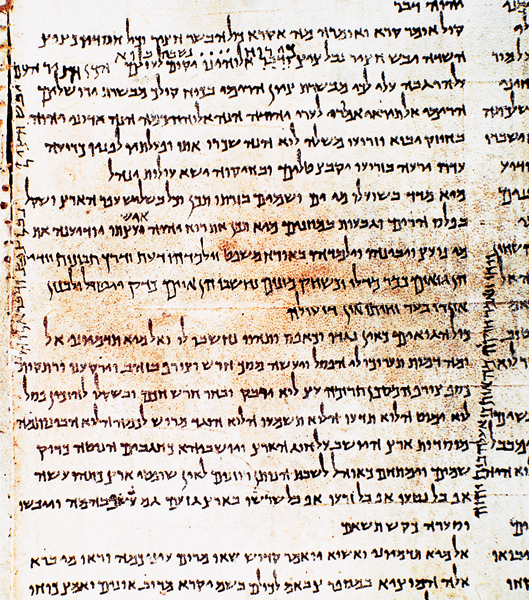
The astute reader sometimes recognizes these. A clear example is “There is no peace for the wicked, says the Lord,” which was tacked onto the end of Isaiah 48. It has no relation to what precedes or follows, but some scribe penned it early enough to be included in all our manuscripts, including the Great Isaiah Scroll.
Similarly, some scribe has inserted verses 9b and 10 of chapter 2 into the MT tradition. 1QIsaa contains the first part of 2:9 and 2:11 but does not have 2:9b and 10 (in italics):2
9 So humankind is humbled,
and everyone brought low.
Do not forgive them!
10 Enter into the rock and hide in the dust
from the terror of the Lord and the glory of his majesty.
11 The proud eyes of mortals will be brought low
and human pride will be humbled;
the Lord alone will be exalted on that day.
(Isaiah 2:9–11, NRSV adapted)
Note that 2:9a and 2:11 are both concerned with the humbling of human pride and use similar diction, expressed in the third person. In contrast, verses 9b and 10 are second-person negative (addressed to God) and positive (addressed to humans) commands that sit uneasily in the context. A scribe has inserted comments into the MT tradition here.
Another insertion in this same chapter is revealed by the Septuagint (the ancient Greek translation, c. 200 B.C.E.). It lacks the insertion noted by Hershel in his article: “Oh, cease to glorify man, who has only a breath in his nostrils. For by what does he merit esteem?” (Isaiah 2:22, JPS).
In the Greek, chapter 2 concludes with “On that day people will … enter the caverns of the rocks … from the terror of the Lord and the glory of his majesty, when he rises to terrify the earth” (Isaiah 2:20–21), but the MT and 1QIsaa continue with the command of verse 22. The change of topic and the grammatical change to a second-person command contrast with the previous verses and suggest that verse 22 is also a later expansion.
Yet another example is doubly attested by the scribe of 1QIsaa and by the Septuagint translator, neither of whom had the italicized words found in chapter 40 of the expanded MT tradition:
6 A voice says, “Proclaim!” And I said, “What shall I proclaim?” All humans are grass, their constancy is like the flower of the field.
7 The grass withers, the flower fades, when the breath of the Lord blows upon it; surely the people are grass.
8 The grass withers, the flower fades; but the word of our God will stand forever.
(Isaiah 40:6–8)
The short original text, which was copied correctly by the 1QIsaa scribe and witnessed also by the Septuagint translator, is a perfectly formulated, positive prophetic oracle of salvation. A later, sloppy scribe, however, has inserted a distracting lament into the Isaiah manuscript. It was eventually incorporated into the tradition that became the MT. Most Bibles now include that insertion. There are numerous examples of similar insertions in many books of the Bible.
Biblical Views: The Pharaoh, the Bible and Liberation (Square)

After the Egyptian dictator Hosni Mubarak stepped down in February, Google executive Wael Ghonim tweeted: “Good morning, Egypt. I truly missed you for the past 30 years!” This revolution, which was nonviolent and democratic, was an entirely modern phenomenon. But the backdrop of the Great Pyramids and the frequent references to Mubarak as the Last Pharaoh bring to mind a time span much longer than 30 years. The rule of the pharaohs in Egypt began around 3000 B.C.E. In the big picture we’re talking about 5,000 years of authoritarian rule by pharaohs, kings, emperors and dictators. In this long span, it is natural to think of the Biblical Exodus as in some ways a precursor of the latest revolution in Egypt. The plea to Pharaoh, “Let my people go,” would be an apt caption to the scenes of popular demonstrations in Cairo’s Liberation Square.
Of course, unlike the recent events in Egypt, the Exodus was neither a popular movement nor a democratic revolution. According to the Biblical account, this movement was in fact largely opposed by the Hebrew slaves, who had been worn down by their slave existence and slave mentality. Moses, the liberator chosen by God, had to force them to be free. Even after their liberation, the people were nostalgic about their Egyptian bondage, where at least they had had enough to eat. The stiff-necked Hebrews were not democrats. They essentially exchanged one king—Pharaoh—for another, to whom they owed absolute obedience. Their new king was God, who gave them laws and made them his people.
The idea of liberation from oppression has roots in the Bible, as well as in other ancient Near Eastern cultures. (For example, the worker-gods rebel against the oppressive rule of the high god Enlil in the Babylonian Atrahasis Epic.) The rights of ordinary people, including widows, orphans and laborers, are affirmed in many texts, including royal inscriptions and legal codes. The concept of democracy, however, is not a Biblical or ancient Near Eastern idea. Most governments had an authoritarian ruler—a king, a pharaoh or a local leader (e.g., the Biblical judges).
These forms of government can be described (following Max Weber) as patrimonial rule.1 In this type of polity, the structure of the patriarchal family—headed by the eldest male—is replicated at each layer of society, including the top layer of the royal “father.” This is the language echoed by Mubarak in his last speech, which was spectacularly unsuccessful. He referred to himself as the “father” of Egypt and the people as his “children.” This is precisely the model of patrimonial rule, where the king is the father of all the people. In the ancient world, the king was appointed by a high god. So, in the Bible, God appoints David to be king, and the government is referred to as the “House of David.” David’s authority as king over his “household” was based on God’s will.
Democracy was a foreign idea in the world of ancient Egypt and Israel. It was a Greek invention, originating in ancient Athens and dismantled by the Macedonian kings who succeeded Alexander the Great (c. 322 B.C.E.). The idea lay dormant for roughly 2,000 years until it was revived by some Enlightenment thinkers, most importantly Baruch Spinoza, John Locke and Thomas Jefferson.
The greatest obstacle to the rise of modern democratic ideals was, perhaps ironically, the Bible. This book that proclaimed “Let my people go” was also the acknowledged basis for the divine right of kings. To oppose the king was to oppose God’s will. Governmental authority flowed from the top down, from God to the king, who ruled the people below him. The first people to question this arrangement and to argue that governmental authority must stem from the people—from the bottom up—had to somehow undermine the Biblical doctrine of the divine right of kings. To do this one had to argue that the Bible was not a sure authority in matters of government.
Two radical thinkers, Thomas Hobbes and Baruch Spinoza, accomplished this by demonstrating that the Biblical books were not written by God but by men, and that the government of Biblical society pertained to the ancient world, not the modern. This move required the invention of modern Biblical scholarship and the development of new ideas about the nature and extent of Biblical authority.2 This was a revolution too, but a revolution in thought, which eventually dissolved the Biblical basis of Western political institutions. Spinoza argued that democracy was the best form of government, since it ensured the free exercise of speech and religion that were necessary prerequisites for human freedom. These radical ideas sparked the American and French revolutions, and are enshrined in the U.S. Constitution and other legal codes of modern democratic states.
The road to Liberation Square leads from the ancient world of pharaohs and kings to the modern world in which the Bible no longer holds ultimate political authority. Freedom from Pharaoh’s oppression was won initially in the Bible, but freedom from authoritative rulers had to wait until the Bible’s own authority was worn down by the radical questions of the freethinkers of the Enlightenment, including several of our Founding Fathers. The Bible had to yield its own political authority in order to prepare the path for freedom.
Biblical Views: Making Sense of the Unlikely Easter Story

Without a doubt, Christianity was an evangelistic religion from the outset. Matthew 28 tells us that the risen Jesus commissioned his followers to go and make disciples of all nations (Matthew 28:19–20).
When you know the context of the New Testament texts—the world and cultures in and to which these stories were written—you quickly realize that sometimes the incongruities and unusual aspects in the story testify to their historical veracity and authenticity.
Evangelism in the Jewish and Greco-Roman worlds required apologetics of various sorts to explain what made a certain group’s claims unique and superior to others. This was especially necessary if you were claiming that a Jewish manual laborer who had been crucified by a Roman governor named Pilate had nonetheless risen from the dead, appeared to various persons, and was starting a new community of followers because his previous ones had all but abandoned hope. The real sticking point for Jesus’ followers is that the culture of the Middle East at that time (and still today) was an honor and shame culture, and crucifixion was the most shameful way to die in that world. It was not seen as a noble martyrdom of any sort. People in that world believed that the manner of your death most revealed your character. On that basis, Jesus was a scoundrel, a man who committed treason against the state, a man who deserved the punishment used for slave revolts. The Romans called it “the extreme punishment,” and no Roman citizen would be subjected to it.
It wouldn’t make sense to create a story about a crucified and risen man being the savior of the world—unless you really believe it is historically true—because the instinctive reaction to such a message is exactly what Paul, the earliest New Testament writer, said it would be: It was a stumbling block or scandal to the Jews, and sheer nonsense to Gentiles (1 Corinthians 1:23). If you have seen the famous graffito from the pagan catacombs in Rome, the drawing of a donkey hanging on a cross, with a Roman kneeling below it with a sarcastic remark about “a man worshiping his god,” you realize how such a message must have come across, at least initially, to those being evangelized in the Roman world.
There are also some seemingly odd features of the stories about the death and Resurrection themselves. If you want to start a world religion in a highly patriarchal world, you don’t make up stories about all the male disciples abandoning Jesus (save one, the Beloved Disciple) and the women being the chief witnesses. Women are last at the cross, first at the empty tomb, first to hear the angelic message “he is risen,” first to see the risen Jesus, and first to go and testify to the male disciples hunkered down behind locked doors in Jerusalem for fear of the Jewish authorities. The witness of women was considered suspect by most in that first-century world, and indeed, Luke 24:11 says that the male disciples thought it was an old wives’ tale when the women came and breathlessly claimed the tomb was empty and Jesus was risen.
Consider the post-Resurrection appearance narratives. The lengthiest ones are to Mary Magdalene and to the heretofore-unheard-of disciples on the road to Emmaus. Not to any members of the Twelve. An individual appearance to Peter is mentioned in passing but never otherwise related in Matthew, Mark or Luke, our earliest Gospels (Luke 24:34). And there is no story in any canonical Gospel about an appearance to James, Jesus’ brother, although Paul is emphatic that it happened, and Paul had talked with James in Jerusalem on several occasions (see 1 Corinthians 15:7).
If you are interested in myth making, or creating a saga that could be received and believed in those first-century cultures for the sake of evangelism, the early Christian approach is certainly not the way to go about it.
How is it that a band of defeated and depressed disciples, who had abandoned hope after the crucifixion of Jesus (see the telling remark in Luke 24:21 as they are leaving town: “We had hoped he would be the one to redeem Israel”), became galvanized and inspired enough to carry the good news of Jesus from Jerusalem to Rome and beyond? Martin Dibelius, the famous old German father of form criticism of the gospel, once admitted that you have to posit a historical “X” big enough to explain the rise of Christianity after the ignominious death of Jesus on a Roman cross. He was right. What happened that caused the deserters to become the martyrs, the deniers to become the confessors, and women to take a chance at being laughed out of court by telling the men that “he is risen and has appeared to us”? For Jesus’ followers, the X that marked the spot between a crucified Jesus and a world-evangelizing group was the appearance of the risen Jesus they saw. They believed that God’s yes to life in the case of Jesus was louder than death’s no.