
Biblical Views: Is Hershel Doomed to the Lake of Fire?

I recently received a telephone call from BAR editor Hershel Shanks. He had just returned from a trip where he had stayed at a hotel that was also hosting, quite by chance, a convention of Gideons, the organization that distributes millions of Bibles in hotel rooms worldwide. (In the United States it is the entire King James Version; elsewhere it is the New Testament plus Psalms and Proverbs.) Shanks got into several conversations with Gideons, as they refer to themselves, and enjoyed their company, although he and they differ in several respects. They are an exclusively men’s organization of evangelical Christians; Shanks is Jewish and would prefer organizations that admit women as well as men. Nevertheless, “I do respect other religious traditions,” Shanks told me, “including evangelical Christians.”
“I was not offended when they urged me to become a Gideon. I could continue to be Jewish, they told me, as long as I accepted Jesus Christ as my personal savior. I was secure enough in my own tradition that I knew I was not about to change, but it was in this context that I accepted their application to become a member.”
The application asked whether the applicant recognized the Lord Jesus Christ as the eternal Son of God and as the applicant’s personal savior, and whether the applicant believed that the Bible was the “inspired, infallible, inerrant Word of God.”
Then came the one that disturbed—even offended—Shanks: Did the applicant “believe in the endless lake of fire for the unsaved?” citing the Book of Revelation 20:10, 14–15. Discussions with Gideons confirmed that Shanks in his present state was literally doomed to the “lake of fire,” unless he made some serious changes in his beliefs. Moreover, the earthquakes in Chile and Haiti may be signs that the end time was near.
The Gideons with whom Shanks was speaking seemed to feel there was no way to interpret this passage from Revelation except literally. That was why Shanks called me: Was this the only way to interpret the passage?
My reaction is twofold. First of all, even on the literal level, the emphasis in Revelation is not on beliefs but on works. Those written in the book of life from the foundation of the world (Revelation 13:8) are presumably the elect or the just. It is not clear, however, that these are all believers in Christ. In Revelation 6:9 those who will be vindicated are those who have been slaughtered on account of the word of God. This group seems to include Jews as well as Christians.
Those whose names will be erased from the book of life are not those whose beliefs are inadequate. Rather, they are those whose works are not “full” or “complete” in the sight of God (3:1–5). According to Revelation 13:8, those whose names are not in the book of life are those who worship “the beast,” that is, the Roman Empire and emperors or, more generally, those who abuse their political power. Chapter 17 makes a similar point (17:8). There is no indication that those who worship the beast include Jews by definition.
In the scene of the Last Judgment (20:11–15), the emphasis is on judgment by works. It is not the unbelievers who are condemned, but those whose works are not pleasing to God.
Finally, the Book of Revelation gives a list of the types of people whose place is the lake of fire (21:8). They are described primarily as those who break the Ten Commandments: the detestable (because of idolatrous worship), murderers, sexually immoral people and liars. Related to these are the poisoners (murderers) or the sorcerers (who count as idolaters). The first two kinds of people mentioned in the list are the cowardly and the faithless. These two vices relate to the situation addressed throughout Revelation: the temptation to worship the beast. The cowardly are those who refuse to resist the idolatrous worship of the beast because they want to preserve their lives or even their social standing. The faithless, similarly, are those who are unfaithful to God by putting a creature, the beast, in God’s place. The word translated “faithless” could also be translated “unbelieving,” but the context suggests that “faithless” is the more likely meaning. It should be obvious that Jews, as well as Christians, reject these vices in principle.
My second reaction concerns the literary character of the Book of Revelation itself. It contains visions and revelations that do not express hard and fast doctrines or facts. They are rather imaginative constructions. They do not tell us exactly how things are or will be. They communicate, instead, a way of looking at things, present and future. The variety of images in the Book of Daniel, in closely related extracanonical apocalypses, and within Revelation itself makes clear that no one vision of the things that really matter is the only true one. My advice to Hershel was that, as a Jew who does not accept Jesus as his savior, he need not worry about being thrown into the lake of fire at the end of time.
Biblical Views: Virgin Mother in Modern Art with Traditional Christian Values

Yes, I know what you are thinking: What on earth possessed the editor of BAR to publish such a disturbing image? Perhaps you are sputtering with outrage at the very idea that the Virgin Mary, the mother of Jesus, could be portrayed half-flayed, with her muscles and part of her skull exposed. But don’t turn the page in disgust too quickly. What I hope to show is that first impressions can be misleading. Sometimes, what at first strikes us as atrocious might even, when viewed in context, end up providing spiritual enrichment—or at least, a nod of understanding. So give me a chance to convince you.

Damien Hirst, the British conceptual artist who created this sculpture titled Virgin Mother, on display in the plaza of Lever House in New York City, has a reputation for shocking his audiences—often, as here, with Biblically titled works. But for now, let’s set the artist aside and look at the Virgin Mother on its own terms because, believe it or not, this work deviates not one bit from traditional Christian theology regarding Jesus and the Virgin Mary. And for all its alien strangeness, this Virgin Mother evokes traditional modes of representing the Virgin Mary in Christian literature and art.1
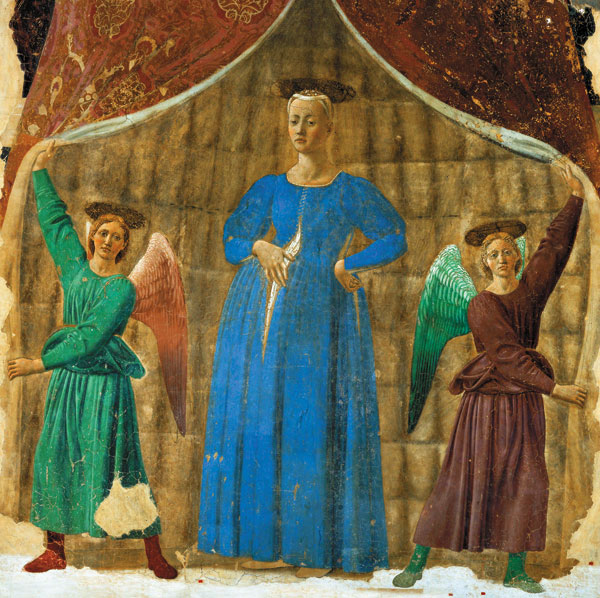
Obviously, the idea that this Virgin is pregnant presents no problems. Mary’s pregnant belly figures naturally in Christian art, the most famous example arguably Piero della Francesca’s Madonna del Parto,2 which the hand of the Virgin here seems consciously to echo as it draws the viewer’s attention to the golden child in her belly—golden, of course because the infant Jesus is precious and holy.
But, you might counter, “She’s naked! Isn’t this just plain disrespectful?” Here is where some long-standing Christian theology comes in, because the Virgin’s nakedness evokes important Christian dogmas. First, as early as the second century, church fathers such as Justin Martyr and Irenaeus—both saints, by the way—drew parallels between Mary and Eve. According to God’s plan of salvation, they explained, Eve’s disobedience brought sin and death, but Mary’s obedience to God brought salvation and eternal life; where fallen Eve’s nakedness symbolized sin, the Virgin’s “yes” made it possible for human nakedness to regain its Edenic innocence and purity. This is why the earliest Christians were baptized in the nude; in their very nakedness the newly baptized defied the shame of sin.
Even before church fathers promoted the Eve-Mary parallel, however, the Virgin Mary played a key role in arguments against the very first Christian heresy (i.e., a belief condemned by church leaders as incorrect) called Docetism. Docetists found repugnant the idea that Jesus had suffered on the cross; they insisted on the full divinity of Jesus and claimed that Jesus only seemed (the Greek word dokein means “to seem”) to suffer and die. Other Christians (the ones whose theology won out) insisted, as Christians do today, that Jesus was both human and divine; Jesus’ suffering and death as a human being on human terms is what atoned for the sins of humanity. Around 107 C.E., Ignatius of Antioch fulminated against the Docetists—he called them “ravening dogs”—and reminded Christians that Jesus “became also man, of Mary the virgin. For ‘the Word was made flesh’ [John 1:14].”3 In other words, because Mary was human, her son Jesus had to be human, too. No one looking at the Virgin Mother would doubt either her humanity or the humanity of the baby nurtured in her womb. The flesh and blood of the Virgin Mother visualize the essential Christian dogma of Jesus’ humanity.4
Readers might be surprised to learn that another part of the Virgin Mother’s anatomy, namely her breasts, also figures prominently in the Christian understanding of Jesus’ incarnation (i.e., becoming human). Those same church fathers I mentioned above insisted that Jesus “made for Himself a body of the seed of the Virgin … [and] was in reality nourished with milk.”5 In his delightful Christmas hymns, Ephrem of Syria (c. 306–373) describes how the Magi “saw the Son in arms and the pure One sucking pure milk,”6 and he reminds Christians, “Though Most High, yet [Jesus] sucked the milk of Mary.”7 Medieval miracle stories of the Virgin tell of repentant sinners on whose lips Mary actually let fall some of her milk.8 The English poet Joseph Beaumont (1619–1699) envisioned “Jesus Between Mary’s Breasts” where Jesus
… found two beds of spice,
A double mount of lilies in whose top
Two milky fountains bubbled up.
He soon resolved: “And well I like!”
He cries,
“My table spread Upon my bed.”
No wonder, then, that private patrons and church officials alike commissioned so many paintings of Jesus nursing at the breast of the Madonna.

So, in the end, I hope readers understand why I can claim that this odd, initially disturbing, monumental sculpture has a lot to do with the spirit of Christianity. After all, Christians rejoice at the unthinkable, that God was born to a human mother and that a king was laid in a manger. And this helpless baby grew up to turn the world’s values upside down, announcing that “many who are first will be last, and the last will be first” (Matthew 19:30). Perhaps similarly, first impressions can be last, and the last thing you might expect can be true.
Biblical Views: The Economics of Family: Changing Biblical Norms

A recent report by the MacArthur Foundation confirmed what most parents of 20-somethings already know: Young adults in the U.S. are taking longer than previous generations to become financially independent. Those in the 18–34 demographic receive an average of 10 percent of their income from parents, and one-fourth of 25-year-old white males live at home. The median age for a first marriage is now 27 for men and 26 for women, up from 23 in 1980.1
While talk radio pundits and disapproving grandparents blame these delays in reaching the benchmarks of adulthood on permissive parenting and lazy kids, the MacArthur report points instead to the significant economic and social changes in the U.S. since 1970, particularly the “change from a manufacturing to a service-based economy that sent many more people to college, and the women’s movement, which opened up educational and professional opportunities.”2 An economy that reserves good jobs for those with college degrees encourages young adults to focus on themselves before they focus on a family, a perspective that has now extended beyond college graduation into the early 30s.
Clearly, as our economy has changed, so have the messages that we internalize about the “right” family structures. The changes are evident in our own society, but they also can be traced through the various periods of ancient Israelite history. The Hebrew Bible does not reflect only one norm for the family, but several—each arising from a distinct economic situation.3
Before the development of the monarchy, agriculture was conducted by extended families, each headed by the oldest male. The enterprise was extremely labor intensive, requiring the building and maintenance of terraces to allow farming in the hills; the digging of cisterns to collect water for consumption and irrigation; plowing and reaping mostly by hand; and the many steps of grain processing, which alone could take 5 hours a day.
Such an economy encouraged large, harmonious extended families. Children were assets rather than dependents (by the age of eight, children in a farming economy can contribute more energy to the family’s income than they consume in calories). Much worked against longevity in the ancient world. The estimated infant mortality rate was 50 percent, death during childbirth was the leading cause of death for women, and most Israelites suffered from chronic malnutrition.
This type of extended-family system is reflected in several parts of the Biblical record, including the Covenant Code (Exodus 20:22–23:33), the story of Samuel’s birth (1 Samuel 1), and in some of the stories of Israel’s matriarchs, Rebecca, Leah and Rachel (Genesis 27, 30). In these stories, women strive to have male children and often die in childbirth, and the family seems largely on its own for survival. Conflicts arise over procreation and threats to extended family relationships.
During the monarchy, land ownership shifted into fewer hands. Struggling farm families rented out their labor and/or their land to those more successful, and the resulting “patrons” steadily accumulated large landholdings. The monarchy itself owned large estates and demanded tribute/taxes from citizens.
Such an economic system encourages reliance on one’s patron and the state rather than the extended family. The state benefits from weakening family ties when the financially vulnerable opt to serve in the military and/or rent out their labor instead of turning to relatives for help.
The existence of large estates is reflected in the Books of Samuel, Kings and several of the prophets. When Samuel scolds Israel for wanting a king, he warns that a king will take people’s sons for warriors, make men into overseers of his own lands, and seize land and stock to give to his courtiers: “you shall be his slaves” (1 Samuel 8:11–17). Micah rails against those who “covet fields, and seize them; and houses, and take them away; they oppress a man and his house, a man and his inheritance” (Micah 2:2). Deuteronomy, likely written during the monarchy, downplays the role of the extended family by shifting responsibility for punishing crimes from the victim’s family to the elders, and by prioritizing the husband-wife bond above other family ties. In the account of Adam and Eve in Genesis 2 (usually credited to J, a source written during the monarchy), a man leaves his family and cleaves to his wife, while in earlier periods women joined the families of their husbands.
During the Persian period, described in the Bible as the return from exile, large private and monarchical estates were gone. Most land was again farmed primarily by extended families, though Persian officials demanded significant taxes. As in an earlier period of the nation’s history, people’s financial well-being was largely dependent on the success of their extended families.
This return to the extended families is reflected in Genesis 1 and Leviticus, both credited to the P source and believed to be post-Exilic. Here, procreation takes high priority. Genesis 1 charges the humans to “be fruitful and multiply.” Regulations for sexual relations in Leviticus increase the likelihood of procreation by forbidding sex during menstruation, male-male sex, and sex with animals. And the elaborate incest prohibitions regulate the interactions of family members living in close proximity.
Although Biblical materials are often treated as presenting a single vision of “family values,” this overview calls attention to how messages about the Israelite family changed over time in response to economic and social changes. Modern people, it seems, are not alone in having to adjust to a “new normal” of family life.
Biblical Views: Farewell to SBL

“The heart has its reasons, which reason does not know.” This famous line from Pascal’s Pensées draws a wise distinction between religious faith and intellectual inquiry. The two have different motivations and pertain to different domains of experience. They are like oil and water, things that do not mix and should not be confused. Pascal was a brilliant mathematician, and he did not allow his Catholic beliefs to interfere with his scholarly investigations. He regarded the authority of the church to be meaningless in such matters. He argued that “all the powers in the world can by their authority no more persuade people of a point of fact than they can change it.”1 That is to say, facts are facts, and faith has no business dealing in the world of facts. Faith resides in the heart and in one’s way of living in the world.
In the same year as the appearance of the Pensées (1670), another book appeared that changed the practice of Biblical scholarship—Spinoza’s Theological-Political Treatise. In it he showed that the Bible can be the subject of systematic rational inquiry. In the course of his study, he gave persuasive reasons to show that Moses could not have written the Pentateuch. For this and other conclusions, Spinoza was branded a heretic and his book was widely condemned. But Biblical scholarship persisted, and over the last few centuries it has become a full-blooded academic field. Pascal would not have been happy with Spinoza’s conclusions, but in a curious way they agreed on the careful distinction between the paths of faith and reason.
Let’s fast forward to the present. My focus is the Society of Biblical Literature (SBL), the main organization for Biblical scholarship in North America. In recent years it has changed its position on the relationship between faith and reason in the study of the Bible. I think that it has forgotten the lessons of both Pascal and Spinoza, and is falling into a confused domain of dissension and hypocrisy. The problem, as I understand it, has to do with money.
SBL used to share its annual meeting with the major American organizations for Near Eastern archaeology (the American Schools of Oriental Research, ASOR) and for the study of religion (the American Association of Religion, AAR). But due to petty disputes among the leaders of these groups, ASOR and AAR have dissolved their links with SBL. In order to keep up its numbers at its annual meeting, SBL has reached out to evangelical and fundamentalist groups, promising them a place within the SBL meeting. So instead of distinguished academic organizations like ASOR and AAR in the fold, we now have fundamentalist groups like the Society of Pentecostal Studies and the Adventist Society for Religious Studies as our intimate partners. These groups now hold SBL sessions at the annual meeting. The participation of these and other groups presumably boosts attendance—and SBL’s income—to previous levels.
What’s wrong with bringing in such groups? Well, some of them proselytize at the SBL meetings. One group invited some Jewish scholars to their session, asked them if they observed the Sabbath, and handed them materials intended to convert them. And recently the SBL online book review journal (Review of Biblical Literature) has featured explicit condemnations of the ordinary methods of critical scholarly inquiry, extolling instead the religious authority of orthodox Christian faith. Listen to this, from Bruce Waltke, widely regarded as the dean of evangelical Biblical studies:
By their faith in the God of Abraham, Isaac, and Jacob, [evangelical scholars] … hear the voice of higher biblical criticism, which replaces faith in God’s revelation with faith in the sufficiency of human reason, as the grating of an old scratched record.2
This is a quaintly stated position, which directly attacks the applicability of human reason to the study of the Bible. Instead of reason, “faith in the God of Abraham, Isaac, and Jacob”—as interpreted by evangelical scholars—should be the rule in Biblical scholarship. Waltke dismisses critical inquiry as an annoying nuisance, like the scratchy sound of an old LP. This is in the midst of a review of a brilliant scholarly commentary on the Book of Proverbs, written by a Jewish scholar, in the Anchor Yale Bible series.
On the one hand, I give Waltke the respect he has earned as a scholar, and I am happy to listen to his views. But when he says such rationally absurd things as “the factual data validates Solomon’s authorship of Prov[erbs] 1:1–24:33” (which belongs to a post-Solomonic stratum of Hebrew, as Waltke ought to know), and when he asserts that Moses wrote the laws of Deuteronomy (which are written in post-Mosaic Hebrew), we are clearly not in the world of critical Biblical scholarship at all. This is religious dogma, plain and simple.
Why is this a problem? Certainly Waltke is entitled to his views. The problem is that the SBL has loosened its own definition of Biblical scholarship, such that partisan attacks of this type are now entirely valid. When I learned of the new move to include fundamentalist groups within the SBL, I wrote to the director and cited the mission statement in the SBL’s official history: “The object of the Society is to stimulate the critical investigation of the classical biblical literatures.”3 The director informed me that in 2004 the SBL revised its mission statement and removed the phrase “critical investigation” from its official standards. Now the mission statement is simply to “foster biblical scholarship.” So critical inquiry—that is to say, reason—has been deliberately deleted as a criterion for the SBL. The views of creationists, snake-handlers and faith-healers now count among the kinds of Biblical scholarship that the society seeks to foster.
The battle royal between faith and reason is now in the center ring at the SBL circus. While the cultured despisers of reason may rejoice—including some postmodernists, feminists4 and eco-theologians—I find it dispiriting. I don’t want to belong to a professional society where people want to convert me, and where they hint in their book reviews that I’m going to hell. As a scholar of the humanities—and I might add, as a Jew—I do not feel at home in such a place. What to do? Well, I’ve let my membership in SBL lapse. Maybe that’s a cowardly response, but sometimes, as Shakespeare wrote, “The better part of valor is discretion.” Sometimes it’s reasonable to avoid conflict. And like Pascal and Spinoza, I’m partial to reason in matters of scholarship. But my heart, for reasons of its own, gently grieves.
Biblical Views: Searching for a Woman’s Voice in Psalms

Feminist study often calls attention to what is absent, such as a female voice or point-of-view in a particular text. I am using this approach, among others, as I study the Book of Psalms. Upon first, second and even third reading, no psalm from Psalms was obviously recited by a woman. In contrast, tens of psalms deal with “male issues,” such as victory in war. Moreover, the Hebrew grammar does not suggest that any psalm was recited by or on behalf of a woman. Many that look gender-neutral in translation are not so in Hebrew; the Jewish Publication Society translation of the beginning of Psalm 1:1, “Happy is the man who has not followed the counsel of the wicked,” is more accurate than the New Revised Standard Version’s “Happy are those who do not follow the advice of the wicked.” The Hebrew word ’ish is masculine singular “man.”
The Psalter contrasts sharply with other Biblical texts. As opposed to the apparent lack of female voice in the Psalter, the Bible does give many examples of women offering prayers or petitions. When Rebekah is pregnant with the twins Jacob and Esau, Genesis 25:22 notes: “But the children struggled in her womb, and she [Rebekah] said, ‘If so, why do I exist?’ She went to inquire of the Lord.”1 Miriam, the sister of Moses and Aaron, chants a psalm-like song in Exodus 15. Many scholars believe that her Song of the Sea is one of the most archaic texts of the Bible.a In 1 Samuel 1–2, Hannah prays twice; the first is a prose petitionary vow, that if God gives her a son, she will return him to God (as a Temple servant), followed by a poetic prayer of thanksgiving after Samuel is born. Eli the high priest, upon seeing Hannah mumble the first prayer, thinks she is drunk because she is praying silently (until modern times, prayers were recited aloud). Nothing in the text, however, suggests that he thought it inappropriate or even strange that a woman was praying. Hannah’s prayer becomes paradigmatic for Jewish prayer in later tradition.2 These examples only highlight the absence of women’s prayers in the Psalter.
Comparative evidence from outside the Bible makes this lack even more striking. Prayers by and for women are well known in the ancient Near East, and are also found in later Jewish culture. A collection of them recently became a bestseller in Israel.3 So why is there no obvious precursor to these prayers in the Book of Psalms?
Hannah’s second prayer, 1 Samuel 2:1–10, which was inserted by an editor of Samuel into its current place, is a psalm (poetic prayer) not found in (the Book of) Psalms; it offers us an important clue concerning how women prayed in ancient Israel. On first reading, these verses seem inappropriate to Hannah’s situation. They concern military victory, not childbearing, as attested by references to “bows,” “strength” and “foes.” Its conclusion suggests that it commemorates or prays for royal victory (verse 10): “He will give power to His king, And triumph to His anointed one.” It is hard to imagine this as the prayer actually recited by a woman who finally conceived a child after years of rivalry with a co-wife, and who is dealing with an insensitive husband (see 1 Samuel 1:8: “Am I not more devoted to you than ten sons?”)! What is this militaristic royal psalm doing in Hannah’s mouth?
Most ancient Israelites were illiterate. When they wanted to offer a poetic prayer, they would ask a Levite to offer it up for them; perhaps the person repeated the prayer word-for-word after the Levite. For a small fee, that Levite would look through his “book” and find the prayer most appropriate to the situation. (For additional shekels, a Levite composed a custom-tailored prayer for a wealthy person.) The psalm that was put into Hannah’s mouth includes “While the barren woman bears seven, the mother of many is forlorn” (verse 5). It has competition and victory as its theme; Hannah may have understood this as referring to her victory over her co-wife Peninnah. An editor may have had her say this—it reflects the cultural reality of people offering ready-made prayers. When most people pray, not all words are of equal value—some are moving, and others are often merely mumbled. I can imagine a woman like Hannah reciting 1 Samuel 2:1–10 and weeping from joy at the words about victory, God’s greatness and barren women bearing children, while simply muttering the rest.
The Book of Psalms is a collection of only some of the psalms or poetic prayers that circulated in ancient Israel—so why didn’t 1 Samuel 2:1–10 make it into the Psalter? I believe that the Psalms, largely Temple-based prayers, were written almost entirely by men for men. Women were peripheralized in the world of the Psalter, perhaps reflecting their minor role in the Temple (see, however, Exodus 38:8; 1 Samuel 2:22). One of the Psalms expressly states: “Your wife shall be like a fruitful vine in the recesses of your house; your sons, like olive saplings around your table” (Psalm 128:3; author’s translation). The (male?) children are well grounded, present around the table, while the wife is fertile but not seen, in the recesses of the house—possibly a reference to an inner room or section of the house where women prepared food and wove textiles. The religious participation of women is largely outside the world-view of the Psalter. Women probably had their own prayers, and these have been lost because they were, with one exception discussed below, not collected by the editors of the Book of Psalms, who were either simply not interested in them, or who believed that they were not “appropriate” for inclusion.
The single exception is Psalm 113. It introduces the Jewish liturgical collection Hallel (“praises,” composed of Psalms 113–118), and is often thought to be “the hymn” referred to in Matthew 26:30. Psalm 113 is in Late Biblical Hebrew, a dialect used in the Babylonian exile and beyond, during the Second Temple period. It shares some material with Hannah’s prayer, which states (1 Samuel 2:8): “He raises the poor from the dust, Lifts up the needy from the refuse heap, Setting them with nobles, Granting them seats of honor”; Psalm 113:7–8 states: “He raises the poor from the dust, lifts up the needy from the refuse heap, to set them with nobles, with the nobles of His people.” The similarities between Hannah’s prayer and Psalm 113 are too extensive and close to suggest coincidence. Psalm 113 is chronologically later than 1 Samuel 2, which suggests that the Psalmist copied from Samuel.
The end of Psalm 113 notes: “He sets the childless woman among her household as a happy mother of children. Hallelujah.” I believe that this is autobiographical. The quote from Hannah’s prayer and the psalm’s conclusion suggest that Psalm 113 is a thanksgiving psalm recited by a woman who had finally given birth. Psalm 113 is the exception that proves the rule that the Psalter is male-oriented.
Biblical Views: Jesus Has the Last Word

Last words are always important. There is a whole category called “famous last words,” and no one’s last words in all of human history are more famous than those of Jesus.
In the Christian tradition you will often hear the phrase “the seven last words of Christ.” This actually refers to the seven last sentences or phrases Jesus uttered from the cross. Numerous classical music compositions are based on these words, so great an influence have they had over the centuries on the celebration of Holy Week, and especially Good Friday.
So what were these famous seven last sentences of Jesus?
The first is in the earliest Gospel, Mark, as well as in Matthew. Jesus quotes the opening line of Psalm 22, spoken in Aramaic: Eloi, Eloi, Lema Sabachtani? “My God, my God, why have you forsaken me?” (Mark 15:34; Matthew 27:46). Jesus was not the first nor the last person to feel abandoned when being unjustly executed. According to these two gospels, these are the only words Jesus spoke from the cross.

In Luke’s gospel, however, we have several sentences attributed to Jesus at the crucifixion: “Father, forgive them for they know not what they do” (Luke 23:34) is spoken by Jesus on behalf of the very people who were crucifying him. A little later in Luke’s portrayal, Jesus addresses the so-called penitent thief hanging on a cross beside him. The bandit had asked to be remembered when Jesus comes into his kingdom, to which Jesus replied “Truly, I say to you—today you will be with me in Paradise” (Luke 23:42–43; Paradise was a Jewish metaphor for the highest level of heaven). At the very end, Jesus says to God, “Father, into your hands I commit my spirit” (Luke 23:46).
The Johannine portrayal of Jesus’ last words is different still. First there is the interchange between Jesus and two people standing below the cross—his mother and the Beloved Disciple—to whom Jesus says “Woman, here is your son” and “Here is your mother” (John 19:26–27). Not only was it legal to make a last will and testament from the cross, but Jesus entrusts his mother not to his brothers and sisters, but rather to his most beloved disciple. This comports with the earlier saying of Jesus (from Mark’s gospel) that his mother, brothers and sisters are whoever does God’s will (Mark 3:31–35). After this, Jesus is reported to have said “I thirst” (John 19:28), which is seen as a fulfillment of Psalm 69:21—“They gave me gall for food, and gave me vinegar for my thirst.” This is sometimes compared and contrasted with the beginning of the account in Matthew 27:34, but these passages are talking about two different drinks. In Matthew the beverage is a drink with a narcotic in it, meant to dull the pain but at the same time prolong the agony of crucifixion, and when Jesus tastes it, he refuses it. In John 19:28 the drink is a jar of wine vinegar, which was the Gatorade of its day, used by soldiers in the heat to slake their thirst. Although the allusion from Psalms does not sound positive, in this case Jesus readily drinks when it is offered to him on a sponge soaked with it. Finally, in the Fourth Gospel, after Jesus drank this wine vinegar, he said “It is completed [or finished]” (John 19:30), meaning he had completed his life’s work and could now commend his spirit to God.
Biblical Views: What’s Up with the Gospel of Thomas?

New manuscript discoveries continually expand our knowledge of what was actually going on in antiquity. The accommodation of this new knowledge can sometimes require us to create new histories. Yet as a Biblical scholar, I am constantly faced with the fact that our old academic models die hard. Why? Because there is a general resistance to changing previous understandings of the Bible based on the discovery of “new” nonbiblical manuscripts. For one thing, the religious view that the Bible is old, trustworthy and sacred has become a cultural icon in our society. Second, not only are believers invested in maintaining traditional faith, but scholars are invested in maintaining their previous academic opinions.
I have noticed that new manuscript discoveries are often labeled in a way that diminishes their importance, both in religious communities and in the academy. Scholars determine that these manuscripts “post-date” the Bible, allowing them to be tabled. They are called “Gnostic,” by which these scholars mean that they were written by “heretics” who corrupted the scripture and were purged from the Church because they refused to worship the creator god YHWH and instead turned to pay homage to the “one god” who they believed existed beyond the universe.a They are thought of as “forgeries,” a legal term that identifies their authors as criminals who falsely assumed apostolic identities. What this might mean for 2 Thessalonians, Colossians or Ephesians (all claiming Paul’s authorship but likely not written by Paul) rarely crosses our minds, because Biblical letters can’t be forgeries. They are either “anonymous” or “pseudonymous.”
Largely because of this resistance, it can take scholars decades to figure out what a manuscript means and put in place a new model that makes sense of the new evidence. It can take even longer for this new model to become common knowledge, distributed outside the academy.
A case in point is the Gospel of Thomas. It was one of more than 50 texts that were discovered in 1945 by Bedouin in the Egyptian desert and came to be known as the Nag Hammadi codices.b Unlike the canonical gospels, it does not contain a narrative of Jesus’ life and ministry but rather is a collection of Jesus’ sayings, some of which are also recorded in the canonical gospels. It was immediately labeled Gnostic, late, secondary, Biblically dependent and inauthentic. Just as old models die hard, so, too, do first impressions last; today, if you open up almost any general book on the Gospel of Thomas, you will see that this is how it is still described. Yet during the intervening 50 years since it was first published, we have worked very hard to understand this text. We struggled with the Gnostic label for a long time until we realized that the Gnostics weren’t a single group and that the Gospel of Thomas represents none of the various types that did exist (Sethian, Valentinian or any other Gnostic Christian community) because it lacks references to distinctive Gnostic mythologies, including the hallmark feature that the God of worship is not the creator god YHWH, but a god beyond our universe.
If it isn’t Gnostic, then how do we explain the fact that the text has an esoteric orientation, is pro-celibacy, demands that the faithful remain unmarried, and favors a view of the end of the world as “realized” (as many Gnostic texts do)? The Kingdom and the New World are not events of the future, but have already come without anyone noticing.1 So the disciples ask Jesus, “When will the dead rest, and when will the new world come?” Jesus replies, “What you look for has come, but you have not perceived it” (Thomas 51).2 As in the Gospel of John, Jesus has already cast the fires of judgment upon the world.3 Jesus demands that his followers seek visions of God before their deaths in order to have immortality, saying, “Gaze upon the Living One while you are alive, in case you die and (then) seek to see him, and you will not be able to see (him)” (Thomas 59).
Believers will not see Jesus coming with the clouds, as was taught by other Christians. Rather, he would appear to those who remake themselves as children—unafraid and shameless:
His disciples said, “When will you appear to us? When will we see you?” Jesus said, “When you strip naked without shame, take your garments, put them under your feet like little children, and trample on them. Then [you will see] the Son of the Living One and you will not be afraid” (Thomas 37).
This teaching invokes the Genesis story in which Adam was viewed as a child before the Fall. In the Gospel of Thomas, to return to the garden as a primordial Adam meant that you had to renounce your body and embrace celibacy. The ideal state necessary for visions of Jesus is a retooled state of the individual, not of the cosmos.
The type of religiosity found in the Gospel of Thomas is not all that unusual. You can find references to it in Biblical and nonbiblical literature. It is nothing more than an early Christian expression of mysticism that developed out of an earlier, apocalyptically oriented Christianity that wished for the immediate end of the world. When the end didn’t happen, the Christians were forced to rethink and rewrite their cherished apocalyptic teachings.
Texts like Luke-Acts (Acts 1:6–8) show us that some Christians chose to delay the end indefinitely by creating a lengthy period of the church and its ministry before the end would be able to come. Other texts like Matthew’s gospel (24:36) rationalized that the end would come, but not even the Son knows when. Still others like John and Thomas collapsed the end into the present, so that the old world ended with the end of Jesus’ life, and the new world began with the church, which was now experiencing all the promises of the kingdom. In the case of the Gospel of Thomas, the Christians were trying to live as they thought they would at the end of time—like the angels in heaven. So they gave up marriage and sex and believed that their bodies were already being transformed into the glorified spiritual bodies of the resurrection. Intimacy with God, visions of Jesus, equal status with angels, the new world, life-beyond-death were already theirs.
We can even locate this mystical form of Christianity historically. It is a form that developed in eastern Syria in the late first and early second centuries, a form of Christianity that was an heir to early Jewish mystical traditions and a precursor to later Eastern Orthodoxy. I think that Thomas’s “place” in early Christianity was misidentified originally not because it represents a type of Christianity unfamiliar to the canonical tradition or deviant from it. The Gospel of Thomas was wrongly identified at first because Western theological interests controlled its interpretation within a Western Christian framework that could not explain its unfamiliar, mystical structure. Yet we now know—in part from manuscript discoveries like the Nag Hammadi collection—that there was a multiplicity of groups, beliefs and traditions in the diverse early Christian communities. Scholars who misunderstood the Gospel of Thomas mislabeled it as Gnostic in order to lump it together with other traditions they thought to be strange, heretical and late.
Old models die hard, but die they must.
Author’s Note: This column is based on my research: Seek to See Him (Leiden: Brill, 1996); Recovering the Original Gospel of Thomas (New York: T&T Clark, 2005); “The Gospel of Thomas,” Expository Times 118 (2007), pp. 469–479; “Mysticism and the Gospel of Thomas,” in Jörg Frey, Enno Edzard Popkes and Jens Schröter, eds., Das Thomasevangelium (Berlin: Walter de Gruyter, 2008), pp. 206–221.
Biblical Views: Judaism—Back to Basics

“You never get too good for the basics.” Some such caution will be familiar to anyone who has trained in a sport, musical instrument or language. We understand that we will have to get through the basics at the start. The hard part is realizing, months or years into training, that we can never leave behind those building blocks: working endlessly on balance and form; constantly practicing scales; struggling with the unsexy conjugation of verbs.
It is the same with academic work. Important insights have originated in the teaching of introductory courses. That is where we come to grips over and over again with the most basic tools and evidence of our disciplines. Each year, as our specialized research and writing progress, we return to the basics with new eyes. And the constant questioning of these foundations, by us and by our students, can expose weaknesses in the fundamentals. I suggest that one of our most rudimentary categories, ancient “Judaism,” could benefit from rethinking.1
In the study of ancient Judea, there is no more basic category than “Judaism.” It seems obvious: ancient Jews practiced Judaism. Since there was a Greek word, Ioudaismos, which looks like “Judaism,” some scholars have suggested that Jews were unique among the ancients in embracing an –ism (there was no Romanism, Athena-ism, Isis-ism, etc.). Our debates have been focused on whether we should speak of early, middle or (surely not) late Judaism, rabbinic, Palestinian, normative, common or sectarian Judaism. And should it be Judaism, or Judaisms, as some scholars have proposed?
But there is a problem. In a search of the more than 9,000 texts available in the Thesaurus Linguae Graecae,2 the noun Ioudaismos appears 342 times. Of these, all but five (i.e., 337) are in Christian texts, and 331 of those are from the third century or later. Of the five occurrences in Jewish texts, four are in a small work of only 15 chapters: 2 Maccabees (2:21, 8:1, 14:38); the other is in 4 Maccabees (4:26), which is derived from 2 Maccabees. The Latin form Iudaismus appears exclusively in Christian authors from the third century on, and there was no ancient Hebrew or Aramaic equivalent.
Let’s pause to take this in. In spite of the ubiquitous talk of ancient Judaism, the possibly corresponding ancient terms appear exclusively in Christian literature, aside from 2 and 4 Maccabees. We find no “Judaism,” then, in the many Greek and Latin texts by observers of Judea and Judeans. It does not appear in Josephus’s 30 volumes, which are devoted to explaining Judean law and culture, or in the roughly comparable library of Philo. The word is absent from Biblical and post-Biblical (apocryphal and pseudepigraphical) texts outside 2 and 4 Maccabees.
Without going further, we can already say confidently that Ioudaismos was a significant part of later Christian discourse, and nearly absent elsewhere. As for the few appearances in 2 and 4 Maccabees, we seem to have only three options: (a) The author of 2 Maccabees coined Ioudaismos for “Judaism” but his experiment did not catch on until the Christians revived it; (b) it was in wide use but by some fluke does not surface in other literature; or (c) the author of 2 Maccabees did not use Ioudaismos to mean “Judaism.” We may set aside (b) as highly unlikely, given the concentration of Ioudaismos in 2 and 4 Maccabees and its absence everywhere else, leaving us to decide between (a) and (c).
The specific purposes and context of 2 Maccabees require us to prefer (c). Greek nouns ending in –ismos are deceptive. They do not indicate “isms” in the English sense of ideologies or belief systems (Anglicanism, Buddhism, atheism, Stalinism), but rather actions. For example, the verbs ostrakizō, Attikizō, Lakōnizō, exorkizō and baptizō produce nouns ending in –ismos, which are best translated as gerunds. We see this in their English descendants: ostracism is the action of ostracizing as baptism is the action of dunking.
Further, the subgroup of these terms that pertain to cultures, such as Mēdismos, Attikismos and Lakōnismos, had decidedly negative connotations. They had become popular words in the political strife that racked the Greek cities during the fifth century B.C.E. They referred to the defection of cities or individuals to the Persian, Athenian or Spartan cause. Although such capitulation may have been unavoidable, it was inglorious. Greek Ioudaismos would most readily be understood, therefore, as a similar alignment with Judean interests. Although Greeks and Romans did adopt Judean culture often enough to attract outside comment, that comment was invariably hostile because faithfulness to one’s ancestral traditions—whatever that tradition—was considered a bedrock value in the ancient world.3 Invoking the politically loaded term Ioudaismos, if it did not bring a sneer, would raise an eyebrow.
Why, then, would the author of 2 Maccabees have used such a term? This work was composed in a unique moment of Judean history. The same author was also the first to use two other –ismos words: Hellēnismos (“Greek-izing”) and allophylismos (“foreign-izing”). It cannot be a coincidence that these neologisms share the same brief narrative with Ioudaismos. In the story, the other two words refer to the discreditable activity of Judean leaders, who abandon their ancestral customs to embrace foreign Greek traditions (2 Maccabees 4:13, 6:24). I would argue that Ioudaismos appears as the countermovement of the Hasmonean priests, who revolt against this “foreign-izing” priestly leadership. In this context, the author ironically describes their program as “Judaizing”—Jerusalem, its desecrated Temple (by Antiochus IV Epiphanes in 164 B.C.E.) and its leadership—to drive home the point that these should have remained Judean from the start. That Ioudaismos found no use among later Judeans or their observers is no more surprising than that its counterpart allophylismos (“foreign-izing”) had no later uptake. They were brilliant coinages of the moment.
Two centuries after 2 Maccabees was written, and in a completely different world, two Christian authors (who were likely familiar with that work) reactivated Ioudaismos for their rhetorical purposes. Both the apostle Paul and Ignatius of Antioch exploited the inherently negative connotations of Ioudaismos as adherence to Judean interests.4 Their gentile Christian followers were becoming keen on Judean ways, and they wanted them to stop.
Although Paul devotes much space in his letters to Judean law and culture (e.g., in Romans), it never occurs to him to use Ioudaismos in those contexts because the word did not mean “Judean law, practice and belief.” He uses the term only in the context of Galatians, where he describes his past efforts—before his own miraculous conversion—to persecute the early followers of Christ and bring them back to Jewish law and practice (Galatians 1:13–14). Paul had long since abandoned this “Judaizing,” whereas Peter and James were still advocating circumcision and adherence to the law for all newly baptized Christians—a practice that Paul finds problematic (Galatians 2:14, 6:12–14). Ignatius faces the same issue. But after presenting Judaizing (Ioudaismos) as the problem, he coins another –ismos word for the ironic antidote. For him—standing 2 Maccabees on its head—“Christianizing” (Christianismos) is the proper activity for Christians, not this alien Judaizing (Ioudaismos).
This linguistic move by the prestigious bishop of Antioch begins to explain later Christian interest in Ioudaismos. Christians went through a long period of social and political vulnerability during the first and second centuries because they did not fit into existing social-political categories. (Ignatius was writing en route to his execution.) They could not say “we are a religion” because no such category existed. Nor were they—unlike the Judeans—a recognized nation (ethnos) with ancestral city, temple, altar and priest-led cult. They were merely a voluntary association, and such clubs were inherently suspect and vulnerable to local authorities.
By the early third century, Christians in many locations were beginning to enjoy a measure of security and strength. This encouraged such thinkers as Tertullian of Carthage to begin reshaping their self-understanding and, along with that, their lexicon. Tertullian saw a new potential in Ignatius’s “Christianism.” He began to use its Latin form (Christianismus) for something much more than a clever alternative to Judaizing: It could stand for a whole system of belief and practice (i.e., Christianity). Although the category had not existed before, a true –ism was born.
Part of the attraction of creating this new category of –isms was that it invited the shaping of the rest of the world in comparable terms. So were born “Judaism” (Latin Iudaismus) and “paganism” (paganitas), reducing the two great cultural traditions against which Christians had struggled for so long to a more manageable size. Paradoxically, Christians appear to have invented both Judaism and paganism.
Biblical Views: The Writing on the Wall

A fascinating session at last year’s annual meeting of the Society of Biblical Literature (SBL) in Boston was dedicated to graffiti, especially early Christian graffiti in Izmir (ancient Smyrna), Turkey.
But what counts as graffiti? Does the word “graffito” imply something clandestine, something possibly illegal, like the defacing of a building by modern graffiti artists in major American cities?
Ancient graffiti were basically of two types: (1) advertisements for politicians or for various sorts of businesses—often for sex or for the sale of property; (2) religious comments, usually about and for minority or illegal religions or philosophies. We can also distinguish between graffiti that were meant to be timely and were therefore put up only in a semi-permanent way (e.g., painted on a wall) and graffiti that were meant to have a longer shelf life (inscribed into stucco, stone or brick).
The amount of ancient graffiti is surprising, if not shocking. For example, scholars have identified some 10,000 political advertisements in Pompeii! One wonders if the ancient Pompeiians lamented as we do the “billboards” besmirching the beauty of their landscape. If we count up all the graffiti in Pompeii, there seem to have been more writings on the walls than inhabitants within them! Considering the amount of graffiti evidence (usually not the work of the upper classes) plus the evidence on ostraca (pottery sherds with writing on them), this suggests a higher level of literacy in the Greco-Roman world than previously suspected. Usually estimates are that between 10 and 15 percent of the population could read and write. This is likely a very conservative estimate.
In my judgment there is a difference between the ability to read and the ability to write. Reading seems to have been a more widespread skill than writing in the first century. Writing was more of a specialized art, especially when it involved engraving texts into hard surfaces, which would require a skilled scribe or artisan. Propaganda graffiti surely assumed that a significant segment of the population could read the inscriptions.
One of the most enlightening lectures at the SBL session was Roger Bagnall’s “New Graffiti from Smyrna in the Context of Early Christianity.” He concentrated on what was found in a basilica basement in the vast Smyrna agora. (In the Roman world a basilica was a type of public building, often a hall of justice; only later was its architectural pattern taken over by the church and used as a design for churches.) The basilica had collapsed in 178 A.D. due to a massive earthquake but was later reconstructed. The part of the basilica Bagnall focused on comes from the late first and early second centuries. Plaster or stucco covered the walls that had graffiti on them. The assortment of graffiti was considerable, focusing on sex, love, civic pride, politics and religion, all jumbled together.
One of the most interesting of Bagnall’s examples reads ό δεδωκως πvεύμα (“the one who has given the Spirit”—namely Kyrios, the Lord Jesus). Bagnall claims that this is probably the earliest evidence of Christian graffiti ever discovered. What was the function of this graffito, inscribed in a public place? It does not seem to have been an advertisement to bring in outsiders, but rather for insiders (Christians), who knew the key clichés, phrases and code words to make sense of the graffito. To insiders it announced that there were Christians in the city with whom other Christians could socialize and worship.
The reason for the coded communication is obvious. It could be dangerous to be an early Christian in ancient Smyrna. Polycarp, a bishop in Smyrna in the first and second centuries, after surviving an attempt by the authorities to burn him at the stake, was stabbed to death.
Christianity was categorized as a superstitio in the Roman Empire before Constantine legalized it in the fourth century, and as such Christians were subject to persecution, prosecution and occasionally execution. The Christian graffiti in Izmir are significant because they confirm both the early presence of Christians in that city and their need to communicate in code.
The papers at the SBL session also help us to understand the level of literacy in the early Christian world. That world was by no means populated only by “women, slaves and minors” (i.e., the illiterate) as we might assume from the polemics of Greco-Romans who despised early Christianity. On the contrary, Christians left their mark not only through epistles and gospels, but also through graffiti.1
Biblical Views: Giants at Jericho

We all know the words of the old spiritual: “Joshua fit the battle of Jericho, and the walls came a-tumblin’ down.” According to the Biblical account of the conquest of Jericho, Joshua and his troops marched around the city once a day for six days; on the seventh day they marched around it seven times, and on the seventh circuit they blew their horns and shouted. “When the people heard the sound of the horns, the people shouted a mighty shout, and the walls fell down” (Joshua 6:20). This is a climactic moment in the Israelite conquest of Canaan. Once the walls of Jericho came tumbling down, the other cities fell like a row of dominoes.
But did it really happen? This has been a vexed question in the history of Biblical archaeology. According to the best interpretations of the archaeological evidence, Jericho was destroyed around 1550 B.C.E.1 and was not settled again until after 1000 B.C.E.a But the emergence of Israel dates to around 1200 B.C.E., right in the middle of this 500-year gap. If Joshua and his troops had surrounded Jericho, there would have been nobody home.
Biblical archaeology—if such a thing really existsb—involves the rigorous correlation of textual data from the Bible and material evidence from archaeology. We must take the best interpretations of both sets of data in order to see what kinds of correlations or patterns are present. The case of Jericho is usually taken as a notorious instance where the Biblical and archaeological data don’t connect at all.
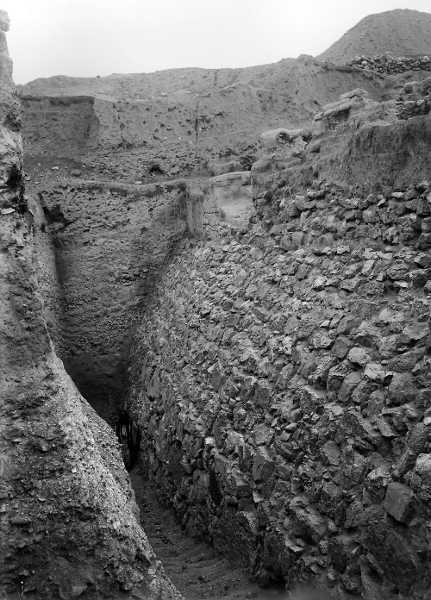
Or do they? I suggest that they do connect in a remarkable way. The problem is that the Biblical evidence hasn’t been sifted properly to yield the correct connection with the archaeological evidence. In my understanding, the walls of Biblical Jericho have been visible all along. It is the Biblical story itself that has forgotten or suppressed a key detail that makes the correlation apparent.
The insight that, in my view, solves this problem was first proposed by a pioneer of Biblical archaeology, G. Ernest Wright. In an article from 1938 with the delightful title “Troglodytes and Giants in Palestine,” Wright observed:
Pausanias [a second-century C.E. Greek geographer] tells us that the great walls of Mycenae, Tiryns and Argos were constructed by the giant Cyclopes … Hebrews viewing some of the cities of Canaan, which we now know to have possessed walls as thick as eighteen feet, and often built of cyclopean masonry, might well have thought in terms of giants, just as did the Greeks.2
In other words, the Israelites would naturally have thought that the giant “cyclopean” walls of many old, ruined Canaanite cities (including Jericho) must have been built by giants. From this they reasonably concluded that the original inhabitants of Canaan were giants.
This conclusion is borne out by many Biblical texts. For example, when Moses sends spies to scout out the Promised Land, they report back:
The people who live in the land are powerful, and their fortified cities are very large, and indeed we saw giants there … All the people that we saw in it are men of great height … We seemed in our own eyes like grasshoppers, and so we must have seemed in their eyes.
(Numbers 13:28, 32–33)
The scouts seem to trace the ancestry of these giants back to the antediluvian marriages between “the sons of God” and human women, whose offspring were mighty warriors called Nephilim (see Numbers 13:33 and Genesis 6:4).c
The prophet Amos also testifies that the original inhabitants of Canaan were giants, whom Yahweh destroyed in the Israelite conquest. Amos says in a divine oracle: “I destroyed the Amorites before them, whose height was the height of cedar trees, and whose strength was like an oak” (Amos 2:9).
King Og of Bashan was one of these aboriginal giants. According to Deuteronomy 3:11, his bed could still be seen on display in the city of Rabbah: “It is nine cubits long and four cubits wide, according to the ordinary cubit.” This translates to 13.5 feet long and 6 feet wide—a bed fit for a giant!
Against the backdrop of these scattered memories of the original giant inhabitants of Canaan, we can fill in the background to the story of Jericho. The walls that survived into the Israelite period were huge, and so their inhabitants would seem to have been giants. We now know that these cyclopean walls were built during the Middle Bronze Age (2000–1550 B.C.E.), which is precisely when Jericho was last occupied before the Israelite period.3 The Israelites saw these ruined walls (which had been destroyed hundreds of years earlier) and knew that giants must have lived there. The Israelites remembered—as Amos recalls—that Yahweh destroyed these giants before them. According to the story of Jericho, the walls fell in a great miracle. Perhaps it didn’t happen exactly how or when the Biblical writer said, but the Israelites believed that Yahweh, the Israelite God, destroyed the city without Joshua and the army having to shoot a single arrow. According to the story that was passed down, after the walls fell, the Israelites “utterly destroyed all that was in the city by sword—man and woman, young and old, ox and sheep and ass” (Joshua 6:21).
The story fails to mention that the men and women, young and old, were thought to be giants. But if we are warranted in supplying this missing piece of Israelite memory based on the other Biblical stories of giants in Canaan, then we have a clear link between the Bible and the archaeological evidence of the massive walls of Jericho. They were the same ruined walls that we can still see today, and they are still breathtakingly huge. It is easy to see why the Israelites would have thought—as Wright observed—that they were built by giants. And when the walls came tumbling down—well, that must have been a great story.