
Biblical Views: Breaking the Trend of Biblical “Breaking News”

Scholars and the general public alike have grown accustomed, perhaps even hardened, to sensational announcements every year that have something to do with the Bible, Jesus or Christian origins. From The Da Vinci Code to the supposed tomb of Jesus and his family, and the seemingly annual reports about finding Noah’s ark or the Ark of the Covenant, much of the news in our field is incredible—literally. And, of course, several artifacts (such as the Jehoash inscription and the James Ossuary inscription) were widely publicized before being declared forgeries—although the evidence in support of forgery is far from conclusive (see Strata).
In light of all of this noise, I would not be surprised in the least if the public interest in Biblical scholarship and archaeology begins to wane. Future discoveries, even important ones, may well be met with cynical responses such as “We have heard this before.” How is the average person supposed to know when a truly remarkable discovery has been made?
This brings me to the stone inscribed with “Gabriel’s Revelation,” recently published in BAR.a This remarkable find required no hype. Yet the impulse to sensationalize the find, complete with extravagant claims, is already well underway. This is unfortunate.
Ada Yardeni, a respected epigrapher, dates the stone and its two columns of inked Hebrew script to the late first century B.C. or early first century A.D. In her BAR article she stated that if this text “were written on leather (and smaller) I would say it was another Dead Sea Scroll fragment.”1 Her initial transcription and translation make it very clear that this text is important and deserves careful study.
Yardeni’s interpretation is cautious. She describes the text as a vision, a string of prophecies, evidently by someone named Gabriel, addressed to someone in the second person. Several passages of Scripture are alluded to or quoted in part. The focus of the vision seems to be Davidic and may be messianic.
Contrasting Yardeni’s cautious interpretation is Israel Knohl’s daring thesis that the Gabriel vision foretells the appearance of a suffering Messiah son of Joseph, a concept that served as a sort of template for Jesus. After all, Jesus was a “son of Joseph” (Luke 4:22; John 6:42), so surely he understood himself in this light. According to Knohl, this explains why Jesus saw himself as a messiah who would suffer and not as a conquering Messiah son of David.2 This seems to me a rather shaky line of reasoning.
Knohl has certainly done a great deal of research into the tradition of the suffering Messiah son of Joseph, but is this messiah even present in the Gabriel text? That is far from certain. Neither “Joseph” nor “son of Joseph” appears in the surviving text, and it makes no mention of a suffering figure.
Even if we agree with Knohl’s interpretation of line 80 (“In three days, live, I, Gabriel, command you”)b as referring to resurrection, who is being resurrected? The text says it is the “prince of princes”; there is nothing here about a Messiah son of Joseph. One should bear in mind that Knohl’s reconstructions and interpretation lend significant support to the thesis of his book The Messiah before Jesus,3 a thesis that has not escaped serious criticism.4
And what can all this tell us about Jesus’ own self-understanding as messiah? Very little, it seems to me. In all probability the expression “in three days, live” alludes to Hosea 6:2, where the prophet assures the beleaguered nation “on the third day he will raise us up, that we may live before him.” This passage later came to be understood as a reference to the day of resurrection. I believe Jesus also alluded to this passage from Hosea when he spoke of being raised up “on the third day” (Matthew 16:21; Luke 9:22). It is indeed interesting that both Jesus and the author of the Gabriel text used similar prophetic language, perhaps referring to resurrection, but I see no reason to link Jesus with the Messiah son of Joseph or the Gabriel text on this basis.
No doubt this interesting debate will continue. The Gabriel text may turn out to be truly significant and of great interest to Jews and Christians alike. It could certainly contribute to our understanding of early Judaism and extra-Biblical prophetic texts around the turn of the era. But we scholars owe it to ourselves and to the public to make sure that careful study of the stone and its properties is undertaken before we start propounding theories that may go well beyond the evidence—particularly in connection to Biblical figures. Priority should be given to further analysis of the text, including the possibility of recovering words and letters no longer visible to the naked eye, locating the site from which it was taken (if possible), and study of the site itself. Perhaps after further study we will be better able to understand the origins and context of this and other fascinating artifacts—without resorting to sensational scholarship.
Biblical Views: Of Philistines and Phalluses

“There is in the Hebrew Bible, in prose and in poetry, in religious admonition and in secular love songs, a healthy and unabashed outspokenness which, in a sense, constitutes one of the great glories of the Old Testament.”
I quote scholar Edward Ullendorff’s 1979 article “The Bawdy Bible”1 to prepare the reader for some explicit examples of the Bible’s “unabashed outspokenness.” Blame it on Aren Maeir’s article in BAR’s May/June 2008 issue about the Philistines and their trouble with “hemorrhoids.”a The discovery at the Philistine cities of Gath (Tell es-Safi) and Ashkelon of situlae (small vial-shaped flasks) in the form of uncircumcised penises (see photo) led Maeir to propose that the five golden ‘opalim (nowadays the vulgar Hebrew term for hemorrhoids) that the Philistines delivered to Israel as guilt offerings for capturing the Ark of the Covenant were actually golden versions of Philistine phallic situlae (1 Samuel 6:4). As Maeir states in his article, the cultic contexts in which the tiny vessels were found indicate the “symbolic importance of the phallus in Philistine culture.” The Philistines offered Yahweh golden penis-shaped vessels because, theorizes Maeir, God had afflicted them with some form of penile dysfunction.
The Hebrew text may support this: In Hebrew, 1 Samuel 5:9 specifies that God smote the men (’anshe) of the city, not the New Revised Standard Version’s “inhabitants.”
The tale of the golden phalluses is only one of several episodes in 1 Samuel that feature the phallus either literally or in double entendre. Let me try to explain why and how.

First Samuel describes both Israel’s struggle against Philistine domination and “good-guy” David’s struggle with “flawed” King Saul. In the ancient world, arguably the most powerful metaphor for political and military authority was male sexual potency. Even on the individual level, a man’s honor depended on the public perception of his dominance over his women. (Even today the stereotypical drill sergeant goads raw recruits as “ladies” to shame them into becoming potent fighting “men.”)
When the Philistines send the golden penis-jars off to Israelite territory—one for each of the five Philistine cities—an Israelite would understand that Yahweh had asserted his dominance over all Philistia. First Samuel 6:5 even says that Yahweh’s hand (yad) had been heavy upon the Philistines and their gods. The wicked double entendre here is yad; the Hebrew word can also mean penis,2 and so, by extension, the Philistine men (women don’t count here) have been emasculated.
Envisioning a similar scene of submission, Jeremiah 50:37 is a bit more to the point: “A sword against her horses and against her chariots, and against all the foreign troops in her midst, so that they may become women!” The phallic swords in this passage that pierce the foreign troops suggest what the sly prophet means by “become women.”
Furthermore, while the sexual political metaphor was ubiquitous in the ancient world, the phallus took on an added significance in relations between the Israelites and the Philistines. One way the Israelites defined themselves over against the Philistines was by the differences in their penises.3 The Israelites were circumcised and the Philistines, alone of Israel’s neighbors, were not; in 1 Samuel “uncircumcised” and “Philistine” are interchangeable. Circumcision embodied Israelite ethnic identity. How appropriate, from an Israelite’s point of view, that in presenting Yahweh with golden ‘opalim, the traumatized Philistines appeared to surrender the essential symbol of themselves (a bit like surrendering the flag).
A full appreciation of two other episodes in 1 Samuel depends on an awareness of these phallic connotations. First, in 1 Samuel 18:25 King Saul imagines he can eliminate David by tempting him with marriage to his daughter. The catch, in true fairy tale fashion, is the impossible quest. David must produce a dowry of 100 Philistine foreskins. According to the Hebrew text, David more than succeeds and triumphantly delivers 200 foreskins, “which were given in full number to the king” (18:27). I remind my students that David was no mohel (a professional circumciser) and would not have bothered to separate the foreskins from his victims’ genitals. David’s phallic feat would suggest to an Israelite audience that (1) David could unman and un-Philistine the Philistines, and (2) beside Saul, passively seated on his throne, David clearly was more of a man (literally; he had 200 extra penises) and by logical extension more qualified to rule Israel.
The other story concerns the death of Saul during the battle on Mt. Gilboa. Already pierced by multiple Philistine arrows and writhing in pain (the verb is also used for labor pains), Saul begs his armor bearer to run him through with his sword “‘so that these uncircumcised may not come and thrust me through, and make sport of me’” (1 Samuel 31:4). When the armor bearer cannot bring himself to treat his superior so disgracefully, Saul falls on his own sword. What Saul dreads is emasculation, whether symbolic or literal (the text is ambiguous), at the hands (so to speak) of the uncircumcised Philistines. The Hebrew hints at Saul’s worst imaginings with the sexually suggestive verb, “make sport.” The fact that King Saul manages to die without technically being killed by the Philistines allows him to preserve some degree of honor for himself and for the Israelites he represents. Indeed, when the Philistines find Saul’s corpse, none of the abuse they inflict upon it (1 Samuel 31:8–10) has a sexual subtext.
Over the millennia since 1 Samuel was composed, we humans have yet fully to advance beyond equating male sexuality with power, a way of thinking that most would agree is not “healthy,” to return to Ullendorff’s adjective. On the other hand, Professor Ullendorff wrote his article to promote a richer appreciation of the Biblical text, which is never a bad idea.
Biblical Views: “Rocks of Unevangelized Lands”

In 1856 Dartmouth College, which is both my alma mater and the institution where I teach, became home to six relief slabs that originally decorated the walls of the Assyrian palace of King Ashurnasirpal II (883–859 B.C.E.). This palace had been discovered in 1845 amid the ruins of Ashurnasirpal’s capital city of Nimrud, about 20 miles south of modern-day Mosul, Iraq , by the British adventurer-cum-archaeologist Austen Henry Layard.
If you know Dartmouth, you know that it—like several other educational institutions that received Ashurnasirpal reliefs (Amherst, Bowdoin, Middlebury, the University of Vermont, Williams)—is a relatively small school located in what was, in 1856, the hinterlands of rural New England. Yet if you know the larger corpus of Ashurnasirpal’s reliefs (a catalog of about 320), you know that they are among the crown jewels of major world museums: the British Museum, the Louvre and the Metropolitan Museum of Art. You also know that these reliefs are treasured because of their magnificent imagery and exquisite workmanship, which vividly demonstrate how grand the palace that first housed the panels must have been. It was at least 258,000 square feet (24,000 meters square) and included a stunning banquet room overlooking the Tigris River.
So how did reliefs from this most splendid palace end up in the various remote outposts of New Hampshire, Maine, Vermont and Massachusetts? The answer, in part, has to do with the sheer number of relief panels that Layard’s excavations uncovered and the fact that his major sponsor, the British Museum, quickly ran out of space for displaying them. The Museum thus instructed Layard to send only reliefs whose images did not duplicate exemplars already in their collection, leaving Layard with a surplus. At about the same time, the American Board of Commissioners of Foreign Missions received permission from authorities of the Ottoman Empire to open a station in Mosul.2 The first American to be dispatched, in 1850, was Dwight Henry Marsh.
Because of his missionary bent, Marsh’s imagination was seized by Layard’s discoveries and “the illustration which they afford of passages in Holy Writ.”3 Marsh further believed that the full significance of this “illustration” was unappreciated. The British had focused only on the reliefs’ ability to “illuminate obscure passages” in the Hebrew Bible (by comparing, for example, the bird-headed, winged figures of the Assyrian panels to the descriptions in Ezekiel 1:5–11 of winged creatures with the features of a man, lion, ox and eagle).4 Marsh, however, embraced the reliefs’ “evangelizing” potential: the possibility that Ashurnasirpal’s reliefs could encourage viewers, including American college students, to commit to the Christian faith, first, by proving to them the “truth” of the Bible (since the very Nimrud from which Ashurnasirpal’s reliefs came—or Kalhu/Calah, to give the city its ancient name—is mentioned in the Bible, in Genesis 10:11–12). More important, Marsh believed the reliefs would prove the superiority of Biblical religion (based on his assumption that any viewer of the reliefs would immediately cede that the ineffable God of the Bible was far more worthy of devotion and worship than the reliefs’ winged geniis).
Thus Marsh, after securing for Williams College two of Layard’s surplus relief panels (and the first two to reach the United States, in 1852),5 wrote to the college’s president about the edifying effect he hoped these images would have on Williams students as they considered “the glory of the incorruptible God changed into an image made like to corruptible man and four-footed beasts and creeping things.”6 Likewise, Henry Lobdell, a missionary-physician, joined Marsh in Mosul in 1852 and shortly thereafter procured reliefs for Amherst, his alma mater.7 Lobdell described Nimrud and kindred sites as “perpetual monuments … of the truth of Scriptural prophecies” and claimed that “the servants of the one living and true God … find in them … witness to the truth of the Old Testament Scriptures.”8
Whether the six reliefs that came to Dartmouth actually had the effect on the institution’s students that these missionaries intended, however, is a matter of some debate. For, although Dartmouth’s reliefs were acquired for the college by Austin Hazen Wright, a missionary colleague of Marsh’s and Lobdell’s, any plans this churchman had for using Ashurnasirpal’s reliefs for their “proselytizing potentialities”9 seem to have been overridden by Oliver Payson Hubbard, Dartmouth’s librarian and Wright’s major contact at the college. Hubbard’s reason for bringing “these most interesting relics”10 to the college was instead historical: The reliefs could bring to life “the Kings and race of Ancient Nineveh”11 and in so doing, bring to life the political, cultural, social and religious world in which the Bible arose.
I mentioned above that Dartmouth is my alma mater; it’s also the alma mater of several other contemporary Biblical scholars whose names may be familiar to the readers of BAR—for example, W. Boyd Barrick, Eric Cline, Robert Gagnon and Eric Meyers—as well as some of the great Biblical scholars of the early part of the 20th century, most notably Francis Brown, author of the Brown, Driver and Briggs Hebrew and English Lexicon of the Old Testament. Because we’re a small school, this surfeit of biblicists among our graduates has always taken me a bit by surprise, but I’ve come to think Oliver Payson Hubbard had something to do with it. By bringing the world of the Bible to Dartmouth more than 150 years ago, Hubbard inspired generations of Dartmouth students to take the study of the Bible back out into the world.
Biblical Views: A Text Without a Home

If you have been paying attention to more recent translations of the Gospel of John, you will have noticed that John 7:53–8:11—the story of the woman caught in adultery of whom Jesus says, “Let him who is without sin among you be the first to throw a stone at her”—has been getting some interesting treatment by the scholars. The TNIV (Today’s New International Version), for example, tells us very forthrightly that our earliest and best manuscripts of the Gospel of John do not include these much beloved and belabored verses. If text determines canon, by which I mean the original inspired text of that gospel is what should be in the canon, then John 7:53–8:11 ought not to be in our Bibles.
The evidence that it was not an original part of this gospel is clear. The verses are absent from a wide array of early and diverse witnesses (papyrus 66, papyrus 75, Aleph [Codex Sinaiticus], B [Codex Vaticanus] and a host of others), and there is evidence that some manuscripts of John place these verses after John 7:36, some after John 7:52, some after John 21:25, and one manuscript even has it in the Gospel of Luke after Luke 21:38! This text was so beloved that numerous later scribes were trying to find an appropriate gospel home for it. But this is not the end of the story.
It was the judgment of Bruce Metzger and his textual committee, which produced the United Bible Societies Greek New Testament in various editions, that “the account has all the earmarks of historical veracity.”1 I quite agree. In fact this story not only reflects Johannine style, it reveals to us the character of Jesus—his way of balancing mercy with justice that we know from other passages not in doubt as to their original place in a canonical gospel. This surely is one of the “many other things Jesus did” referred to in John 21:25. There just wasn’t room to include them all on the original papyrus scroll of the Fourth Gospel.
Translators are notoriously conservative. They tend to follow like sheep the example of what previous translators have done about including this or that disputed bit of the New Testament, even when they know it is textually dubious. Such is the case with John 7:53–8:11. You will be hard-pressed to find any English translation that leaves this story out—despite its textual history—though increasingly the translators are warning us (as in the TNIV) that it was not in the original text. In a parenthesis that is right in the text, it says, “The earliest manuscripts and other ancient witnesses do not have John 7:53–8:11.” This is what you call truth in advertising, but if it is not in the original, why didn’t they put these verses in a footnote or in the margin?
What do I, a practicing Christian and New Testament scholar, do with this story when it comes to teaching and preaching it? On the one hand I think it is historically authentic, dealing with a real episode in the life of Jesus, and on the other hand I know it did not make the cut when the original author or editor compiled this wonderful gospel. Well, for me, since I am only supposed to be preaching “the Word of God,” by which I mean what is clearly in the canon, I will not preach on this text, because text determines canon. I will, however, use the story to illustrate some other gospel text I am preaching on, to reveal the compassionate nature of Jesus. In a teaching setting where the issue is what Jesus actually did say and do, I am free to use it for historical, theological and ethical purposes.
Finally, some may be wondering, “Why all this fuss over one text? Why do I need to know this wasn’t an original part of the Gospel of John?” My answer is that if one believes that the Bible is concerned with truth, then one needs to be honest about that truth, about what we do know about it, and what we don’t. I don’t think it much helps the church, the synagogue or anyone to hide the truth, on the assumption that “they can’t handle the truth!” If memory serves, Jesus thought otherwise. He trusted the judgment of his audience, and so should the translators of the New Testament. This is not a matter of liberal or conservative, and it’s not part of a conspiracy to deprive someone of a beloved historical story. It’s about being faithful and honest about and to the one who said, “I am the way, the truth and the life.”
Biblical Views: Forgers and Scholars—Unlikely Bedfellows

Like other readers of BAR, I look forward to the news about forgeries and fakes. There’s something deliciously dangerous about these affairs, involving characters who are a hybrid of scholars and criminals. This is the world of Humphrey Bogart (a.k.a. detective Sam Spade) in The Maltese Falcon: Is this bird statue a real antique treasure, or is it a fake or even an antique fake? Who are the mysterious connoisseurs, collectors, enforcers and experts? Why do good guys (scholars, detectives) sometimes turn into bad guys? Who is playing whom as a sap? Like a film noir, everything seems shadowy and dramatic.
The dance between scholars and forgers goes a long way back, with many fascinating byways. It can even be argued that modern historical scholarship—including Biblical scholarship—owes some of its most important practices to the pursuit of forgeries. In other words, the scholars and the forgers are codependent (to use a trendy term), not only in the commission and detection of crime, but in the very practice of historical inquiry. This is why the Renaissance scholar Anthony Grafton calls the forger “the criminal sibling” of the historical critic.1
The most famous moment in the rise of historical criticism in the Renaissance was Lorenzo Valla’s unmasking of a forged text known as the Donation of Constantine. In this text the emperor Constantine (fourth century C.E.) purportedly donated a large part of his empire to the pope. By carefully scrutinizing its Latin usage, Valla showed that this text had not been written in Constantine’s time, but was a medieval forgery. The forger was presumably a papal scribe who was advancing the pope’s claims to political power.
Valla observed—with evident glee—that the forger betrayed himself by using words that were not used during Roman times, such as “satrap” (provincial governor):
Numbskull, blockhead! Do the Caesars speak thus; are Roman decrees usually drafted thus? Whoever heard of satraps being mentioned in the councils of the Romans? I do not remember ever to have read of any Roman satrap being mentioned, or even of a satrap in any of the Roman provinces.2
By carefully combing the text for its diction, style and grammar, Valla was able to demonstrate that its historical provenance was not ancient Rome. He had shown how to detect when a text was written, by a grand demonstration of historical criticism. This was a major intellectual triumph, paving the way for the growth of historical criticism in the Renaissance and beyond. This was a coming-out party, in which the scholar vanquished the forger, and a famous piece of political propaganda was exposed.
The political stakes of modern forgeries are usually less momentous, but there is good money in it, so forgeries proliferate. We should celebrate the historical criticism that rises to this constant challenge. As the forgers become better, so do the scholars. Forgery is, in this respect, a spur to good scholarship, just as it was in Renaissance times. To read the scholars’ criticisms of the Jehoash inscription or the “brother of Jesus” inscription on the James ossuary or the inscription on the ivory pomegranate that says “belonging to the house [of Yahw]eh, holy to the priests,” is a rare treat. It is a drama of erudition, insight and critical thinking, renewing the vigor of historical criticism.
Without the forgers, the scholars would lack the challenge to ply their craft at its highest level. Even an authentic document needs the possibility of forgery as an incentive to keep the focus tight. The Dead Sea Scrolls were initially thought to be medieval texts—or even modern forgeries—but the best scholars of the time methodically proved their antiquity. They demonstrated the historical reality of this ancient trove, shedding new light on a vanished past.
Is it real or not? This question keeps us sharp and keeps the tools of historical scholarship in good repair. We benefit from the presence of forgers. But we don’t want them to sleep well at night. They need to know that savvy scholars—like Sam Spade with a Ph.D.—are on the case.
Biblical Views: Should Palm Sunday Be Celebrated in the Fall?

During the first century, Christians did not believe that the official calendar of Rome, or the local calendars that honored the deities of various cities, marked real time. In their minds, the only time that mattered was eternity and the moment when God would dissolve this world in a final judgment that would bring his own people into Paradise. They were convinced that Jesus had been the first person to make this transition.
Baptism emerged as a key Christian ritual. Baptized Christians who had prepared themselves to follow Christ, after an extensive period of study, prayer and fasting, shared in his death and resurrection on Easter, the Sunday after Passover. They, too, would someday join him in Paradise.
The logic that joined Passover, baptism, and Jesus’ death and resurrection is a principle of the entire liturgical calendar of Christianity that endures to this day in the penitential season of Lent.
Liturgical logic, rather than historical reason, often guides the Gospels. The result is sometimes disagreement from gospel to gospel, and sometimes outright anachronism. John’s gospel presents Jesus’ death at the time the paschal lambs were slain, just before the Passover (John 19:14, 31). The Synoptic Gospels, however, portray the Last Supper as a Seder, the Passover meal when this same lamb was eaten (Matthew 26:17–19; Mark 14:12–16; Luke 22:7–13). Both portrayals cannot be right, and there is good reason to believe both are wrong.
The identification of the Last Supper with the Passover Seder is implausible. No mention is made of the Passover lamb in the account of the Last Supper (much less its selection and preparation days before), nor of the bitter herbs, the unleavened bread (matzah) or the Exodus from Egypt, all of which are formally prescribed in the Book of Exodus (chapter 12) as understood in ancient Judaism. More important, the Temple authorities are presented as deciding not to have Jesus arrested during Passover, but only before or after the feast itself, in order to avoid a riot (Matthew 26:3–5; Mark 14:1–2). That would have been reasonable, because Passover drew tens of thousands of pilgrims and required that the priests keep stricter purity than would be consistent with close dealing with Roman soldiers. It seems clear that Jesus died near the time of Passover, but he must have entered Jerusalem much earlier. In the Gospels, however, his entry and death were tightly coordinated with Passover itself under the later influence of the liturgical practice of the Church.
To think historically, we need to avoid being dazzled by the impression, frequently drawn from a hasty reading of the Synoptic Gospels, that Passover was the only feast that mattered greatly to Jews or Christians. The dominance of Passover in the New Testament is primarily a function of how the Pascha (as Christians called the Passover in Greek, reflecting the Aramaic pronunciation) emerged as the main Christian feast.
Jesus’ entry into Jerusalem is likely to have occurred well before the time of his death in the spring, prior to Passover. His procession at or near the time of Sukkoth (Tabernacles), the great feast of the autumn harvest, would help to explain the texts of the Gospels. Leafy branches dominated by a palm frond (lulav in Hebrew; plural, lulavim) featured prominently in the procession of Sukkoth. The bundle also included myrtle and willow, all of which were waved about with a citron, a lemon-like fruit called an etrog in Hebrew (see Mishnaha Sukkah 3:1–4:5). These bundles of abundance are a key symbol in the gospel scene when leafy branches are laid before the entering Savior (Matthew 21:8; Mark 11:8; John 12:13). Jesus’ entry into Jerusalem is also marked as a ritual occasion by the recitation of material from the Hallel, a group of psalms (Psalms 113–118) that were sung all through Sukkoth. All four Gospels quote slightly varying parts of Psalm 118:25–26. In Mark 11:9 the welcoming crowd sings: “Hosanna!b Blessed is he who comes in the name of the Lord! Blessed is the kingdom of our father David that is coming! Hosanna in the highest” (see also Matthew 21:9; Luke 19:38; John 12:13).
Procession to the Temple with lulav in hand was a requirement of the eight-day Sukkoth festival, even on the Sabbath, because it was an intrinsic part of the festivity (Mishnah Sukkah 4:4). There was a vigorous, sometimes even contentious strain in all this. The same passage of the Mishnah relates that attendants used to scatter lulavim for worshipers to collect as they would, but that led to people fighting over them and even hitting one another with the palm fronds, until that practice was stopped. The problem will be familiar to anyone who has tried to keep order in a Sunday school on Palm Sunday. Although my congregants can find it a nuisance, I have long enjoyed this rambunctious affinity with the genuine setting of Jesus’ entry into Jerusalem.
The Aramaic Targumc of the last chapter of the Book of Zechariah predicts that God’s kingdom will be manifested over the entire earth when the offerings of Sukkoth are presented by both Israelites and non-Jews at the Temple. It further predicts that these worshipers will prepare and offer their sacrifices themselves, without the intervention of middlemen. The last words of the book promise that “there shall never again be one doing trade in the sanctuary of the LORD of hosts at that time” (Targum Zechariah14:21). The thrust of the targumic prophecy motivated Jesus in the dramatic confrontation he provoked in the Temple when he expelled both traders and their animals (Matthew 21:12–13; Mark 11:15–17; Luke 19:45–46; John 2:14–17). Zechariah’s vision of a Sukkoth that restored the land to Israel and the Temple to the sacrifice God desired was a fundamental aspect of Jesus’ purpose during his last months in Jerusalem.
Zechariah 9:9 presents the messianic king as riding on a colt. For a royal figure, garments might well be strewn in the way (2 Kings 9:13). That was all the more natural at Sukkoth in the case of Jesus, who was a descendant of King David (see Matthew 21:4–9; Mark 11:7–10; Luke 19:35–38). In all of this, there is a deep connection between Jesus’ messianic role and the Book of Zechariah. Understanding the historical timing of Jesus’ entry into Jerusalem at Sukkoth opens all this up to us.
Biblical Views: Yahweh as Achilles

Sing “Wrath!” O Goddess; the wrath of Achilles, Peleus’ son,
and its devastation, which laid anguish a thousandfold upon the Achaians.
So begins Homer’s Iliad. But can one draw parallels between Homer and the Bible? I agree with Susan Niditch who, in War in the Hebrew Bible, notes that in the Bible, “heroic warrior material is part of larger narrative patterns that are typical of a cross-cultural range of epic stories about heroes.”1 For example, David’s encounter with Goliath in 1 Samuel 17 follows a story pattern similar to Homeric warrior epic. (In fact, given Goliath’s Philistine ethnicity, he probably could claim an ancestor or two among the Greeks at Troy,a and he might have sung a Philistine variant of the Iliad!) Similarly, the bloody mélée at Gibeon (2 Samuel2) between the soldiers of rival generals Joab and Abner recalls Iliadic skirmishes.
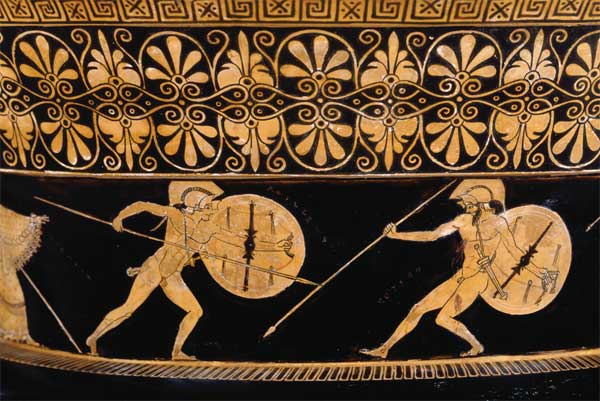
Thanks to some obliging source citations on the part of Biblical writers, we know the names of some lost Israelite documents that apparently contained substantial chunks of Israelite epic poetry.b The Book of Jashar, for example, supplied the snippet of song about the sun standing still at Gibeon (Joshua 10:13) as well as the “Song of the Bow” (2 Samuel 1:18, “David’s Lament”) a composition remarkably close in style and spirit to Achilles’ outpouring of grief over his slain companion, Patroklos. Compare Achilles in Iliad XVIII:
… my dear companion has perished, Patroklos,
whom I loved beyond all other companions, as well as my own life.
I have lost him …2
with David’s song:
Jonathan lies slain upon your high places.
I am distressed for you, my brother Jonathan;
greatly beloved were you to me;
your love to me was wonderful,
passing the love of women.
(2 Samuel 1:25–26)
Perhaps most tantalizing of all is the Book of the Wars of Yahweh, mentioned only in Numbers 21:14. This appears to be the source of three archaic poetry fragments, the last of which taunts the defeated people of Chemosh, Moab’s god and Yahweh’s particular foe in the Transjordanian portion of Israel’s conquest. Unlike the Iliad, whose heroes are human—albeit, like Achilles, sometimes of divine parentage—this lost Israelite document points to Yahweh as Israel’s mightiest warrior. As we know from the oldest strata of the Hebrew Bible, Yahweh was first and foremost a divine warrior. Exodus 15, which may date as early as the 11th century B.C.E.,c expresses this simply: “Yahweh is a man of war, Yahweh is his name” (15:3). In Judges 5, another archaic text, Yahweh commands not only the tribes of Israel but the stars and the Kishon River.
Yahweh’s martial persona also undergirds the seventh-century Deuteronomist’s holy war theology. As laid out in Deuteronomy 20, the Israelite army must “not lose heart, or be afraid … for it is Yahweh your God who goes with you, to fight for you against your enemies, to give you victory” (20:3–4). Furthermore, and most notoriously, “as for the towns of these peoples that Yahweh your God is giving you as an inheritance, you must not let anything that breathes remain alive. You shall annihilate them” (20:16–17). The “ban” (Hebrew, herem) requiring wholesale slaughter did not originate with the rationale provided in Deuteronomy 20 that stresses the necessity of eliminating any trace of abominated Canaanite religious practice. Rather, as Niditch demonstrates, the wholesale slaughter of the defeated enemy constituted a victory thank offering, a sacrifice of the most valuable war spoil, human beings, to God.3
I can express this more colloquially: Yahweh, as the mightiest warrior, is the battle’s MVP (Most Valuable Player) and merits the greatest portion of the spoils. The same “MVP principle” operated in Homer’s warrior society in the form of the geras, the portion of sacrificial meat or war spoils awarded to a warrior as a public expression of his personal honor. Remember that Achilles’ horrific anger is provoked when Agamemnon, the nominal leader of the Greeks, commandeers for himself a captive woman, Briseis, who had already been awarded to Achilles as his geras. Achilles rails at Agamemnon that “always the greater part of the painful fighting is the work of my hands; but when the time comes to distribute the booty, yours is far the greater reward” (I.165–167). As the “best of the Achaians,” Achilles’ wrath boils over; he cannot acquiesce to Agamemnon’s subversion of the warrior code, and he withdraws to his tent, “minded no longer to stay here dishonored and pile up your wealth and your luxury” (I.171). Without Achilles, the Greeks falter.
As classicist Gregory Nagy points out, Achilles burns with menis, a special word for the terrifying wrath of gods, not mortals.4 For precisely the same reason, Yahweh reacts fearsomely to the improper division of the spoils after the fall of Jericho, a victory manifestly won by Yahweh alone (Joshua 6). Because Achan withheld some of the spoils of Jericho, “the anger of the Lord burned against the Israelites” (Joshua 7:1). And then, exactly like Achilles, Yahweh withdraws, abandoning his merely mortal comrades to ignominious defeat at the hands of the men of Ai (Joshua 7:4–5). In the Iliad, Achilles eventually relents, but not before Patroklos is dead and Agamemnon humbled. As for Yahweh, only after the Israelites make suitable amends by stoning Achan with his entire family does the Divine Warrior—the “best of the Israelites”—return to war and inevitable victory. Like Joshua and David, Joab and Abner, Yahweh, too, is an epic hero.
Biblical Views: Sacred Texts in an Oral Culture: How Did They Function?

Ours is a text-based culture, a culture of the written word. You need look no further than your computer screen to verify this. An Internet age is conceivable only if there is widespread literacy, which in turn leads to widespread production of texts.
It may be difficult for us, in a text-based culture, to conceive of and understand an oral culture, much less how sacred texts function in such a culture. However difficult it may be, it is nevertheless important that we try to understand oral culture, since all the cultures of the Bible were essentially oral cultures.
The literacy rate in Biblical cultures ranged from about 5 percent to 20 percent depending on the culture and which subgroup within the culture we are discussing. Not surprisingly then, all ancient peoples, whether literate or not, preferred the living word—which is to say the spoken word. No wonder Jesus said to his audiences, “Let those who have ears, listen.” He never said, “Let those who have eyes, read.”
So far as we can tell, no documents in antiquity were intended for “silent” reading, and only a few were intended for private individuals to read. Ancient documents were always meant to be read out loud, and usually read out loud to a group of people. For the most part, documents were simply the necessary surrogates for oral communication. This was particularly true of ancient letters.
Most ancient documents, including letters, were not really texts in the modern sense at all. They were composed with their aural and oral potential in mind, and they were meant to be orally delivered when they arrived at their destination. Thus, for example, when one reads the opening verses of Ephesians, loaded as it is with aural devices (assonance, alliteration, rhythm, rhyme and various rhetorical devices), it becomes perfectly clear that no one was ever meant to hear this in any language but Greek, and furthermore, no one was ever meant to read this silently. It needed to be heard.
There was a third reason it needed to be orally delivered. Texts were expensive to produce: Papyrus was expensive, ink was expensive, and scribes were ultra-expensive. (Being a secretary in Jesus’ time could be a lucrative job.) Because of the cost of making documents, a letter in Greek often had no separation of words, sentences, paragraphs or the like, little or no punctuation, and all capital letters. Imagine having to sort out a document that began as follows:
PAULASERVANTOFCHRISTJESUSCALLEDTOBEANAPOSTLEANDSETAPARTFORTHEGOSPELOFGOD.
The only way to decipher such a collection of letters was to sound them out—out loud. In St. Augustine’s fourth-century Confessions, he says that St. Ambrose was the most remarkable man he had ever met because he could read without moving his lips or making a sound. In this oral culture, texts were often simply surrogates for oral speech, and this is true of many Biblical texts as well.
It is hard for us to wrap our minds around it, but texts were scarce in the Biblical world and were often thus treated with great respect. Since literacy was an accomplishment only of the educated, and the educated tended to be from the social elite, texts in the Biblical world served the purposes of the elite—conveying their authority, passing down their judgments, establishing their property claims, indicating their heredity and the like. But since all ancient people were profoundly religious, the most important documents, even among the elite, were religious texts.
What do texts in an oral culture tell us about their authors? It is too seldom taken into account that the 27 books of the New Testament reflect a remarkable level of literacy, and indeed of rhetorical skill, among the inner circle of leaders of the early Christian movement. Early Christianity was not, by and large, a movement led by illiterate peasants or the socially deprived. New Testament texts reflect a considerable knowledge of Greek, rhetoric and general Greco-Roman culture.
The New Testament letters are not really letters, though they sometimes have epistolary openings and closings. They are discourses, homilies, rhetorical speeches of various sorts that their authors could not be present to deliver to a particular audience, and so instead they sent a surrogate to proclaim them. These documents would not be handed to just anyone. From what we can tell, Paul expected one of his coworkers, such as Timothy or Titus or Phoebe, to go and orally deliver the contents of the document in a rhetorically effective manner. Only someone skilled in reading seamless prose, and indeed who already knew the contents of the document, could place the emphases in the right places so as to effectively communicate the message.
In an oral culture, words, especially religious words, were regarded not as mere ciphers or symbols. Words were believed to have power and an effect on people, but only if they were properly communicated and pronounced. It was not just the sacred names of God that were considered to have inherent power, but sacred words in general. Consider, for example, what Isaiah 55:11 says: “So shall my word be that goes out from my mouth; it shall not return to me empty, but it shall accomplish that which I purpose, and succeed in the thing for which I sent it.” The Word or words of a living and powerful God were viewed as living and powerful in themselves.1 You can therefore imagine how a precious and expensive document that contained God’s own words would be viewed. It would be something that needed to be kept in a sacred place like a temple or a synagogue, and only certain persons with clean hands and pure hearts would be allowed to unroll the sacred scroll and read it, much less interpret it.
From what we can tell, texts that ultimately became part of the New Testament were treasured during the first century and were lovingly and carefully copied for centuries thereafter. There is even evidence beginning in the second century of the use of female Christian scribes, who had “fairer” hands, to copy and begin to decorate these sacred texts.
Biblical Views: Dishing Dirt

An English garden is a wonderful thing. The flowers and shrubbery are laid out in neat, well-tended rows, attesting to the well-ordered English sensibility. But if you track any of the excellent soil into the house itself or—heaven forbid—the kitchen, then chaos is unleashed. The good soil has become dirt, and penance (and a bit of cleaning) must be performed. My own suburban lawn—which I’m told descends from the proper English garden—is less orderly and lush, but the danger of tracking in the soil still remains. Due to my wife’s encouragement, I have learned to honor the distinction between rich soil and wretched dirt.
The British anthropologist Mary Douglas—who recently died at the age of 86, a week after being knighted at Buckingham Palace—took this simple situation and built upon it a theory of human culture and an explanation of the Biblical food laws. She took the maxim of Lord Chesterfield that “dirt is matter out of place,” and unpacked its deeper implications. The presence of “dirt” displays the boundaries of our categories, including cultural, moral and religious categories. To put it another way, our prohibitions are the bright lines that trace the structure of the cosmos, that is, the experienced cosmos, the world that we subjectively live in. These prohibitions teach, justify and even create the ordered world that we inhabit. To investigate a culture’s system of dirt, therefore, is to explore the cosmos of that culture.
In several books, including her most famous, Purity and Danger,1 Mary Douglas explored the Biblical dietary laws and the Biblical cosmos from this perspective. She argued that the food prohibitions in Leviticus 11 link up, in a nested set of analogies, with the broader structures of the Israelite cosmos and therefore serve as illuminations of the moral principles of this cosmos. The animals that are prohibited as food—such as the camel, rabbit, pig, shellfish and raven—lack the characteristics of the exemplary or prototypical animals in the three cosmic domains of land, sea and sky. These three domains were created as part of the structure of creation in Genesis 1. In these domains, exemplary land animals have cloven hooves and chew the cud, exemplary water animals have scales and fins, and exemplary sky animals seem to be vegetarian. The most exemplary—that is, physically perfect—land and sky animals were also permitted for sacrifice. The sacrificial animals serve as gifts for God’s altar and provide a model for the proper (kosher) food for the Israelite table. In this way, Israel’s food is aligned with God’s food. God is holier than Israel—and God’s sacrificial food must be in a higher state of “wholeness”—but through its daily meals the Israelites in some sense imitate God and align themselves with his holiness. The prohibited animals are the “dirt” that mark and reinforce the boundaries of these nested categories of the moral and cosmic order. By honoring these prohibitions, the Israelites continually enact and celebrate their religious cosmos.
Mary Douglas extended these meditations on dirt and Biblical prohibitions to include broader issues of Biblical culture. She found a systematic contrast between the moral order envisaged by the rules in Leviticus, for example, and the moral order in the prohibitive rules of Deuteronomy. She found that a correlation exists between these moral visions and the social institutions of the books’ authors—the P (Priestly) source for Leviticus and the D (Deuteronomistic) source for Deuteronomy. The priests were a hierarchical institution, and they had what Douglas calls a hierarchical “thought-style.” Priestly speech (i.e., Leviticus) conveys meaning by repetition and analogies, and it asserts its claims by its authority, not by argument. In contrast, Deuteronomy was rooted in scribal schools, which were individualistic institutions in which one was ranked by wisdom and eloquence, not by the circumstances of one’s birth. Deuteronomy conveys its message by persuasive rhetoric, consistently explaining why its rules are right and just. It appeals to inner dispositions—including love and personal memory—to ground its claims. It is a more individualistic thought-style than Leviticus, and it gives a distinctive interpretation of Israel’s religious tradition.
To give a small example, consider the prohibition—the “dirt”—of work on the Sabbath, as formulated in the Sabbath Commandment (Exodus 20:8–11 and Deuteronomy 5:12–15). The Priestly justification of this prohibition links it with God’s creation of the orderly cosmos in Genesis 1: “For in six days the Lord made heaven and earth, the sea, and all that is in them, but rested the seventh day” (Exodus 20:11). The Sabbath is Israel’s reenactment and commemoration of God’s rest in the week of creation. It is, in a sense, an imitation of God and a celebration of the cosmic order.
The prohibition of work on the Sabbath has a different justification in Deuteronomy: “Remember that you were a slave in the land of Egypt, and the Lord your God brought you out from there with a mighty hand and an outstretched arm” (Deuteronomy 5:15). Deuteronomy links the prohibition of labor with God’s deliverance of Israel from Egyptian bondage. The Sabbath celebrates and commemorates freedom from slavery. The reference to divine deliverance is colored by the metaphor of God’s “strong hand and outstretched arm,” an evocative and comforting image. According to this verse, each Israelite personally experienced this act of liberation, for each has a personal memory of it—the verbs “remember” and “(he) delivered you” address the individual Israelite. In the language and thought-style of Deuteronomy, the prohibition of labor on the Sabbath calls to mind the personal experience of each Israelite—and his or her moral conscience—in celebrating this God-given freedom.
The differences between the Priestly and the Deuteronomistic justification of the Sabbath show the subtle differences in their understandings of the moral order of the cosmos and the place of Israel within it. The rule is the same, but its meaning differs. For the one, the Sabbath is part of the structure of creation, which inserts Israel into the cosmic hierarchy. Although Israel is subordinate to God, Israel’s rest is analogous to God’s rest, creating a nested structure. For the other, the Sabbath appeals to personal memory of the Exodus, as if each individual had been a slave and was personally liberated by God. The different emphasis on the collective structure versus individual memory and freedom is characteristic of the difference between the moral worlds of the P and D, and correlates with the distinctive social institutions which support these thought-styles.
In these differences we see the complexity and richness of Biblical culture, which included varied institutions—such as the priests and the scribes—and their respective modes of moral discernment. This example illustrates how Mary Douglas’s theoretical perspective on dirt and culture allows us to read the Bible more richly. The Bible is an intertwining of different thought-styles that each use the prohibition of dirt to define their orientation to God and the world. Mary Douglas shows how the humble concept of “dirt” can mark a garden path into the complexities of the Biblical cosmos—and our own.
Biblical Views: The Archaeology of Rahab

With its many layers and compositional phases, the Bible is often compared to a Near Eastern tell composed of strata accumulated over successive historical periods. However, there is yet another way the Bible can be compared to a tell; namely the layers of interpretation that one Biblical narrative can generate over time. Having attracted its share of interpreters, the story of Rahab the prostitute1 (Joshua 2; 6) exemplifies this process and shows why an awareness of this type of Biblical stratigraphy enhances an appreciation of the Biblical text as a living document.
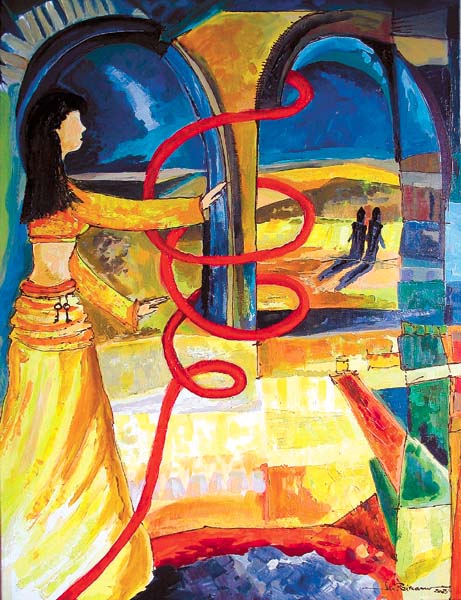
From the perspective of the Deuteronomistic historians (the Deuteronomistic history consists of Deuteronomy through Kings, including the Book of Joshua), Rahab has at least two strikes against her: She is a prostitute2 and a foreign (Canaanite) woman (see Joshua 23:12). Nevertheless, as a number of modern interpreters have observed, the Rahab story succeeds by reversing expectations. Rahab the harlot has always impressed readers as brave, quick-witted and decisive when she hides Joshua’s spies, diverts the king of Jericho’s posse and negotiates her family’s safety on the basis of her faith in the Israelite God Yahweh. Not surprisingly, feminist theologians3 have taken Rahab to heart as a rarity in the patriarchal Bible: a named and independent female hero who even displays a prophetic spirit when she proclaims to the spies, “The LORD [YAHWEH] your God is indeed God in heaven above and on earth below” (Joshua 2:11).
Unlike their modern counterparts, all the ancient Jewish and Christian interpreters of Rahab’s story begin with the assumption that after surviving the fall of Jericho, she repudiated her sinful profession and lived an exemplary life. Her appearance as one of only four women in Matthew’s genealogy of Jesus (Matthew 1:5)a attests to her high standing in first-century C.E. Jewish circles. The Talmudic tradition (Megillah 15a) that Rahab was a beautiful proselyte (a convert to Judaism) who married Joshua also belongs to this stratum of interpretation. The early Christians admired Rahab for similar reasons. For the author of James, Rahab was an example of justification by both works and faith (James 2:25). The author of 1 Clement asserts that she was a sinner saved by her faith (thus providing the prototype of the reformed prostitute that Mary Magdalene became in Gregory the Great’s sixth-century sermon). Justin Martyr favored a typological reading whereby the scarlet thread in Rahab’s window (Joshua 2:18) became an inclusive “symbol of the blood of Christ, by which those who were at one time harlots and unrighteous persons out of all nations are saved” (Dialogue with Trypho 111). And Augustine struggled in his sermon Against Lying to minimize Rahab’s deceit and acclaim her more admirable actions “meet to be imitated.”
In the later 20th century, Norman Gottwald laid the groundwork for ideologically informed readings of the Rahab story when he suggested that by validating a foreign woman, the Joshua narrative subverts the Deuteronomistic historians’ xenophobic theology.4 In other words, despite the Deuteronomistic insistence on an ethnically pure Israel, the story of Rahab, alongside that of the enterprising Gibeonites (Joshua 9), might actually preserve an ancient counter-memory of “foreign” groups being included in Israel’s covenant with Yahweh.
This positive interpretive history of Rahab actually presents an instructive paradox, because if we try to hear her story with truly ancient ears—in other words, as seventh-century B.C.E. patriarchal Israelites—we likely would perceive a less high-toned message. True, the narration refers several times to Rahab’s family by the respectable patriarchal term bet-’ab (“house of the father”), but both her profession—the very factor which enables her to act independently—and the fact that a woman is shown making political and religious decisions for her family thoroughly undercut her family’s claim to honor, the primary social currency of patriarchal societies. Behind the notice in Joshua 6:25 that Rahab’s family has lived among the Israelites “to this very day” lurks an imputation of second-class status on the part of her descendants. Rahab’s story hides within it an ethnic slur reminiscent of the story of Lot’s daughters, who incestuously produce the ancestors of the Ammonites and Moabites (Genesis 19:37–38).
I find this paradox instructive precisely because the later interpretations of Rahab’s story run so counter to its probable original intent, a phenomenon lost on many critics of the Bible. A good example is Richard Dawkins, author of the bestseller The God Delusion.5 A shortcoming pointed out by many reviewers is Dawkins’s simplistic understanding of the nature of human religiousness and, more specifically, of the Bible. Dawkins knows his Bible, but as he rails against claims of Biblical inerrancy, he fails to take into account other interpretive traditions. In fact, the literal approach to the Bible that draws his ire gained momentum only in the last century or so. On the other hand, rabbis, church fathers and Biblical scholars of all stripes have demonstrated for centuries a conviction that a “literal” reading hardly does justice to a living Biblical text whose inherent depths and complexities continue to reveal themselves. Dawkins is right that the Bible’s authoritative status (i.e., as the source of rules) has led to injustice, but interpreters past and present have just as often been able to find meanings that transcend the potentially negative implications of a Biblical passage.6 The prostitute Rahab serves as a case in point.