
Big City, Small Town—Why Size Matters
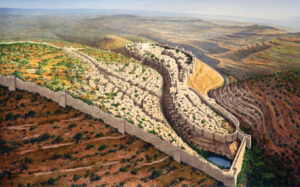
BALAGE BALOGH / ARCHAEOLOGY ILLUSTRATED
With rare exceptions, biblical Hebrew utilizes exactly one word, ‘ir, to reference permanent settlements—everything from tiny villages to giant metropolises. This versatility leads to its frequent use in the Hebrew Bible, where ‘ir appears some 1,093 times. Its broad range of meaning gives us multiple translation options, including “city,” “town,” and “village.” English translations usually render it as “city,” with “town” appearing much less often, and “village” used rarely or not at all. This is not best practice! As we will see, many ‘arim (plural of ‘ir) were villages, not cities or towns, and most other Israelite settlements were in fact towns, not cities.
To translate correctly, we should consider our understanding of the words “city,” “town,” and “village.”1 One factor is the number of residents: the greater the population, the more appropriate are the terms “town” and “city.” The Hebrew Bible utilizes ‘ir to reference settlements of 100,000 or more, including the ancient capitals Nineveh, Babylon, Memphis, and Thebes, which are all unquestionably cities. In comparison, Israelite settlements were not merely small, but tiny. The largest by far was eighth-century BCE Jerusalem, with a peak population of between 12,000 and 25,000. Second was probably the settlement at Tell el-Qadi, identified with biblical Dan (known as Laish in Judges 18:29), hosting 5,000 residents. No other Israelite settlement had more than 3,000 residents, and fewer than 20 had as many as 1,000.2
In addition to population, we must consider regional influence. Villages have little impact on matters beyond their gates; they exist to house and serve residents. Towns garner prominence from elements that attract visitors (e.g., administrative centers, shrines, craft makers, markets). A settlement that contains fewer residents than neighboring villages may yet be designated a town because of its regional prominence. Similarly, cities are like towns, but with greater population and influence as well as major cultural attractions, such as centers of government, learning, and religion. So to select the best English word to describe a particular Israelite settlement, we must consider population and the breadth and depth of its outside influence.
As noted above, the only ancient Israelite settlement that qualified as a city was Jerusalem, and even then, only after the construction of Solomon’s Temple in the tenth century. (Samaria, the capital of the Northern Kingdom, had significant regional influence, but its population probably never exceeded 2,000 people.) Prior to Solomon, Jerusalem was too small to be called a city. Similarly, notable settlements like Bethel (where Jacob established an altar), Hebron (David’s capital in Judah), and Lachish (a heavily fortified settlement in the Shephelah) should be referenced as towns, and sites with fewer than 1,000 residents and little influence are best identified as villages.
How does this translation strategy impact our reading of the Bible? Let’s look at occurrences of ‘ir in the Book of 1 Samuel. The first relates to Ramathaim, Samuel’s hometown and Saul’s first capital. Ramathaim is probably the unnamed ‘ir of Samuel’s residence when Saul visits him in 1 Samuel 9. Whereas 1 Samuel 7 and 8 depict the prophet as a national figure, in chapter 9, Samuel’s prominence appears more regional—in fact, Saul has never heard of him! Ramathaim may fairly be called a “village” in 1 Samuel 1, but its function as Samuel’s home base and Saul’s future headquarters suggests increased prominence that warrants the term “town.”
First Samuel also utilizes ‘ir to describe Shiloh, the home of the Ark of the Covenant and a worship center mentioned some 32 times in the Hebrew Bible, including 1 Samuel 1:3 and 4:13. Although it is important enough to host Eli and draw visitors such as Samuel’s father Elkanah, its small population (under 1,000 residents, based on the archaeological record) suggests that it was a town, not a city.
First Samuel 5:9, 11, and 12 and 6:18 refer to the five principal ‘arim of the Philistines: Ashdod, Ashkelon, Ekron, Gath, and Gaza. In the tenth century, the Philistines, though holding a territory similar in size to ancient Judah, did not have a single capital and instead gathered around these five settlements. Excavations show that Gath and Ashkelon were substantially larger and more industrious than comparable sites in Israel, suggesting considerable influence outside their borders. Yet it is unlikely that any Philistine settlement had a population greater than 5,000, meaning these five ‘arim are best understood as “towns.”
The settlement in 1 Samuel that most merits the designation “city” is the unnamed Amalekite center in 1 Samuel 15:5. Even though archaeologists cannot guess the location envisioned by the author, Saul’s enormous army (numbering 210,000 soldiers!) makes sense only for a sizable target.
Perhaps the most important instance in which we should translate ‘ir as “village” is 1 Samuel 16:4, in which Samuel visits Bethlehem to anoint David as king. There is little archaeological evidence to suggest that Bethlehem was more than a village during David’s time. This goes hand in hand with the important idea that King David came from the most humble of beginnings, born in a place without significance (as in Micah 5:2, another verse in which ‘ir should be rendered “village”). Although it is possible Bethlehem became more prominent in later centuries owing to its strategic location (the site’s fortifications are referenced in 2 Samuel 23:14–17 and 2 Chronicles 11:5–11), it nonetheless seems to have remained a relatively small village throughout the Iron Age.
In 1 Samuel 22, Saul’s men kill all the priests of Nob, 85 men in total. Given verse 19’s description of Nob as an ‘ir of priests, the entire settlement would not have had more than several hundred residents. We do not see indications of Nob’s influence outside of its gates, so it is best understood as a village.
Finally, in 1 Samuel 27, David’s Philistine patron Achish gives him Ziklag (identified as an ‘ir) to house the families of David and his 600 fighters. The location of Ziklag is uncertain; several proposed sites indicate a preexisting settlement with a substantial history. But per the text alone, Ziklag is a village: Its primary function is to house David’s men and their families.
Unquestionably, many occurrences of ‘ir in the Hebrew Bible should be translated “city.” But we need to be careful not to overuse this option. English offers us three main words to designate permanent settlements of varying size and importance. We should use them! Surely, this will help us grasp the biblical authors’ message.
Biblical Bestiary: Dog
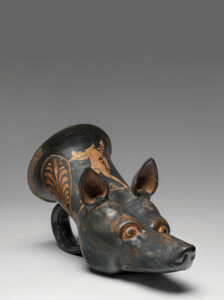
THE J. PAUL GETTY MUSEUM, VILLA COLLECTION, MALIBU, CALIFORNIA; PUBLIC DOMAIN
Favorite family pet and trusted companion, the domestic dog (Canis lupus familiaris) belongs to the same taxonomic family (Canidae, “canines”) as wolves, jackals, foxes, and coyotes. It is a subspecies of the gray wolf that has evolved into hundreds of distinct breeds.
Humans kept dogs as early as the ninth millennium BCE, even before the domestication of sheep, goat, and cattle. As members of the human family, dogs have played roles as hunters, guardians, shepherds, and pets.
Highly appreciated in Egyptian society, pet dogs are frequently depicted in private tombs—active by their owners’ sides or resting under their seats. Captioned with their names in hieroglyphs, some dogs even appear on funerary stelae, where they accompany their masters for all eternity. Hunting hounds, on the other hand, were sometimes exploited for elite sport, while other dogs were intentionally killed and presented as votive mummies to the canid deities Anubis and Wepwawet.
In ancient Mesopotamia, dogs were often associated with Gula, the goddess of healing. Many dog figurines dedicated to the goddess and inscribed with prayers have been found in her shrines. Dog burials appear in cultic contexts, including an entire dog cemetery at the temple of Gula-Ninisina at Isin in modern-day Iraq. The dog’s guardian role is aptly expressed in a Sumerian proverb: “In the city of no-dog, the fox is overseer.”
Despite its positive role in herding and guarding, the dog (keleb) often has negative connotations in the Hebrew Bible, typically as a figure of insignificance. Hazael, the future king of Aram, calls himself “a mere dog” (2 Kings 8:13), and Mephibosheth says to David: “What is your servant, that you should look upon a dead dog such as I am?” (2 Samuel 9:8). In letters to a higher-status person, similar self-abasement was used in formulae of deference. Low esteem for the dog continues in the New Testament, where Jesus admonishes not to “give what is holy to dogs” (Matthew 7:6); or when Paul says about the false teachers, “Beware of the dogs, beware of the evil workers” (Philippians 3:2).
From the Greco-Roman world comes this rhyton (zoomorphic ceremonial vessel) in the shape of a hound’s head. Made in southern Italy around 330 BCE, the vessel is almost 8 inches tall. The painted scene shows a satyr walking with a plate and a fennel rod in what must have been a Dionysian revelry.
Text Treasures: Nimrud Letters: The Royal Archives of Assyria
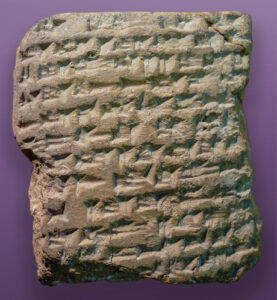
STATE ARCHIVES OF ASSYRIA ONLINE, CC BY-SA 3.0
The Nimrud Letters are cuneiform tablets from the Assyrian royal city of Kalhu (present-day Nimrud). Their contents shed light on the history of the ancient Near East in the second half of the eighth century BCE, when Assyria became a regional superpower that eventually conquered or subdued the biblical kingdoms of Israel and Judah.
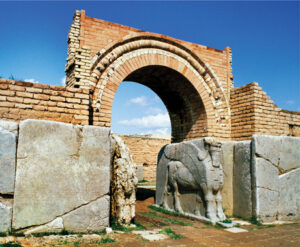
The tablets received their modern name after the place of their discovery, the city of Nimrud, which sits on the east bank of the Tigris River some 20 miles southeast of Mosul in northern Iraq. In the spring of 1952, a team from the British School of Archaeology in Iraq excavated them from an ancient dump beneath the chancery offices of the so-called Northwest Palace, which was established by Ashurnasirpal II as the principal royal residence in his new capital. Despite their secondary location, the tablets likely were originally housed in the same room, since they were part of the Assyrian state archives.
The group consists of almost 300 tablets and fragments, which make up about 230 individual letters. Made of clay and shaped into rectangles to fit the human hand, they typically do not exceed 3 inches in width but vary significantly in length depending on the extent of the text. Most of the letters are written in the Neo-Assyrian dialect and cuneiform script of the Akkadian language, whereas only about 30 letters use the Neo-Babylonian dialect and script. The Nimrud Letters are currently held in the National Museum of Iraq in Baghdad and the British Museum in London.
Most of these letters come from the second half of the eighth century. Although their dating and attribution is not definitive, they mostly represent the correspondence of the Assyrian kings Tiglath-Pileser III (r. 744–727) and Sargon II (r. 721–705). A small portion belongs to Shalmaneser V and Sennacherib when they were both still crown princes.
As correspondence between the Assyrian kings and their military officials and provincial governors, the Nimrud Letters provide a wealth of information on administrative and military matters of the Assyrian Empire. Among the letters’ broad range of subjects are royal building projects, tribute and taxes, international relations, and the distribution of supplies and goods. Curiously, they also elucidate the education and functions of the Assyrian crown princes and the workings of the royal express service facilitated by horses’ and mules. Significant for biblical studies, the letters offer insights into the imperial expansionist politics that led to the Assyrian annexation of Babylonia and other parts of the Near East, including the kingdoms of Israel and Judah. We also learn about deportations of populations from conquered territories—a practice illustrated in the famous Lachish reliefs from Nineveh and mentioned several times in the Hebrew Bible (e.g., 2 Kings 15–18; 1 Chronicles 5).
MICK SHARP / ALAMY STOCK PHOTO
Henry W.F. Saggs, who took part in the 1952 excavations, published an edition and translation of the entire corpus in 2001: The Nimrud Letters, 1952 (Cromwell Press). A much-improved critical edition and translation appeared in 2012: Mikko Luukko, The Correspondence of Tiglath-Pileser III and Sargon II from Calah/Nimrud (Eisenbrauns). A searchable version is available from the State Archives of Assyria Online portal, with facsimiles and photos of the tablets also available online, from the Cuneiform Digital Library Initiative.
Scholars refer to individual letters by their publication acronym (CTN V for Saggs’s edition in the Cuneiform Texts from Nimrud series; SAA 19 for Luukko’s edition in the State Archives of Assyria series) followed by a sequence number. For example, the tablet pictured opposite is CTN V 164, which corresponds to SAA 19 25. In what is the earliest mention of Ionian Greeks in Assyrian sources, Tiglath-Pileser III’s official on the Levantine coast informs the king: “The Ionians came and gave battle … They did not take anything (and) when they saw my troops they embarked their boats and fled into the midst of the sea.”
Losing Abraham’s Religion: More on Israelite Religion in Egypt
© RMN-GRAND PALAIS / ART RESOURCE, NY
In part one of this two-part article,a we considered evidence from within the Book of Exodus that suggests that, in the view of some biblical authors, the Israelites maintained the ancestral religion of the Patriarchs during their lengthy sojourn in Egypt. In part two, we take into account further material in Exodus, as well as in later biblical and post-biblical traditions, that suggests that they abandoned it, at least in part.
The first piece of evidence to consider is the Israelites’ neglect of the practice of circumcision. According to the Pentateuch, circumcision was instituted in and practiced throughout the ancestral period (Genesis 17:10–14). It was the sign of the covenant God made with Abraham and was to be a perpetual ordinance for Abraham and his descendants. Whether or not it was practiced consistently among the Israelites during the Egyptian sojourn—or indeed at any point prior to the post-exilic period—is unknown. Early Jewish interpreters supposed that when Pharaoh’s daughter opens the basket in which Moses has been placed and exclaims that he is a Hebrew (Exodus 2:6), it must be because she observes that he is circumcised. However, some modern scholars have pointed out that since Pharaoh has decreed that all baby boys must be thrown into the Nile, she would surely conclude that any child so abandoned to the river must be Israelite. Consequently, this episode probably provides no clues about whether the Israelites were practicing circumcision during the Egyptian sojourn.
Many years later, when Moses is returning to Egypt after having lived among the Midianites for about two decades, he is traveling with his wife, Zipporah, and his son, Gershom. The text, though difficult, appears to recount that, along the way, the Lord tries to kill Gershom because he is uncircumcised (Exodus 4:24). This would seem to indicate that, as an Israelite, Moses should have already circumcised Gershom on the eighth day after his birth, in accordance with the patriarchal tradition (Genesis 17:12). Clearly, however, he had not.
A second piece of evidence that the Israelites abandoned their ancestral religion may be that they did not practice sacrifice while in Egypt. According to Exodus 5:1, Moses and Aaron petition Pharaoh to let the Hebrews go, so that they can celebrate a festival in the wilderness: “Let us go three days’ journey into the wilderness to sacrifice to the Lord our God, or he will fall upon us with pestilence or sword” (Exodus 5:3). Sekel Tob, a 12th-century midrash, interpolates a Mosaic explanation that “from the time our ancestors left Canaan we have not offered him a single sacrifice.” The implication is that the Israelites could suffer greatly for their neglect of sacrificial worship.
A third clue may be that the Israelites did not know the divine name Yahweh. In part one, I suggested that the ancestors had known the name Yahweh; yet, when God appears to Moses in the burning bush and announces that he is going to send him to liberate the Israelites, Moses asks how he should answer if they ask him the name of the god who sent him (Exodus 3:13). If, as I suggested in the previous installment, the ancestors had known the divine name, why would Moses need to ask it here? Although there are several interpretive possibilities, one suggestion is that, if they had known the divine name in Egypt, they must have forgotten it.
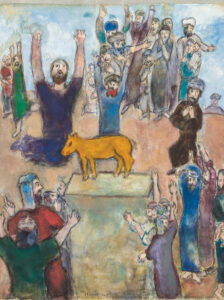
A fourth clue is the golden calf episode. In Exodus 32, when Moses comes down from the mountain with the two tablets of the covenant, he finds the Israelites worshiping an image of a calf. One longstanding view is that the calf was meant to represent Yahweh. But the fact that Moses burns the calf with fire, grinds it into powder, scatters it on the water, and makes the people drink it (Exodus 32:19–20) suggests otherwise. There were numerous bull, cow, and calf divinities in ancient Egypt, and the golden calf probably represented one or more of these.1 That the Israelites would so quickly return to the worship of one of these deities suggests that they had become familiar and comfortable with them during their time in Egypt.
A fifth indication is that of later biblical traditions in which the period of Egyptian bondage was characterized by idolatry. The Book of Joshua claims that, after the people had moved into the Promised Land, Joshua led the Israelites in a covenant renewal service in which he challenged the people to “put away the gods that your ancestors served beyond the River and in Egypt and serve the Lord” (24:14). Apparently, during the period of Egyptian bondage, some Israelites worshiped the gods of Mesopotamia, while others had adopted the worship of the gods of Egypt.
Many years later, in the sixth century BCE, the prophet Ezekiel recounted that, when Yahweh had chosen Israel and swore to them that he would bring them out of Egypt, he urged them to cast away the gods of Egypt, but “not one of them cast away the detestable things on which their eyes feasted, nor did they forsake the idols of Egypt” (Ezekiel 20:8).
In this brief review of biblical traditions related to the questions about Israelite religious practice during the time between the conclusion of the ancestral period and the inauguration of Mosaic religion, we have seen that the evidence is mixed. There are some clues that suggest the biblical writers understood that at least some Israelites maintained the ancestral religion, but there are others that indicate that the Israelites as a whole did not. If this was indeed the case, it only served to highlight for the (later) Israelites their special connection to God as demonstrated in the Exodus and thereafter. As the psalmist declares, yes, their ancestors strayed in Egypt, “yet he saved them for his name’s sake” (Psalm 106:8).
A Thousand Words: Joshua’s Conquest
BRITISH LIBRARY OR 13704, F. 15R / PUBLIC DOMAIN
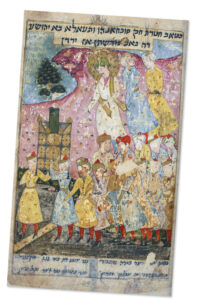
Between the 17th and 19th centuries, a little-known literary and artistic tradition reached its peak in Persia: the production and illustration of Judeo-Persian manuscripts. Texts generally fall into two categories: Hebrew transliterations of great Persian literary works, on the one hand; and original Judeo-Persian poetic compositions, on the other. The language used in these works is a dialect of Persian heavily influenced by Hebrew and Aramaic and written using the Hebrew alphabet.
The manuscript shown here, dating to the late 17th or early 18th century, is a copy of the Fath Nama (“Book of Conquest”), originally written around 1474 by the Jewish-Persian poet Imrani of Isfahan. The text is a poetic paraphrase in Judeo-Persian that aims to render on an epic scale the great biblical narratives in Joshua, Ruth, and Samuel.
A key component of the Judeo-Persian manuscript tradition is the use of miniature illustrations to accompany the text, such as those that appear in this manuscript. Miniature art of this type flourished under the Safavid dynasty (16th–17th centuries) and gained wide-spread use in subsequent periods. This image depicts Joshua and the people of Israel preparing to cross the Jordan River with the Ark of the Covenant. They are dressed in late 18th-century Persian garb. Joshua is in the center at the top, presiding over the crossing; his head is ringed with a stylized halo. Below and to the left, the ark is being carried over the water.
What’s in a Name?: Tiglath-Pileser
PUBLIC DOMAIN, VIA WIKIMEDIA COMMONS
Tukultī-apil-Ešarra
Tukult.ī = “my trust” | apil = “heir of” | Ešarra = “Esharra temple”
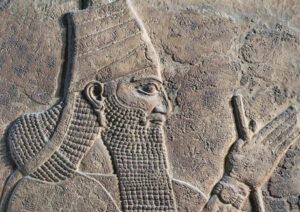
Tukultī-apil-Ešarra is an Akkadian royal name attested in written sources from ancient Assyria and neighboring regions, including Israel and Judah. Its modern spelling, Tiglath-Pileser, is adopted from the Hebrew Bible (2 Kings 15:29), where it appears also as Tilgath-Pilneser (2 Chronicles 28:20).
The name is a nominal sentence, meaning that its predicate is not a verb but a noun, with the verb “to be” implied but not expressly written. In this case, “trust” (tukultu) is the subject, with a first-person possessive suffix (-ī): tukultī, “my trust.” The predicate is the noun aplu, “heir,” further identified as related to Esharra. The relationship (“of,” in English) between aplu and Ešarra is expressed through a construct form (aplu to apil), hence apil Ešarra, “the heir of Esharra.” This gives the phrase “My trust is the heir of Esharra.” But what does this mean?
Esharra was an ancient temple in Ashur, the religious capital of the Assyrian Empire, dedicated to the homonymous Assyrian chief deity, the warrior god Ashur. Assyrians understood the Esharra temple to be ritually connected to an even earlier Sumerian temple to the god Enlil in Nippur. And because Enlil’s son was the warrior god Ninurta, later Assyrian kings associated him with their own god Ashur. On the surface, the phrase “the heir of Esharra” then refers to Ninurta, but the ideological reference is to Ashur. Thus, between these layers of meaning, the name Tiglath-Pileser really means, “My trust is (the god) Ashur.”
Of the three Assyrian kings who bore this name, Tiglath-Pileser III (r. 744–727 BCE) was the most consequential. A central founder of the Assyrian Empire, he transformed Assyria into a superpower that, under subsequent rulers, conquered Babylon and eventually subdued most of the Levant, including the kingdoms of Israel and Judah. In 2 Kings 15:19, Tiglath-Pileser III is called Pul, which reflects his Babylonian name, Pūlu.
Ancient Courts and the Letter of James

IAN TOWNSLEY / ALAMY STOCK PHOTO
The New Testament’s Letter of James has received much less attention than the letters of Paul. Questions linger about the short letter, such as who actually wrote it, when, where, and why. Although there is some consensus about certain aspects of the book, such as its urban background or the author’s indebtedness to Hellenistic Judaism, much of the work continues to garner debate among scholars.
One such debate centers on James 2:1–7, where the author describes two figures: a gold-ringed man dressed in “shining clothes” who enters the assembly, and another fellow in dirty clothes. James states that the well-appareled man receives good treatment from the audience and is graciously offered a seat, while the poorly dressed one is ordered to stand or sit at their feet. For James, such actions manifest preference or partiality for the finely clothed individual, while they dishonor the second man (2:6).
Some interpreters think this scenario, which would be a common enough occurrence in the honor- and status-conscious world of Mediterranean antiquity, reflects a meal setting, while others argue that a worship meeting is presupposed. I contend, however, that the author has in mind a courtroom scene, based on clues in the text itself.1
First, it is worth remembering that courts in the Roman Empire were usually public. This means that legal disputes were on full display to the city’s population. A typical day out for an urbanite might include watching a trial for some time, depending upon how interesting and entertaining it was. A great range of people could therefore observe and become familiar with the various procedures and behaviors that took place in the context of legal disputes. There is no reason to think that someone deeply embedded in Hellenistic Judaism, as the author of James was, would not have watched the drama of a court case unfold before his eyes. And it is clear that those who identified with Judaism, including those who became Christ-followers such as the author of James, were active in metropolitan contexts throughout the Roman Empire.
Although today we might not think of courtroom dynamics as particularly entertaining, they could be in antiquity, because the participants would dress and behave in certain ways to impress or earn the sympathy of the judges or jurors. A well-clad person was advertising their power and status. A person in dirty clothes, such as the figure in James, may have deliberately donned such attire because wearing besmirched clothing was a means of advertising that they had been wronged in some way.
We know of other ancient examples of this practice, such as one described by Seneca the Elder (Declamations 10.1.2), where a young man dresses in soiled clothes and follows around after a rich man who allegedly murdered the youth’s father. The young man has been sued by the wealthy person for libel, and his dirty clothes reflect his defendant status. Similarly, Quintilian also counsels litigants to wear mourning clothes, which usually consisted of garments rubbed in ashes or dirt, as a means of garnering support for one’s cause at court (Institutes of Oratory 6.1.33). Of course, it is possible that dirty clothes might simply point to a person’s indigence, but it is clear that such garb, which could be worn by a wealthy person, could also communicate that an injustice had occurred. James 2:2 indicates clearly that the second man is in dirty clothing, which could therefore signal that he has been wronged in some way.
In Roman courts, benches for judges, jurors, defendants and their supporters, as well as for the audience, could be moved around. Often, the space between the person accused and the judges or jurors was not great, such that defendants could fall at the feet of magistrates and beg for mercy if necessary. One wonders, then, if James’s description of the audience’s poor treatment of the man in soiled dress, ordering him to stand or sit at their feet (2:3), reflects knowledge of the physical features of these courts. Such an order suggests that the audience has made a distinction between the well and poorly dressed men, and thus that they have become judges with evil thoughts (2:5). Taken in by the apparent power and influence of the gold-ringed man in shining clothes, they apparently command the other individual to supplicate at their feet even before he has had a chance to make his case. James condemns such outrageous behavior. Such corruption was commonplace in Roman courts, where preferential treatment of wealthy and high-status people was widespread. In fact, displays of partiality were the norm, not the exception, in ancient courts. In my view, James reflects an awareness of these pervasive injustices.
Some might object to a courtroom scenario on the basis that James refers to a “synagogue” as the place that the two men enter (2:2). However, a variety of activities took place in ancient synagogues, including legal proceedings, and there are indications that Roman and later rabbinic legal proceedings shared things in common. It could be that James has in mind a legal dispute that did not take place within an official court setting, but occurred among members of the audience, in the synagogue. Paul, for example, recommended that the Corinthian church try to resolve their disputes internally (1 Corinthians 6:1–8). But even if James is imagining a legal setting within the group to which he writes, its features, including the dress of the litigants and the physical characteristics of the courtroom (ancient synagogues usually had benches against the walls), could be modeled on the court scenes that he witnessed within the matrix of ancient public life more broadly.
This short discussion may address a minor issue among the many that puzzle interpreters of James. In antiquity, however, to show unjust favoritism within an ancient court, whatever the context, could have devastating consequences, including exile or death for litigants. If a courtroom is the setting for the scenario that James describes in 2:1–7, then it illustrates to what extent acts of partiality were not only a violation of the Torah, but also potentially deadly within such a world.
The Fall of Jerusalem: Who Was to Blame?
LEBRECHT MUSIC & ARTS / ALAMY STOCK PHOTO
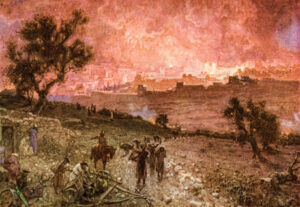
In ancient literary accounts detailing the falls of great cities, the question of where to assign blame typically emerges. Different authors offered different reasons why the gods would allow their city to be conquered. A brief review of this millennia-long historiographic tradition—from ancient Mesopotamia to Homeric Greece—highlights the unique approach of the biblical authors in explaining the fall of Jerusalem to the Babylonians in 586 BCE. Indeed, as we’ll see, the version of Jerusalem’s fall preserved in the Hebrew Bible was likely one of several competing narratives available to its original audience to explain the destruction.1
One Bronze Age tradition about a city’s demise comes from a text known as the Song of Release, which tells of the destruction of Ebla, a Syrian city that had achieved international influence already in the third millennium BCE. Found at Hattusa, the Hittite capital, and dating to around 1400 BCE, the poorly preserved epic includes one key scene describing a conversation between King Meki of Ebla and his council of elders. Meki conveys the storm god’s demand that they release captives from a certain town called Ikinkalis; the god promises victory and prosperity if they do and utter destruction if they do not (compare Deuteronomy 28). One elder rejects Meki’s argument, and the council sides with him (contrast Rehoboam in 1 Kings 12:1–20). This leaves Meki to attempt to expunge his city’s sin by pleading his case before the god’s statue—but to no avail.
This version of the “fall of a city” story absolves the king of all blame and puts it squarely on the backs of the city’s elders, which suggests the song was meant to flatter royal interests. Strikingly, it runs counter to the common Near Eastern storyline, in which it is the cultic failings of the city’s ruler that are to blame for the suffering inflicted on his subjects.
Accordingly, the Sumerian Curse of Agade (c. 2100 BCE) blames the Sargonic king Naram-Sin for the fall of his dynasty (2340–2160 BCE) and its capital city Agade (also known as Akkad) by asserting that he tore down the temple of Enlil. Interestingly, however, the Akkadian Cuthean Legend of Naram-Sin (c. 1800 BCE) responds to the earlier account by presenting the king as well-meaning but understandably resistant to his diviners’ claim that the gods have decided to destroy Agade. Clearly, we should expect that different sets of survivors of fallen cities offered competing storylines when making sense of their trauma.
Elsewhere in the Mediterranean world, the story about the fall of Troy found in Homer’s Iliad (eighth century BCE) incorporates the plot types attached to both Ebla and Agade. One key episode mentioned in the Greek epic parallels the assembly scene of the Song of Release. Apparently, before the main events of the Iliad, the Trojan council of elders refused the demand of the Achaean ambassadors to return Helen because they had been bribed by her seducer Paris (3.204; 11.22–24). Meanwhile, the general plotline of the Cuthean Legend of Naram-Sin is assigned in the Iliad to Hector, who willfully rejects the advice of his augur and refuses to retreat within the city walls, setting up his fatal confrontation with Achilles (12.200–243; 18.253–312; 22.98–107).
In combining different versions of Troy’s fall, the Iliad distributes blame between its council and various members of the royal house. Meanwhile, it suppresses two more versions of the fall of Troy that follow more closely the standard Near Eastern pattern by blaming Troy’s first king Laomedon—either because he rudely sent away Apollo and Poseidon after they had built Troy’s walls (Iliad 7.442–63; 21.436–60; marginal note to Iliad 21.444), or because he reneged on his promise to recompense Heracles for slaying a pernicious sea monster (Iliad 14.249–62; 15.12–35; Pindar, Nemean Ode 4.25–30; Isthmean Ode 6.27–35).
When it comes to the fall of Jerusalem, the biblical authors writing stories of the city’s destruction in the post-exilic period were extremely concerned about assigning blame. By assiduously denying that the kings of Judah (i.e., David’s dynastic line) were responsible and blaming instead the stiff-necked people of Israel (just as the Song of Release blames the city council and absolves Meki), the Bible resists the traditional reasoning of Mediterranean historiography and argues for continued support of the Davidic line.
Still, the biblical scribes included juicy details about the dynasty’s failings, from David’s betrayal of Uriah (2 Samuel 11–12), to Solomon’s catering to the idols of his many wives (1 Kings 11), to Rehoboam’s harsh rule. Apparently, these were too well known to the scribes’ original post-exilic audience simply to be overlooked. Therefore, we can infer that the version preserved for us, which explains how God remains faithful in his commitment to the all-too-human line of David (2 Samuel 7), was originally arguing against a rival version of events in which the failings of the Davidic rulers are to blame, transgressing against God and their own people.
When the exiles returned from Babylon to Jerusalem around 538 BCE, they encountered people now living in the vicinity who opposed the intentions of the newly returned to reinstall priestly families and rebuild the Temple (Ezra 4; Nehemiah 1:2–3). It would have been those people left behind who adhered to the standard storyline blaming the king for the fall of his city, while the returners would have followed a party line congenial to the Davidic court exiled in Babylon. This is the viewpoint—placing blame on the people of Israel—that is articulated by Nehemiah when he prays to God to support his return to Judah in order to manage the restoration of Jerusalem (Nehemiah 1:4–11). No surprise, then, that Isaiah’s and Ezekiel’s excoriations of the people of Israel are what made it into the post-exilic version of events available to us in the Hebrew Bible, and that Lamentations does not dare transfer blame to the Davidic line, even as the mourning voice of Jerusalem passionately describes the brutality of God’s punishment.
Whence-A-Word?: Writing on the Wall
The common phrase “writing on the wall” comes from the biblical story of Daniel and the Babylonian king Belshazzar (Daniel 5) in which a mysterious inscription predicts the king’s impending doom.
In the Book of Daniel, the Babylonian king Belshazzar throws a party for some 1,000 of his noble guests at which he decides to drink from cups that his predecessor, Nebuchadnezzar, had taken from the Jerusalem Temple. Suddenly, a mysterious hand appears, writing on the plaster wall an inscription that nobody seems able to decipher. Then comes Daniel (also called Belteshazzar), who during his exile in Babylon was made the chief of the Babylonian magicians, having explained previously the dream of King Nebuchadnezzar about a tree (Daniel 4). He reads the writing on the wall as mene, mene, teqel, uparsin, translating it as “numbered, numbered, weighed, and divided.”
Paradoxically, the Book of Daniel is one of only two biblical books written mostly in Aramaic. Sixth-century Babylonians would have been able to understand the language, so it is confusing that King Belshazzar and his wise men cannot read the sentence. It could be due to some kind of cryptography, or perhaps they simply do not understand what they are reading. Nevertheless, Daniel interprets the supernatural inscription as a divine judgment against Belshazzar, explaining that God has “numbered” the king’s days, that the king has been “weighed” and found wanting, and that his kingdom has been “divided” and given to the Medes and Persians. Although modern scholars continue to wrestle with the sentence’s grammar, Daniel’s interpretation uses the double meaning of each word’s root letters: mnh meaning both “to count” and “to finish”; tql meaning “to weigh” and “to be wanting”; and prs meaning “to divide” and “Persia.”
In modern usage, the inscription on the plaster wall in Belshazzar’s palace at Babylon signifies something apparently ominous. Sometimes referred to with the shorthand expression menetekel, the phrase “writing on the wall” is synonymous with a clear warning sign heralding someone’s doom or an inevitable catastrophe.
Biblical Bestiary: Locust

PHOTO © HEINI SCHNEEBELI / BRIDGEMAN IMAGES
Locusts are a type of grasshopper that can swarm. Since there is no taxonomic difference between grasshoppers and locusts, they are impossible to distinguish in artistic representations. Of approximately 12,000 grasshopper species, which all belong to the family Acrididae, only 19 can swarm and are considered locusts. Two species have lived in the lands of the Bible: the desert locust (Schistocerca gregaria) and the migratory locust (Locusta migratoria).
Although grasshoppers are solitary winged insects inhabiting grasslands and semi-arid regions of all continents except Antarctica, locusts persist in hot and dry areas, including the Sahara Desert. When conditions are right, locusts change color and transition into the migratory gregarious phase; they then form groups and eventually take to the skies. Riding the winds and consuming their own weight in food every day, locusts can travel great distances devastating crops and pastureland. During such outbreaks, swarms consisting of billions of ravenous insects can cover hundreds of square miles. To this day, locust plagues cause famines and trigger human migrations.
Unsurprisingly, the Hebrew Bible, which uses ten different words to signify the insect or its different stages, portrays locusts as terrible pests (2 Chronicles 7:13; Psalm 105:34–35; Joel 1–2), most famously in the Egyptian plagues narrative (Exodus 10:3–19). In Judges 6:5 and Jeremiah 46:23, enemy armies are compared to swarms of locusts, a common literary theme across the ancient Near East. Although the Torah prohibits eating most insects, it permits eating certain types of grasshoppers and locusts (Leviticus 11:22). Indeed, grasshoppers are highly nutritious and have been consumed in different cultures for millennia. In the Gospels, John the Baptist is reported to have lived on “locusts and wild honey” during his wilderness ministry (Matthew 3:4; Mark 1:6).
Among the rare artistic representations of grasshoppers is this small amulet, now in a private collection. Less then 2 inches long, it is made of lapis lazuli and likely comes from Roman-era Egypt. Other ancient illustrations come from Egyptian wall paintings as well as Assyrian reliefs showing servants bringing locusts to a royal feast.