Congratulations to Mark Fairchild on his spectacular photos of Laodicea and to the Turkish excavators who are doing an amazing job of restoration (“Laodicea’s ‘Lukewarm’ Legacy: Conflicts of Prosperity in an Ancient Christian City,” BAR, March/April 2017). However, I was surprised he did not fully explore the metaphor of “lukewarm” Laodicea. With five nymphaea and four Roman baths, clearly water was both a source of pride and expense.
Laodicea was dependent on outside sources for its water, brought in by aqueduct. Nearby Hierapolis was famous for its hot springs, which you can still enjoy today in the ruins of a Roman bath. There were cold springs in Colossae, also nearby. So whichever the source, by the time the water got to Laodicea it would be lukewarm (even in the church).
Cynthia Burdge, MD Kailua, Hawaii
Learning About Laodicea
Congratulations to Mark Fairchild for his outstanding article on Laodicea. I suspect I’m not alone in wanting to learn the historical story behind the many places, people and practices mentioned in the Bible. This article is a fabulous example of revealing just such historical detail and context. Kudos!
Doug Martin San Diego, California
KING SOLOMON’S TEMPLE
A Symbol to Freemasonry
Your writers Joseph Patrich and Shlomit Weksler-Bdolah describe Charles Warren’s giving the name Free Masons Hall “for some unknown reason” to an “impressive hall about 400 feet from the Temple” (“Old, New Banquet Hall by the Temple Mount,” BAR, March/April 2017).
However, if it should happen that Charles Warren was a Freemason of the 19th century, the reason would not be far to seek. Masonic rituals of both the three basic degrees and many of the added degrees are built around teaching stories purporting to relate to the building of Solomon’s Temple. That the stories are allegories, not history, should be plain from the fact that the first thing a new Mason is taught is that “Freemasonry is a system of morality,” rather than an assertion that it preserves history. However, in the 19th century, much more than today, there were many Masons who took quite literally that their modern Masonic order was descended from the rituals of those masons who built Solomon’s Temple.
Nancy G. Cross Hamtramck, Michigan
Sir Charles Warren was initiated into Freemasonry in 1859 and was involved in various lodges throughout the British Empire.—Ed.
DEPICTING THE MESSIAH’S MOTHER
The Virgin Mary Comes to Light
What a very fine piece of writing by Mary Joan Winn Leith (“Earliest Depictions of the Virgin Mary,” BAR, March/April 2017). I now have a new appreciation for the place and person of Mary in Christian history and tradition. Leith gently lifts Mary, the mother of God, as a singular and unique lady out of centuries of pious themes and remembrances with archaeological support.
Claude A. Weingand Hendersonville, Tennessee
DISRESPECT OR DIALOGUE?
The Misuse of “Misogyny”
Hershel Shanks attempts to prove that the Bible has contempt for women (First Person: “Misogyny in the Bible,” BAR, March/April 2017). He uses the article by Christopher Rollston that gives several examples in the Bible to make that point. What Shanks doesn’t mention, and he should know better, is the context of the cultures in which the Biblical texts were written.
Archaeology is supposed to be the study of those cultures. The world in general did not treat women as they should. The Bible made laws to protect women in those difficult times, even giving a woman who was raped the opportunity to be married and have someone take care of her. Tamar never married because of this very reason but was taken care of by the family of King David.
The books of Ruth and Esther honor great women of old; there is Hannah who by her faith gave birth to the great prophet Samuel, etc. In the New Testament, Jesus surrounded himself with women, many of whom the world had cast off, like Mary Magdalene, who was the first person Jesus appeared to after his resurrection. Hershel and Christopher 056should not be celebrating but weeping for what they have done. This is one more reason I let my subscription expire.
Joe Rubbo Shipshewana, Indiana
BAR Builds Respectful Dialogue
For years now when my frosty-covered Alaskan mailbox delivers my BAR magazine, I become lost to the people I know as I devour every article, test myself against Strata answers and enjoy my hand-held paper media device. My brain enjoys where you take me. Yet this time you moved me emotionally. Hershel Shanks’s “Misogyny in the Bible” was more than an essay on sexism.
More so now than since the McCarthy blacklisting of the 1950s, our world is partitioning itself and building barriers, dividing on tribal DNA, political thought and economic fear—growing hate and anger. We need to see hope and examples. Showing the friendship and respect that Mr. Shanks and Dr. Rollston hold for each other—despite where they live, their religious backgrounds and their professional thoughts—was wonderful. They are what true scientific exploration and debate is about.
Yes, BAR has brought up controversial issues in the past. Great! We need to see the issues as readers. Yet in debate, BAR always respects the thought process and the scholar.
Pastor Rick Cavens Wasilla, Alaska
GRATITUDE BEHIND BARS
A Heartfelt Thanks to BAR Readers
I want to thank not only all of you at BAR, but all the people who responded to the letter of mine that you printed in the magazine (Queries & Comments: “Bible Questions from Behind Bars,”BAR, July/August 2016). I want them to know I’m grateful for the mail. And I’ve learned a lot from their letters!
Stay healthy!
Brett Disiere Amarillo, Texas
Queries & Comments
008
Grave Concerns
Don’t Disrespect the Dead
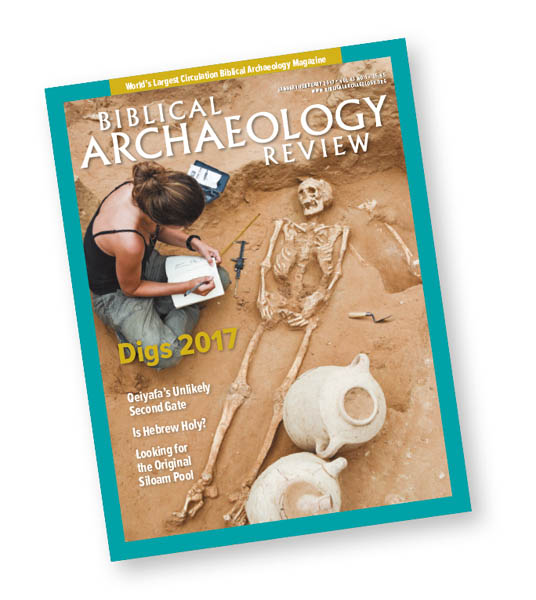
The cover of the January/February 2017 issue confirmed my feelings about your magazine. The skeleton on the cover—head turned, posed with the pottery and tools, looking at the worker taking notes—was contrived and demeaning. Excavating bones or flesh buried for centuries in a far-off land—or digging up my grandfather in Indiana last week—is disrespectful. You should know better.
Duane R. Folzenlogel Indianapolis, Indiana
Bar the Skeletons
I want you to know I enjoy your magazine more than any other I have ever subscribed to. But you might want to consider how many pictures of skeletons you picture. I’m not complaining, but the skeletons of old and unnamed humans are very sad to see.
Joyce Boles Vancouver, Washington
Setting The Record Straight
True Origins of “Biblical Archaeology”
W.F. Albright did not coin the term “Biblical archaeology,” as stated in the January/February 2017 issue of BAR (“Strata: “Who Did It?”). It existed before he was born! The Society of Biblical Archaeology was created in London in 1870, Samuel Birch having suggested its name. The society published nine volumes of its proceedings from 1878 to 1918 and 40 of its transactions from 1872 to 1893. The Oxford English Dictionary does not list any earlier use.
Alan Millard Emeritus Rankin Professor of Hebrew and Ancient Semitic Languages The University of Liverpool Liverpool, England
Cuneiform’s Contribution
In the Eye of the Beholder
I thought I might add something to Laurie E. Pearce’s response to Rod Steffes’ letter (see “Queries & Comments,” BAR, January/February 2017) about the persistence of cuneiform writing (Laurie E. Pearce, “How Bad Was the Babylonian Exile?” BAR, September/October 2016).
Regarding the supposed disadvantages of cuneiform writing and writing materials—“cumbersome,” “clumsy,” etc., are often in the eye of the beholder and would not describe how the system works when used by a trained expert. It’s my impression that in the hands of a skilled scribe, writing cuneiform on tablets could be effortless; I think these scribes had it down pat. I also think it’s easy to exaggerate the advantages of an alphabet.
I’ve been working with ancient Egyptian language and texts since I was a kid hanging out in the Brooklyn Museum’s Wilbour Library, and of all the forms of Egyptian, the one that took me longest to master was Coptic—the only one written in an alphabet! Why? Because it lacks the visual and mnemonic clues that the other scripts use—logograms, determinatives, the distinctive sign choices and configurations of a word. I confess that I had to look up a word in Coptic many more times before I remembered it, compared with what we call the “native scripts.”
Also, I taught in China for six years, during which time my two children went to Chinese school, and they have remained fully bilingual and biliterate. They have never found anything cumbersome about reading or writing Chinese. In the historical notes to his “Judge Dee” detective stories, sinologist and diplomat Robert H. van Gulik remarks on how a skilled clerk recording a meeting, court proceedings, etc., in Chinese is doing something very similar to writing in shorthand.
Edmund S. Meltzer Coeditor, Journal of the Society for the Study of Egyptian Antiquities Adjunct Faculty, Pacifica Graduate Institute Carpinteria, California
Corrections
Sistine Chapel Image
While reading BAR as soon as it came (as I always do), I was glad to learn about the reopening of the Santa Maria Antiqua Church in the Roman Forum (Strata: Rome’s Other058Sistine Chapel,” BAR, January/February 2017). The accompanying exterior photo, however, depicts the Church of Santa Maria di Loreto, across the Via dei Fori Imperiali from the Roman Forum, and not far from the Piazza Venezia. This 16th-century church faces the Forum of Trajan; in fact, Trajan’s column can be seen in your illustration.
David M. Powers Dennis, Masssachusetts
You are correct.—Ed.
Vita Constantini Citation
David Christian Clausen (Archaeological Views: “Mount Zion’s Upper Room and Tomb of David,” BAR, January/February 2017) says that the anonymous Vita Constantini is roughly dated to the tenth century C.E. Yet in the corresponding footnote you list Eusebius, a fourth-century church historian, as its author. Which is correct—fourth or tenth?
An editorial error crept into this article in our attempt to give a full citation of the work. David Clausen references the 10th-century Vita Constantini by an anonymous source—NOT the fourth-century work of the same name by Eusebius.—Ed.
Queries & Comments
008
That’s No Edomite Goddess
A Case of Mistaken Identity
The object on the November/December 2016 BAR cover (and page 39) is identified as an Edomite goddess. Really?! Fess up! It’s really a bust of Woody Allen, isn’t it?
Joseph I. Lauer Brooklyn, New York
Woody Sighting?
Why was Woody Allen on your cover?
Robert D. Dominiec Chicago, Illinois
Many readers have made a similar suggestion.—Ed.
Relics In Rubble
Questioning Crusader Coin Caption
The caption for the silver Crusader coin of Baldwin III in “Relics in Rubble” by Gabriel Barkay and Zachi Dvira (BAR 42:06) says that the coin depicts the Tower of David. As the tower was built some four centuries after Baldwin died, this is most unlikely. Rather, it looks like a portcullis, a fairly common design on Western European coins of the time.
Kevin Akin Riverside, California
Zachi Dvira Responds: The term “Tower of David” refers to the whole citadel compound near the Jaffa Gate and not only to the Ottoman minaret that stands at the compound today. This compound includes fortifications from the time of King Herod and was used since then during all periods, with many renovations and additions. The design on the coin of Baldwin III is probably depicting the citadel as it looked at that time. The minaret that was added in the 17th century is obviously not depicted on the coin.
Numismatist Robert Kool Responds: The tradition of attaching the Herodian tower and defenses with King David had its origins in Byzantine times. It was widely adopted in the Middle Ages, particularly in the Crusader period.
The medieval citadel was the most important fortification in Jerusalem, dominating the city. Whoever held it ruled the city. That is why soon it was held by the kings of Jerusalem.
Frankish kings of Jerusalem saw themselves as the successors of the Biblical Israelite kings, particularly David, whose line would bring forth the messiah, Christ. So their use of the Turris David (Tower of David) on their coinage, particularly their FIRST coinage, was a highly symbolic and political gesture.
Unholy Ink or Sacred Link?
More Biblical References to Tattoos?
I read the article by Mark W. Chavalas about tattooing (“Unholy Ink: What Does the Bible Say about Tattoos?” BAR 42:06) with interest, especially because I have a small tattoo. Two Bible verses come to mind. First, Isaiah 49:16, which says, “See, I have written your name on my hand.” Also, Revelation 19:16: “On His robe and on His upper leg was written this name: King of Kings and Lord of Lords.” Doesn’t it sound like a form of a tattoo?
Janice Bagwell Conroe, Texas
Mark Chavalas Responds: The difficult passage in Isaiah 49:16 is actually a beautiful figurative image. Instead of the slave (i.e., Zion) inscribing the image of her master (i.e., Yahweh) on her palms (or hands), Yahweh inscribes His servant’s name on His hands, which is a role reversal. John Oswalt (The Book of Isaiah Chapters 40–66 [Grand Rapids, MI: Eerdmans, 1998], p. 306) sees this as a type of divine condescension, an expression of divine devotion toward Zion (Israel). This fits well with the idea of tattooing as a form of slave identification (or sign of devotion to a master). The passage in Revelation 19:16 appears to be a bit different. Here a name is inscribed on the thigh of Christ. Cicero (In Verrum 2.4.44) mentions a name placed on the thigh of a statue of Apollo. Certainly this is not a slave identification like the other passage, but an identification which exhibits the true essence of the recipient. In other words, the thigh inscription represents the true nature of Christ as King of Kings and Lord of Lords.
Tattoo—God’s Approval or Taboo?
In light of Mark W. Chavalas’s Biblical Views column, we should consider the verse in Song of Songs 8:6: “Set me as a seal upon your heart, as a010 seal upon your arm…” It sounds as if she is asking for a tattoo of her name on his arm.
Pablo R. Andiñach Professor of Hebrew Bible Institute of Universitario ISEDET Buenos Aires, Argentina
Quilting the Temple Mount Floor
Inspired and Industrious
We have subscribed to BAR for many years. Imagine my surprise when my husband handed me the November/December 2016 issue, turned to page 58 and said, “I have an idea for a quilt for you.” He was reading the article about the Temple Mount Floor tiles. I took his suggestion, and here’s a picture of the result.
Nancy Ruhlman Mount Vernon, Washington
Quilt Designs from the Temple?
I couldn’t believe my eyes when I saw the story on the Temple Mount floor by Frankie Snyder, Gabriel Barkay and Zachi Dvira (“What the Temple Mount Floor Looked Like,” BAR 42:06).
Like they say, “There’s nothing new under the sun.” We quilters use these patterns. The pattern I am talking about is called “King’s Crown.” One of the patterns on the floor of King Herod’s Temple is still called “King’s Crown” today!
Ella Betts-Marsolek Fargo, North Dakota
The Truth about Tischendorf
Hero or Thief?
I am writing in response to the article “‘Lost Gospels’—Lost No More” by Tony Burke (BAR 42:05). There is another story about Codex Sinaiticus different from Constantine Tischendorf’s. It is found in The Sisters of Sinai: How Two Lady Adventurers Discovered the Hidden Gospels by Janet Soskice, published by Knopf (2009). Tischendorf did not rescue the Codex from the fire. He took 43 sheets of the manuscript to Leipzig and returned to the monastery determined to get the rest of it. He told the monks he was borrowing the manuscript to have it copied. He even wrote a promissory note to return it, but instead gave it to the Russian empire. The monks were furious when they realized what had happened. Perhaps Tischendorf066 told the heroic story about himself to cover up what he had done. I thought it might be useful to debunk this old heroic myth of Tischendorf’s.
Rev. Leona Irsch Rochester, New York
You Blow My Mind!
Your Issue Is so Fine!
Thanks for this especially fine issue of BAR (November/December 2016). The level of excellence throughout blows my mind! BAR is always good, but the articles and photography of this issue stand out in my experience.
Kathleen Dooley Joplin, Missouri
Queries & Comments
008
BAR Released Behind Bars
BAR Wins “Obscenity” Case
A classic painting of Adam and Eve in the Garden of Eden by the famous 16th–17th-century painters Peter Paul Rubens and Jan Brueghel the Elder was declared obscene by California prison authorities. BAR contained a copy of this painting, and the entire issue was accordingly withheld from California prisoners (see Queries & Comments,BAR 42:05).
BAR appealed the decision, and the California ruling was reversed by the California Department of Adult Institutions. The issue of BAR has been released to California prisoners.—Ed.
Inquiring Readers Want To Know…
Why Not Look?
“Where Is the Land of Sheba” by Bar Kribus (BAR 42:05) says that Ethiopians believe that the real Ark of the Covenant resides within the Chapel of the Tablet in Aksum, Ethiopia. Why not look inside and see if the Ark is there?
Dick Marti Tifton, Georgia
Bar Kribus responds:
The contents of the Chapel of the Tablet are one of Ethiopia’s best-kept secrets. Only one man is allowed access—a monk who serves as guardian of the Ark. He holds the post for life and is the only one to see inside the chapel. The compound is guarded—and for good reason. Any attempt to break into the chapel would be a violation of the sanctity of the place and an affront to the tradition of the Ethiopian Orthodox Church.
To comprehend why, we must understand the function and symbolic importance of the object within the chapel. This object (which, according to Ethiopian tradition, is the Ark of the Covenant), is known by the Ge‘ez term “Tabota Tsion” or “Tabot of Zion.” The Ge‘ez word “tabot” is parallel to the Hebrew word “teivah” (Ark). The word “Zion” has a complex spiritual meaning in Ethiopian Orthodox theology and is, among other usages, used to refer to the Ark of the Covenant.
The importance, in Ethiopian Orthodox theology, of the presence of the Ark of the Covenant in Aksum cannot be overestimated: It is seen as demonstrating that the Ethiopian people have been chosen by God as the new people of Israel, and it served as a source of legitimacy of the Ethiopian emperors of the Solomonic dynasty (1270–1974). By virtue of its presence in Aksum, the town is considered a “new” Jerusalem, Ethiopia’s holiest city in the eyes of its Christian population.
Needless to say, Ethiopian Orthodox believers do not require proof that the Ark is in Aksum. For them it is a matter of faith. Throughout the years, many non-Ethiopians have been intrigued by the Ethiopian claim of possession of the Ark. A number of popular and scholarly attempts have been made to understand the nature of the object inside the chapel. Opinions vary, and it is probable that the mystery will remain an enigma for many years to come.
Babylonian and Biblical Questions
Two recent BAR pieces puzzle me. The first, “How Bad Was the Babylonian Exile?” by Laurie E. Pearce (BAR 42:05), refers to cuneiform tablets that were inscribed somewhere around the time of the Judean exile (sixth century B.C.E.). Does anyone know why an advanced civilization continued to use clay tablets and cuneiform (both of which seem clumsy ways of recording information) when their rivals and those whom they conquered had already switched to alphabets and papyrus?
My second question regards Biblical Views: “Reading the Bible Through Ancient Eyes” by Richard L. Rohrbaugh (BAR 42:05). Given Dr. Rohrbaugh’s argument that Jesus’ parable of the slaves and talents has been taken out of its historical and cultural context, what does 010he think Jesus was saying to the people who heard him?
Rod Steffes Omaha, Nebraska
Laurie E. Pearce responds:
From its first use in the late fourth millennium B.C.E., cuneiform was employed as a writing system for more than three millennia in the ancient Near East; the latest cuneiform text can be dated to 79 C.E. Although the characteristic wedge-shaped signs could be incised by professional carvers into stone monuments, cuneiform inscriptions were most frequently produced by scribes who used a stylus to impress the wedge-shaped logographic and syllabic signs, representing words and sounds, respectively, into clay tablets. The riverine environment of Mesopotamia ensured the availability of clay as an inexpensive medium. Papyrus was not native to the banks of the Tigris and Euphrates rivers, and in the more humid climate of Mesopotamia, the writing material it produced could not have endured as it did in arid Egypt.
From at least the eighth century B.C.E. on, evidence for the use in Mesopotamia of alphabetic scripts exists both on clay and pliable media. In the Assyrian Empire, short notices inked in Aramaic script appeared together with cuneiform inscriptions on clay tags used for administrative purposes. Painted decorations and bas reliefs at numerous Assyrian palaces illustrate cuneiform scribes and alphabetic scribes working alongside each other; each holds the medium and tools for his respective task.
The continuing use of Babylonian cuneiform under Persian and Hellenistic rule may be understood both as a politically astute strategy and as a means of perpetuating a social identity. The early Persian kings used cuneiform as the language and script of administration in the satrap of Babylon both because there existed no written form of the Old Persian language, and because they recognized that maintaining linguistic and epigraphic continuity in the bread basket of the Achaemenid Empire would contribute support for and stability in the new regime.
Although cuneiform use declined dramatically by the period of Seleucid rule, from 331 to 64 B.C.E., members of traditional urban elite families of Babylon and Uruk continued to produce cuneiform literary and scientific texts and to record the sales of land and prebendary income [Look it up—Ed.] as a means of maintaining their elite social status.
Richard L. Rohrbaugh responds:
Scholars have long recognized that all language, including the language in stories such as the parables, is dependent on context for its meaning. For example, think of the English word “hot.” It means one thing in the desert, another on a basketball court and yet another in a strenuous argument. Add to that the fact that we do not know the specific context of any of the parables of Jesus. Each of them is placed in the context 059of a story line developed by a given Gospel writer. The parable of the great banquet, for example, is a wedding feast in the Gospel of Matthew (Matthew 22:1–14), a dinner at the home of a Pharisee in Luke (Luke 7:36–50) and is cited by Thomas with no context at all.
This means it is often easier to say what a given parable meant to a Gospel writer than what it meant to Jesus. In the case of the parable of the talents, Matthew (Matthew 25:14–30) and Luke (Luke 19:11–27) see it differently. In Matthew, Jesus is on the Mount of Olives and is asked by the disciples what the signs of the end of the age will be. The parable is thus in a series of eschatological responses to the disciples’ question. In Luke, however, Jesus is in Jericho. After the story of Zacchaeus, a generous rich man, Luke says those listening think the kingdom of God must be coming immediately. He disabuses them of that wishful thinking with Jesus’ story of the greedy master in the parable.
But we do not know when, where and in what circumstance Jesus told the story. So we have only one responsible strategy open to us if the meaning of the story in the lifetime of Jesus is our primary interest. We have to set it in the general social/cultural context of the first-century Mediterranean world. That is the only option available. While that does not offer a specific context or a specific occasion that would definitively clarify the original intent, it does limit us to meanings that would be plausible in that particular world. That is what I tried to do in the article on this parable.
After recreating as much of the social/cultural context as our evidence allows, and then considering ancient literary, historical or archaeological comparanda, the story has to make sense to hearers in that particular world. Obviously there are multiple—but limited—plausible options.
Two seem especially compelling in the world of Jesus. One is viewing this story as a warning to or condemnation of those who might be tempted to aggrandize themselves at the expense of their neighbors by cooperating in such schemes. The other is that holding such behavior up to public view is a way of shaming greedy masters who rob the poor. Both are in concert with much that we know about the teaching of Jesus, and either would gain a ready hearing in the village world of first-century Galilee.
Potpourri
Troublesome Homonyms
You seem to have an on-going problem with homonyms. “From Eden to Ednah: Lilith in the Garden” by Dan Ben-Amos (BAR 42:03) contained confusion between “penal” and “penile.” And in “‘Lost Gospels’—Lost No More” by Tony Burke (BAR 42:05), it was “horde” and “hoard.” A “horde” is a large group—as, for instance, a group of tourists. A “hoard” is a carefully guarded collection, for example, of manuscripts.
Christopher Sanford Durham, North Carolina
Requesting Clarification Re: Gospel Letter
So, how many letters have you received about the illustration in “‘Lost Gospels’—Lost No More” by Tony Burke (BAR 42:05, p. 47) labeling the photographed page as from the Gospel of Thomas? Even somebody who doesn’t read Greek at all can probably make out the large text in the center of the page: KATA IΩANNHN, that is, ACCORDING TO JOHN.
Karen Sadock Dumont, New Jersey
Tony Burke responds:
Titles in ancient manuscripts usually occur at the end of the text (what’s called the “explicit” rather than the beginning, which is called the “incipit”). The image in question is the ending of the Apocryphon of John (Nag Hammadi Codex 2, pp. 1–32), with the title written in Coptic, and then the beginning of the Gospel of Thomas (Nag Hammadi Codex 2, pp. 32–51). One can see the name of Thomas in lines 2–3 (Didymos Judas Thomas) as part of the opening saying in the text: “These are the secret sayings which the living Jesus spoke and which Didymos Judas Thomas wrote down.”
Verdict: No mistake.—Ed.
Queries & Comments
008
Tidbits
Archaeology Supporting the Bible
“Archaeology Gives New Reality to Paul’s Ephesus Riot” by James R. Edwards (BAR 42:04) is the best. The printed passage on the riot at Ephesus (Acts 19:23–41) was conveniently available. And the pictures, map and background all support the conclusion that “Luke knew what he was talking about in recording the riot in the theater.” It is wonderful to read an article that uses archaeology to support the Bible.
Jay Moyers Centennial, Colorado
My Hat’s Off to Hershel
I just finished reading Hershel Shanks’s article on the ivory pomegranate and the authenticity of its inscription (“Ivory Pomegranate,” BAR 42:02). He and I are the same age (86), and I am in wonder at his determination, perspicacity and energy!
Barbara Damon Fort Worth, Texas
Celebrating Ancient Synagogue Restoration
I just read Chaim Ben David’s article “Um el-Kanatir” (BAR 42:04) about the reconstruction of the ancient Um el-Kanatir synagogue. Bravo! It was great to see an ancient building restored in this way. Not only can science learn more about the past, but the public can get a deeper feel for antiquity and their connection to it. I hope this trend continues.
As the synagogue is now back together, more or less, are there any plans to conduct a service there, as a sort of re-dedication?
Andrew Caruthers Wenatchee, Washington
Chaim Ben David responds:
According to Jewish halakhah (religious law), there is no need for rededication since a destroyed synagogue remains holy. Many public prayers have already been held in the rebuilt synagogue. My son’s bar mitzvah was celebrated there.
Spell Check Monster Rears Ugly Head
While certainly not a crime deserving imprisonment, I hope that Professor Dan Ben-Amos is not trying to stir up a new controversy with his repeated use of the word “penal” (see “From Eden to Ednah—Lilith in the Garden,” BAR 42:03) to refer to the hotly contested meaning of the Hebrew word tsela‘. His confusion of “penal,” which has to do with a penalty inflicted for a criminal act, with “penile,” which derives from the noun penis, is indeed disconcerting. But I believe it is the editors of BAR who deserve several lashes (with a wet noodle perhaps?) for not picking a bone with the author’s intended or not meaning and setting his house back in order by correcting the infraction.
Rabbi Alan LaPayover Assistant Librarian Reconstructionist Rabbinical College Wyncote, Pennsylvania
The reference made in Dan Ben-Amos’s article to “penal” was an error. It should be “penile.”—Ed.
Not Offended So Far
In the past I’ve seen copies of BAR, but I have finally gotten ’round to being a subscriber, and so far you’ve managed to stimulate rather than offend. Thank you.
Robert (Bob) W. Knight Modi’in, Israel
010
Hadrian Restored and Revealed
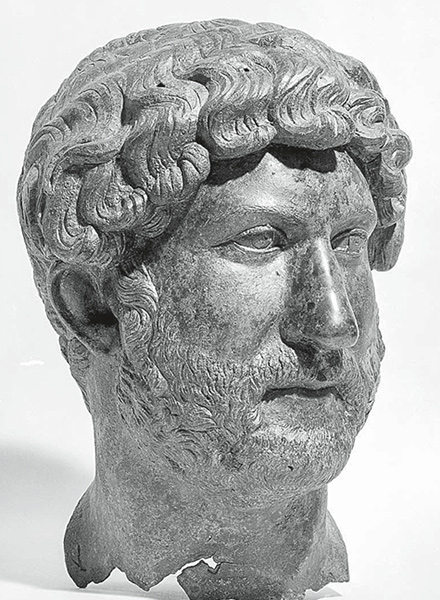
A recent Israel Museum exhibit on the Roman emperor Hadrian included three stunning bronze statues of Hadrian (see Strata: “Hadrian’s Many Faces,” BAR 42:04). One of them (pictured as the center of three) was actually discovered more than 40 years ago in Israel by an American tourist, Morton Leventhal, while he was using a metal detector to search for ancient coins.
Mr. Leventhal lives in our community. I know it would be appreciated by Mr. Leventhal, his family and the community if his contribution to the Hadrian discovery were acknowledged in BAR.
David Sitzer New York, New York
We hope Mr. Leventhal, his family and the community enjoy this recognition, although Mr. Leventhal’s activity was illegal.
In 1978, we wanted to put a color picture of this Hadrian on BAR’s cover. But the Israel Antiquities Department refused to release a color picture of the statue (nor would it allow us to take a color picture 064 of it) because it had not yet appeared in a scholarly journal (see “Editorial: Free Hadrian,” BAR 04:03). The widespread protest of BAR readers was unable to reverse the decision. Of course that would not be the case today; the pictures would be readily available from the Israel Antiquities Authority.—Ed.
Correction
Greenspoon Column
Leonard Greenspoon’s July/August column, “The Bible in the News: Methusaleh & Co.,” refers to the lyrics for “It Ain’t Necessarily So” by George Gershwin. The lyrics were written by his brother, Ira Gershwin.
Queries & Comments
008
Joseph and Esarhaddon— Connections?
Not Convinced Tales Are “Parallel”
I am a new and avid reader of BAR. My background is in story and writing, and I study folktale and literary theory, which is why I really enjoyed Eckart Frahm’s article, “Surprising Parallels Between Joseph and King Esarhaddon” (BAR 42:03). But I’m not yet convinced (though I could be) that the parallels suggest that one story came from the other.
At present, I agree more with the author’s statement that “[o]ne could argue they reflect little else than the universal nature of the theme of fraternal rivalry.”
John McGeary, M.F.A. Pittsburgh, PA
Too Many “Maybes”
In the May/June issue Eckart Frahm makes some interesting parallels between Joseph and Esarhaddon, except for:
1. Jacob, his sons and the rest of his family didn’t move to Egypt until after the sons went to Egypt to get grain for a starving family back in Canaan. In fact, he resisted going there all during the many times the brothers were going back and forth. Finally, when Joseph revealed his true identity, Jacob agreed to take the family to the land of Goshen (the northeast corner of Egypt).
2. Jacob didn’t work for Laban for 20 years to get Rachel as his wife, only 14.
3. Joseph did die in Egypt, a natural death, but Frahm gives us no proof that Esarhaddon died there, only that he died in a campaign to Egypt. It’s a long way from Assyria to Egypt.
The two full paragraphs on page 49 may be excluded in their entirety from the discussion. They include: “there is no proof,” “suggest,” “remains unclear,” “may have,” “seems to have been,” “can easily imagine,” “probably” and finally a “seem to have been.” Let me be clear about this. There is no objection to attempting to put together “what really happened” from known facts, but I do have an objection to excogitation from a series of “maybes” and “probablies.”
J. Birney Dibble, M.D. Eau Claire, Wisconsin
Prof. Greenstein Sees Common Fugitive Hero Story Pattern
In his article, distinguished Assyriologist Professor Eckart Frahm compares the Biblical narrative of Joseph to the autobiographical accounts of Assyrian King Esarhaddon, a younger son and successor of Sennacherib, who reigned from 680 to 669 B.C.E. Finding a number of points in common—particularly that of sibling hatred—Frahm suggests “that the author(s) of the Joseph story borrowed a number of key motifs from the story of Esarhaddon’s rise to power.” This suggestion entails a relatively late date for the Joseph story.
Biblical scholars have been comparing the pattern of the story of Esarhaddon to Biblical narratives for decades. I recently published a study (in John J. Collins, T.M. Lemos and Saul M. Olyan, eds., Worship, Women, and War: Essays in Honor of Susan Niditch, Brown Judaic Studies 357 [Providence, RI: Brown University, 2015]) delineating a widespread ancient Near Eastern and Biblical narrative pattern, using 14 points of comparison, in which a leader or leading figure must flee, or be removed, from home; spends a period of time in exile; returns home in triumph at the prompting of a god(dess); and establishes or renews a cult(ic practice). In most cases the hero is a younger son. This “fugitive hero pattern,” as I call it, is first attested in the Egyptian story of Sinuhe (c. 1900 B.C.E.); it lies behind the story of King Idrimi from northern Syria (c. 1450); it occurs in the Hittite narrative of King Hattushili III (c. 1275), who, like Joseph, was removed and did not flee of his own accord; and, in the first millennium B.C.E., it is found in the stories of Esarhaddon and of the Babylonian king Nabonidus. Among the Biblical stories that conform to the pattern are Jacob, Joseph, Moses, David—and several others in part.
010
In one of the optional sequences in the pattern, the hero marries the daughter of his host abroad. This occurs in the stories of Jacob, Moses, David and—with a variation—Joseph (he marries the daughter of Potiphera, whose name is nearly identical to that of his Egyptian master Potiphar, whose wife tries to seduce Joseph), as well as in the stories of Sinuhe and Hattushili (with a variation). It does not occur in either of the later Mesopotamian narratives—those of Esarhaddon and Nabonidus. It is therefore very improbable that the contours of the Joseph story were borrowed from Esarhaddon’s, which lacks the typical sequence of marrying the host’s daughter. Most of the similarities between the narratives of Joseph and Esarhaddon are explained by their construction according to the fugitive hero pattern. My analysis suggests that this narrative pattern originated in the Levant and reached Mesopotamia, probably by way of Aram, to which both Esarhaddon and Nabonidus were connected.
Ed Greenstein Professor of Biblical Studies Bar-Ilan University Ramat-Gan, Israel
Professor Porten Questions Use of Image
It’s indeed a mystery where Eckart Frahm (“Surprising Parallels Between Joseph and King Esarhaddon”) turned up the nice Aramaic fragment on page 49 of his article. It has nothing to do with Aḥiqar. It is the left edge of a letter fragment and was published by E. Sachau and may be found in Bezalel Porten and Ada Yardeni, Textbook of Aramaic Documents from Ancient Egypt—volume 4: Ostraca and Assorted Inscriptions, page 18 bottom. Were I to venture a guess why it was cited for Aḥiqar, I would say because line 1 reads, as an opening epistolary blessing, “[May the gods seek after] the welfare of my brother at all [times].” The letters of “my brother” are the same as the first three letters of the name Aḥiqar, namely aleph, ḥet, yod.
Bezalel Porten Professor Emeritus Department of Jewish History The Hebrew University of Jerusalem
BAR: Opinions Diverge
BAR Issue Withheld from Prisoner
Greetings. I had for some time wondered why I missed the January/February 2016 issue of BAR. It was withheld because on page 42 there is an image that is “sexually explicit” and contains “frontal nudity.” I’m clueless to what appeared on page 42. But I know from multiple past issues that it couldn’t have been anywhere near to the term of “purposeful eroticism” and hence contraband.
Eric Manfredi Sierra Conservation Center Jamestown, California
You’re right.—Ed.
BAR Back Issues Wreaking Havoc
I write with some annoyance, perhaps even anger, because I have purchased the DVD of your back issues. My anger is because I was not warned that this DVD was addictive. When I get medicine, the box is covered with all kinds of warnings, but you did not put a single warning on this DVD. My apartment has become much dirtier, my sink became066 full of dishes waiting to be washed, and my health was even endangered as I was so wrapped up in the DVD that I forgot to catch my transportation to the grocery store.
I recently had my 86th birthday. Mr. Shanks, I believe we were born in the same year, 1930, which must have been a vintage year.
Herbert H. Beckwith Ellsworth, Maine
Pastor Won’t Renew
I am not renewing our church’s subscription to BAR. We all want to go where true archaeology leads us and let the findings be what they are, but when people start sharing their opinions about the Bible without evidence, it becomes too much to take. What evidence proves that Eve was taken from Adam’s penis (“Creating Woman,” BAR 42:02)? I have learned that you can always find someone somewhere who is willing to say, “This Hebrew word means this or that,” without any proof!
Rev. Tom Butler Reservoir Bible Church Hollidaysburg, Pennsylvania
Correction
Photo Credit
The photographs of the jug and silver hoard in Archaeological Views: “A Silver Lining at Abel Beth Maacah” (BAR 42:04) should have been credited to archaeological photographer Gabi Laron. Additionally, Hazor is located 30 kilometers (18.6 mi) south of Abel Beth Maacah, not 30 miles.
Queries & Comments
008
Is Religion a Reason for Violence?
Rabbi Hot About Hendel
I’m a charter subscriber to BAR. I’ve read every issue, from the first to the latest, and enjoyed them immensely. But now, for the first time, I’m angry at an author and at BAR for printing Ronald Hendel’s “Biblical Views: The Bible and Religious Violence” (BAR 42:02). The alleged theme is violence in the three monotheistic religions, in the past and today.
Hendel is a professor of Hebrew Bible. His descriptions of holy wars in the Biblical period are accurate. But when he tries to learn a lesson from them for today, he steps way outside his area of expertise and authority and displays his own distorted agenda.
He rightly condemns “radical Islam” for the atrocities that have been perpetrated in its name and that have been justified by a number of its clergy. But in Hendel’s agenda, it’s important that all three religions be condemned equally.
His first example: One Christian man admits to murdering people at an abortion clinic in Colorado. Thousands of Christian clergy condemn his actions, but no matter. To Hendel, Christianity itself is guilty of murder.
His next example: Three Jews in Israel are accused of setting a fire that murders an Arab family. Thousands of Jewish clergy condemn the crime, but no matter. To Hendel, Judaism itself is guilty of murder.
This is not the first time that a scholar has pontificated about contemporary issues outside his area of expertise. Some scholars do feel the need to influence people beyond their usual, relatively narrow audience by taking outrageous public positions. But—to the best of my knowledge—this is the first time that BAR has accommodated any of them so blatantly.
I really hope that this will be a one-time exception. I don’t want BAR to degenerate into a periodical in which experts in their own fields regularly feel free to rant about other matters.
Rabbi Hillel A. Cohen West Hempstead, New York
Ba’al Banned?
Porten: Shanks Needs Nuancing
You need to nuance your “First Person: Banning Ba’al” (BAR 42:02) because David had a son named Baalyada, as noted in 1 Chronicles 14:7. In 2 Samuel 5:16, the name is sanitized into Elyada (from Ba’al- to El-). There are a couple other Ba’al names at this time.1 There are also 30 Ba’al names in the Idumean ostraca.
And I don’t think Eshbaal means “Man of Ba’al.” Rather it means “Ba’al exists.”2
Bezalel Porten Professor Emeritus Department of Jewish History Hebrew University of Jerusalem
Dear Buzzy (as he is known to his friends),
It seems to me you have proved my point: You say the Biblical text says El-Ada, instead of Ba’al-Ada, because this “sanitizes” it. Doesn’t this prove my point? You go on to make my point even stronger: You say there are 30 Ba’al names in the Idumean ostraca you are working on. But these are Aramean names, not Hebrew names, as if to emphasize my point: For the Arameans, Ba’al names are OK—but not for Judahites.—Ed.
Unpublished Finds
Stop the Loss to Biblical Archaeology
Robert Merrillee’s “In Their Own Words” (BAR 42:02) mentions the serious lack of post-excavation “follow-up” (analysis, cataloging, curation and full publication) in archaeology. The desire to dig/excavate at the expense of scientific analysis and publication results in the reporting of many archaeological discoveries being at best delayed and at worst lost forever.
Professional archaeology differs from pot-hunting and looting only in the thoroughness of the excavation and the analysis and reporting of the finds. Without publication, there is little difference in these two activities.
Archaeologists, if they are to be considered “professional,” must publish their findings in a timely manner. To do less is malpractice. Those who would dig and not write must be010 restricted until their reports are published.a
Egypt has begun this effort by strictly requiring full reports before new archaeological season projects are authorized. Israel must do this, too. There is too much money and scientific information being lost by those researchers who delay reporting until they forget or pass away.
E.J. Neiburger Curator of Anthropology (Retired) Lake County Museum Grayslake, Illinois
Mary Joan Winn Leith’s mention of the Hebrew word tachat (“Creating Woman,” BAR 42:02), in support of Ziony Zevit’s theory that Eve was created from the baculum (penis bone) of the Adam (man), brings to mind two incidents.
The first: My Biblical Hebrew teacher, Dr. Dennis Kinlaw (Asbury Theological Seminary), in about 1964 proposed a similar interpretation of tachat: that it should be translated “under,” thus implying that tesla‘ did not refer to the man’s “rib,” but to a “part” of something on his underside, that is, his genitals, from which Eve was created (constructed). I have been teaching this theory ever since then in my Biblical Hebrew classes, but without any knowledge of the baculum.
The second: In 1983 I took a group of my Biblical Hebrew students from the Bible college in which I was then teaching to Israel for a two-month archaeological dig/stay at Tel Aphek. I urged them to bring along their vocabulary cards to continue practicing while there and to be aware of all the modern Hebrew they would be seeing on signs, etc., as we made sightseeing trips on the weekends. On one such trip, our Israeli guide brought his wife along. She was sitting in the back of the bus alongside one of my students who was verbally practicing his vocabulary cards. He came to tachat, which he kept repeating out loud with the English meaning “under.” Our guide’s wife appeared somewhat embarrassed and finally said to him, “Please don’t keep saying that word. That’s the part of a woman she sits on!” (In Modern Hebrew, of course!)
Barry L. Ross Professor of Old Testament (retired) Anderson University School of Theology Anderson, Indiana
I hope so. At this point the Israel Museum refuses to put it on display. No explanation.—Ed.
Bible Questions from Behind Bars
I’m at a maximum security prison in what is called “administrative segregation,” which is a government term for solitary confinement. Since I’m in this cell all by myself—everyday, all day—I write to lots of places, but, seldom (really never) do I get a response.
Do they make a Bible that actually uses the name of the Jewish God? In your magazine it says the name is Yahweh. One of the commandments is to not take the name in “vain.” I’m sure you know what that means and where I am going with this. (If you ask most folks the name of the Almighty Creator, they’ll tell you “God.”) So, does the Bible with his name exist? How can I get one?
This is how I pass my time—writing places, trying to learn things. I know very little about the Bible. I own one, but reading it is pointless when you can’t answer all the questions that come up.
Okay, if you nice, busy, super intelligent people don’t have the time—or desire—to respond to a character like myself, I understand. After three years of doing this, I’m used to not getting answers. So I’ll leave you to the difficult, confusing work you do.
Brett Disiere Tennessee Colony, Texas
We will transmit reader responses to this letter.—Ed.
Queries & Comments
010
The Bible vs. Archaeology—Colliding Viewpoints: The Backstory
This issue of BAR contains an extraordinary exchange of letters among giants of the profession that may have no precedent.
It all began quite innocently. In each issue of BAR, we publish a short quotation from the work of a major archaeological or Biblical scholar in a department called “In Their Own Words.” In the January/February 2016 issue, this department consisted of six lines by Peter Machinist of Harvard University. In his quotation, Machinist examines whether the Bible should be considered in a search for Israel’s origins in Palestine. His answer is yes.
This evoked a heated response from the famed excavator of Gezer, William G. Dever. Peter is a “friend and colleague” of nearly 50 years, wrote Dever, but “absolutely no archaeologist today” regards the Bible as historically valuable in understanding Israel’s emergence in Canaan. “Precisely the opposite” is the case.
Dever bolstered his case by citing the work of several leading archaeologists, including Ann Killebrew, Ami Mazar and Larry Stager.
But Dever did not get much comfort from the scholars he cites, to whom we sent Dever’s response. For example, Harvard’s Larry Stager wrote us, “My view on the relationship of the Bible and archaeology is much closer to Machinist’s than to Dever’s, as anyone would know who has read my articles and books over the last 45 years.”
Ami Mazar writes, “Basically I agree with Peter’s statement. If we would have to rely on archaeology alone, we would not be able to say anything about Israel until the ninth century B.C.E.”
Ann Killebrew edges a bit closer to Dever. “Both Machinist and Dever are correct in their own way … I have no problem with Bill [Dever] referring to me, but I also understand where Peter Machinist is coming from.”
Below we print William Dever’s reply to Peter Machinist’s “In Their Own Words” and the responses by Killebrew, Mazar and Stager.—Ed.
Dever’s Fiery Response
In response to Peter Machinist (BAR 42:01)—a close friend and colleague for nearly 50 years—I must point out that absolutely no archaeologist today views the Biblical narrative of Israel’s origins in Canaan as “the arena within which the nonbiblical data have finally to make sense” or within which they “finally … acquire a specific, concrete historical identity.”
The fact is precisely the opposite case for writing any new history of ancient Israel in any era. In view of the progress of our two disciplines (archaeology and Bible), the archaeological data more often illumine the Biblical text, rarely the other way around.
I could give you hundreds of case studies to show that (1) these two sources for history writing are independent and must be kept so in the initial inquiry in the interest of honest scholarship; (2) the key is the comparison of the two classes of data in order to establish “convergences,” if any; and (3) in many cases it is the new archaeological data that will prove primary, not the textual data.
If there is any doubt, read the Book of Joshua; then read any recent archaeological discussion of Israelite origins; then decide which offers the more believable, more reliable “historical identity.” That would include books authored by me, Ann Killebrew and Avi Faust—as well as many publications by Israel Finkelstein, Ami Mazar, Larry Stager and others.
The Hebrew Bible may sometimes help to determine how Israel “remembered” its origins, but often the Bible has “invented” these origins (or created its “cultural memory” to use the term now in vogue). Israel’s “experiences,” even if often imaginary, were indeed formative for the later tradition preserved in the Bible, but that is more theology than history.
Until we all understand our two disciplines more clearly—and courageously—there will be little progress toward a useful 011012 dialogue. And that is a desideratum on which I think that Peter and I will agree.
Sincerely yours,
William G. Dever Professor Emeritus University of Arizona Distinguished Visiting Professor Lycoming College Williamsport, Pennsylvania
Killebrew: Text and Archaeology Complement Each Other
In my opinion, they (Machinist and Dever) are both correct in their own way. In any attempt to reconstruct the early Iron Age of the southern Levant and questions regarding the emergence of Israel, both the textual (Biblical and non-Biblical) and archaeological evidence are all part of the primary data and complement each other, even though at times they may appear to be somewhat contradictory. I have no problem with Bill Dever referring to me, but I also understand where Peter Machinist is coming from.
Ann Killebrew Associate Professor Penn State University Park, Pennsylvania
Mazar: We Cannot Rely on Archaeology Alone
Basically I agree with Peter Machinist’s statement. If we would have to rely on archaeology alone, we would not be able to say anything about Israel until the ninth century B.C.E., except the one mention in the Merneptah Stele in the late 13th century.a The Iron I settlement wave in the highland would be silent and no more meaningful than the similar settlement wave of the Middle Bronze Age 500 years earlier. It is only the Biblical tradition that provides clues to the identity and context of these archaeological phenomena. But whether they arrived from outside or were insiders, I still cannot say for sure. Most of them were probably insiders.
Amihai Mazar Professor Emeritus Institute of Archaeology The Hebrew University of Jerusalem Jerusalem, Israel
Stager: Closer to Machinist’s Viewpoint than to Dever’s
My view on the relationship of Bible and archaeology is much closer to Machinist’s than to Dever’s, as anyone would know who has read my articles and books over the last 45 years. One of the most popular books expressing the importance of texts, including the Bible, and archaeology is Life in Biblical Israel by Philip J. King and Lawrence E. Stager (Louisville: Westminster John Knox, 2011).
Lawrence Stager Dorot Professor of the Archaeology of Israel Harvard University Cambridge, Massachusetts
Baculum
Happy to Think for Myself
I have neither a Rev. at the beginning of my name, nor an M.D. or Ph.D. following it. I am a simple layman. But I grew up enjoying and appreciating science. Evolution was drilled into me for such a long time that I once considered it fact. When I saw it conflicted with my adult-found Christianity and Bible knowledge, there was conflict. I believe in the Bible because a few decades of study and research have convinced me of its truth. I feel the same way about science. Science actually enhances my Bible study. That is why I enjoy BAR so much. It makes me think. It makes me research. It makes me challenge my beliefs. Do I believe everything in BAR? No. But I appreciate the opportunity to think for myself. Such articles as Ziony Zevit’s “Was Eve Made from Adam’s Rib—or His Baculum?” (BAR 41:05) do not hinder my faith; they strengthen it.
Steven Hoffman Farmer City, Illinois
The Final Straw
We are absolutely dumbfounded that you have decided to continue to defend Ziony Zevit’s fallacy! This is the final straw.
Rev. John Miller New York, New York
065
Conflicting Aspects of Human Nature
Shawna Dolansky (“The Multiple Truths of Myths,” BAR 42:01) sees the conflicting descriptions of creation in the Book of Genesis as attempts by the Biblical writers to explain various aspects of their own lives, thus 066 presenting the modern reader with “many truths about the cultures that composed and disseminated them.” The famed rabbinic scholar and philosopher, Joseph B. Soloveitchik, in his essay, “The Lonely Man of Faith,” sees the two parallel Biblical accounts of man’s creation as describing two conflicting aspects of man’s nature. In Genesis 1, man is majestic and creative, seeking control of his environment, while in Genesis 2 and 3, man is humble, lonely and submissive, seeking redemption and a relationship with God and his fellow man. The Torah thus explains for us the complexity in the human condition—portraying man as both thinker and creator, servant and master.
Rabbi Seth Landa, M.D. Teaneck, New Jersey
Loved All the Brouhaha
I loved all of the brouhaha about whether it could be possible that Eve might have been created from Adam’s penis bone.
Mona B. Goodman Hartley, Texas
Keep it Up!
Please keep challenging our thinking and printing both sides in Q&C.
Jacob Eige Raleigh, North Carolina
Correction
Manicheans
The reference to Manchurians in “Monastic Views of Work” (BAR 42:01) is a clerical error and should refer to Manicheans, instead. Manicheans are followers of Manichaeism, a religion founded by the Persian Mani, who sought to reform Christianity, in the latter half of the third century.
This article is BAR at its best. It uses simple archaeology and historical accounts along with the Bible to give you the likely location of Cana of Galilee.
Gary Archer Big Spring, Texas
McCollough Educates Students on Cana
Several of my students read Tom McCollough’s article (BAR 41:06), and each was most grateful for the way it helped them understand the process by which Cana was located. Thank you for making it available.
John Munroe, M.Div., Ph.D. Faculty, Online Learning (Theology) St. Joseph’s College Standish, Maine
Coptic
Leo Depuydt Offends Reader
I’m one of the many subscribers who read BAR cover to cover shortly after it arrives. I particularly enjoy articles outside my area of primary interest. This time, however, I was stopped short by the first paragraph of Leo Depuydt’s article (“Coptic—Egypt’s Christian Language,” BAR 41:06). I’m used to BAR as a forum for respectful disagreement, but the absurd metaphors and mean tone in this article were out of line. If the goal was to get my attention, Depuydt succeeded by offending me and so losing me as a reader.
Ann Stehney, Ph.D. Bethlehem, Pennsylvania
Potpourri
A Happy BAR Reunion
What an excellent magazine you have. BAR and I reunited after 20 years of unintentional separation. Glad you, Hershel, and I are still alive.
Brett Williams Iowa City, Iowa
Heavier Ancient Stones
In the November/December 2015 issue, the Strata question on p. 22 asked, “How many tons does the largest ancient stone block weigh?” The answer given was 1,650 (metric) tons for a limestone block measuring 64 feet by 19.6 feet by 18 feet in Lebanon’s Baalbek quarry. There is, however, a much larger limestone block in a quarry near the Greco-Roman town of Akoris (modern Tihna el-Gebel) in Middle Egypt. This block, which is rounded at one end, measures 80.4 feet long by 29.5 feet wide by at least 21.3 feet thick. Assuming an average limestone density of 2.6 grams per cubic centimeter, as was done for the Baalbek block, and taking into consideration its non-rectangular shape, the estimated weight of the Akoris block is about 3,600 metric tons.1
There is another, better-known limestone block of similar size in the Sultan Pasha quarry near the modern city of El Minya, also in Middle Egypt. This one is cut in the outline of a colossal seated statue of the 18th Dynasty king Amenhotep III and is 72.2 feet long by 26.2 feet wide by 29.5 feet thick.2
James A. Harrell Professor Emeritus of Geology The University of Toledo Toledo, Ohio
From BAR to MEAR?
Inasmuch as locations in Syria, Iraq and Jordan are among the places referred to in the Bible, and many of the finds in Israel are from pre-Biblical times, maybe the magazine should change its name, so no one is left out. Middle Eastern Archaeology Review would be more inclusive, and readers could relate the finds to the Bible, or not.
Judith Abeles San Diego, California
Addendum
Manuscript Moved
The Ashkar-Gilson Hebrew Manuscript, discussed in Paul Sanders’s “Missing Link in Hebrew Bible Formation” (BAR 41:06), has now been returned from the Shrine of the Book in Jerusalem to Duke University, where it is on display in the David M. Rubenstein Rare Book & Manuscript Library.
I write to express my disappointment with your magazine. I wish to cancel my subscription.
Many of the articles published in BAR do not accurately reflect what the Bible teaches. Come on now, Eve being created from Adam’s penis bone, rather than his rib? That is plainly not a Bible teaching. I wonder, then, what other articles BAR publishes are filled with speculation, rather than Biblical truth. I do not need and will not read articles that damage my faith or attempt to cause me to doubt what I know is the truth from the Bible.
Sue Glaze Oakland, Maryland
Never Purchased a Tabloid Magazine
How does Ziony Zevit’s article have anything remotely to do with Biblical archaeology?
I have never purchased a tabloid magazine in my entire life—and I have no intention of ever doing so. I certainly didn’t realize that was what I was doing when I subscribed to BAR.
Rev. Randall L. Krabill Dalton, Ohio
Downright Laughable
I am a longtime BAR subscriber and anticipate the arrival of each issue. As a pastor, I find that the learned articles and resulting discussion have added insight to my study and teaching of the Bible and given me much personal pleasure, even if often challenging my views.
But the article “Was Eve Made from Adam’s Rib—or his Baculum?” was so outlandish that I am compelled to comment. Ziony Zevit’s attempt to prove that the Hebrew term tsela‘ could not mean the traditionally accepted “rib” is totally unconvincing. Surely if the root idea is something “on the side of,” then suggesting a hypothetical penis bone is clearly getting side-tracked. It only gets worse when he supposes that if the Lord used the man’s rib to create the woman, then it must logically result that all males henceforth would have one less rib! In his conclusion, he agrees with folklorist Alan Dundes that the author of the Genesis 2 account wrote on the origin of “a seam of light tissue on the underside of his penis.” Downright laughable and unworthy of comment.
As Jesus scathingly said, “You blind guides! You strain out a gnat and swallow a camel” (Matthew 23:24). Or as my wife cogently observed, surely the article was a belated April Fools’ Day joke!
Hershel, keep up the good work and do not cancel my subscription.
Rev. Don Brubacher Northern Ontario, Canada
Traditional Meaning “Unacceptable”
The traditional translation to “rib” in Genesis 2:21–22 is not only difficult to accept, but simply unacceptable, for several reasons: (1) The Septuagint translated tsela‘ as pleurá in Greek, and Jerome as costa in the Latin Vulgate. Both terms rarely may mean “rib” and most frequently mean “side”—never baculum(!), as you can ascertain in any good Greek and Latin dictionary; and (2) in the Gospel of John, chapters 19 and 20, the same Greek pleurá (equivalent to Hebrew tsela‘) appears four times, referring to the side of Christ, not to his rib. For instance, in John 19:34, one of the soldiers thrust his lance into his side (pleurá), and immediately blood and water flowed out. The Greek Fathers saw in this scene the formation of the new Eve from the side of the new Adam!
Rev. Ney Brasil Pereira Professor of Biblical Exegesis Instituto Teológico de Santa Catarina (ITESC) Florianópolis, Brazil
Baculum Is Not on Side
As the author acknowledges, the Hebrew word in question always refers to something off-center. There are no scriptural uses that refer to the front (where the penis is). How does the author justify moving from side to front?
Maybe not strict exegesis, but Matthew Henry in his commentary offers a better understanding: “The woman was made of a rib out of the side of Adam; not made out of his head to rule over him, nor out of his feet to be trampled upon by him, but out of his side to be equal with him, under his arm to be protected, and near his heart to be beloved.”
Fr. David Wechter Hermits of St. Mary of Carmel Houston, Minnesota
Ribs Are Rich in Stem Cells
Logically, if I wanted to produce a living being to be a companion to Adam, the easiest way would be to use stem cells and generate a clone of that individual. One of the easiest sources of stem cells can be from bones with marrow. And while a baculum can contain some marrow, it is mostly hard cortical bone. A rib, on the 009 other hand, has a rich environment of bone marrow material—and thus, abundant stem cells. And one would not have to actually remove the source in total to do this, just the stem cells. So the rib could remain intact.
My personal conclusion is that Eve was made from stem cells in one of Adam’s ribs.
Victor Horadam, M.D. Mesquite, Texas
Transported to the Garden of Eden
I was so intrigued by BAR’s article by Ziony Zevit that I immediately bought his book, What Really Happened in the Garden of Eden? Regardless of the debate regarding whether Eve was formed from Adam’s rib or his baculum, I can honestly say that in almost 50 years of Bible reading and research, I have never read a book that opened my eyes so much in just one quantum jump.
Zevit transports one “literally” into the Garden of Eden, drawing out nuances from the original Hebrew that one would never expect from a simple reading in any standard English translation of the Old Testament. I almost felt myself there “in Eden” alongside Adam and Eve, understanding what God (YHWH) really said, what the serpent really said and what really happened. A totally extraordinary literary—and, dare I say, “religious”—experience.
Peter Bentley Hong Kong, China
Let a Biblical Allegory Be
I found the article “Was Eve Made from Adam’s Rib—or His Baculum?” by Ziony Zevit, both interesting and charming. However, informed by my medical background, I see a problem with the author’s proposed physical explanation of what is surely supposed to be an allegorical story. He proposes that God performed an actual operation on a particular man, Adam, and not on mankind in general, and backs up his thesis by describing the operative scar (i.e., the median raphé on the underside of the penis). Even if we accept the description of what happened to Adam, how does that explain why all of Adam’s male descendants also lack a baculum and also have the “scar” on their penis? For the absence of a baculum to carry down through all succeeding generations, God would have had to simultaneously alter the DNA in Adam’s germ cells. If he could do that (surely within the scope of divine power), why bother with the surgery on Adam himself? And, conversely, why bother with altering Adam’s descendants if the operation on Adam had already accomplished God’s purpose—making Eve?
The best approach is to let a beautiful Biblical allegory remain an allegory, to be commented on by rabbis rather than by scientists.
Barnett Zumoff, M.D. Professor of Medicine Icahn School of Medicine at Mount Sinai New York, New York
062
Adam and Eve’s Belly Buttons
I realize the cover picture on the September/October BAR is just a copy of a 12th-century mosaic; however, it amuses me that the figures of Adam and Eve are shown with belly buttons.
Richard Yount San Tan Valley, Arizona
Awaits Visual Depiction
I’m looking forward to the ingenious artist who will visualize for the world the birth of Eve from Adam’s penis bone. This would merit a center fold in the next BAR, a singular revelation of the free-wheeling sexuality of the 21st century in the history of Western art.
Jo Milgrom Schechter Institute of Jewish Studies Jerusalem, Israel
We have received enormous response to Ziony Zevit’s article “Was Eve Made from Adam’s Rib—or His Baculum?”—far more than the selection printed above. According to Genesis 2:21, God took a tsela‘ from the man and fashioned it into a woman. Zevit has argued that the Hebrew word tsela‘ should be translated as “baculum” (penis bone)—rather than as “rib.”
As a result of BAR readers’ recent letters, we have asked two senior scholars each to expand on some of the general issues and address some of the readers’ objections in the next three issues of BAR. The first will be Mary Joan Leith, whose BARreview of Zevit’s book What Really Happened in the Garden of Eden? (BAR 40:03), started it all. She chairs the Department of Religious Studies at Stonehill College in Easton, Massachusetts. Second will be prominent folklorist Dan Ben-Amos of the University of Pennsylvania in Philadelphia, who, in a letter to the editor published in BAR (BAR 41:01), called our attention to support for Zevit’s argument in folklore and anthropology studies.
A number of readers submitting letters on Zevit’s article objected to the possibility of the Genesis story involving an intimate sexual part. But another view is that the translation of tsela‘ as “rib” does not necessarily add to the richness of the Genesis story, and new depths of meaning may be 063 found in the story when one considers a different translation of this word.—Ed.
Potpourri
The Horror of ISIS Destruction
I think BAR is not paying enough, or any, attention to the decimations, depredations and desecrations of ISIS. There should be a leading article about this horrific tragedy. However interesting, this beautiful magazine is focusing on debates over Temple artifacts unearthed in peaceful places. BAR is fiddling while Palmyra burns.
Bill Willcox Washington, D.C.
I wish we had some suggestions as to how to prevent this horror.—Ed.
Get Over It
It never ceases to amaze me at the dogmatic, stubborn and narrow-mindedness of people who read something in BAR that they don’t like and then cancel their subscriptions. They need to get over themselves; there are other thoughts, ideas and opinions besides their own.
Rant over.
Donna McDonell Spokane, Washington
Corrections
How Canaanites Worshiped
In “How Canaanites Worshiped” by Itzick Shai (BAR 41:05), we refer to “a large courtyard of approximately 52 square feet.” It should instead be 52 feet by 52 feet square.
Hippos
The label “Tell excavations” that appears on the photograph of Antiochia Hippos (Sussita) on p. 42 of Michael Eisenberg’s article, “Pan at Hippos—Face of Greek God Unearthed” (BAR 41:06), should be corrected to “Hippos” or “City excavations.” Hippos is a Classical period site and part of Sussita National Park. Although it has some strata accumulation in certain points, it is not an artificial mound—or tell.