
WorldWide

The Oculate Being, likely the patron spirit or deity of an early fertility cult on Peru’s south coast, is embodied in this rare ceramic mask decorated with resin-based paint. Serpents slither across its face. The snake heads radiate from the sides and form a corona around the edges of the mask. The most prominent features of the mask are the large, round eyes. The curved, smiling mouth reveals a row of teeth. A small figure pops out from the top of the mask and, wearing a similar mask himself, impersonates the Oculate Being. The function of the mask is unclear.

Dated from 300 B.C. to 1 A.D., the mask belongs to the Paracas culture, which flourished in the first millennium B.C. on the southern coast of Peru in the Andes. It is among the earliest known complex societies in South America. The Paracas and other contemporaneous societies were the predecessors of later civilizations in the Andes, including the Incas.
The mask is in the collection of the Cleveland Museum of Art.
WorldWide

Looking more extraterrestrial than human, the prominent eyes of two figures stare unblinkingly from this small alabaster statuette.
In the 1930s archaeologist Max Mallowan excavated hundreds of these figurines, measuring only a couple of inches tall, at a large ancient Mesopotamian site in northeastern Syria called Tell Brak. Appropriately named eye idols for their most pronounced feature, the figurines were found in a lavishly decorated temple that featured eye imagery in designs on the altar and in other interior carvings.

The figurines vary slightly in composition, and some have minimal decoration, such as carved lines or zigzags on the body, probably depicting clothing. They have been grouped into distinct types: those with only one pair of eyes (plain or decorated); those with three, four or six eyes on a single figure; those with a second, “child” figure carved on the front; and those on which the eyes have been completely drilled through.
The eye was a popular religious and magical symbol throughout the ancient Near East, but these eye idols seem to be unique to Tell Brak. Scholars believe they functioned as votives, possibly representing the worshipers who left them in the temple.
WorldWide

This 3-inch-tall glass pendant depicting a male figure with wide, staring eyes, puckered lips, a thick, wavy beard and tightly cropped hair was found in a Phoenician burial ground near the town of Olbia in Sardinia. Topped by a small suspension loop, the head (which likely represents the Phoenician god Melqart or Eshmoun) was the centerpiece of an elaborate beaded necklace made during the fourth or third century B.C.E. to protect the owner from harm and evil spirits in the world beyond.

Found throughout the Phoenician world, glass pendants depicting gods, demons and animals were produced in a variety of brilliant colors and styles using the so-called sand-core technique. The rough shape of the bead was molded with damp sand, wrapped in cloth, and then fixed to the end of a rod and dipped in molten glass. While the bead was still hot, other colors of molten glass, such as the translucent blues and opaque whites and yellows in this example, were added to create the bead’s unique facial features and designs.
WorldWide

This formidable warrior is a member of the world-famous terracotta army from the mausoleum of Qin Shi Huang, the first emperor of China (ruled 221–210 B.C.E.). Only a fourth of the estimated 8,000 life-size warriors have been unearthed from the sprawling mausoleum. The warriors were each positioned according to rank and equipped with real weapons. Their role was to protect the emperor, who still lies in an unexcavated tomb, in the afterlife.
This kneeling warrior’s topknot, mustache and body armor reflect an exceptional level of individuality that can be seen in each of the terracotta soldiers. Artisans mass-produced the clay bodies and then customized each warrior with hats, heads, facial hair, shoes, etc. The position of this warrior’s hands indicates he was an archer who once held a crossbow.

Remains of the clay army were first discovered in 1974 by a group of peasants outside of Xi’an in the Shaanxi province in northwest China. Thirty-five years of excavations have revealed 600 pits, most as-yet unexplored, over a 22-square-mile area.
WorldWide
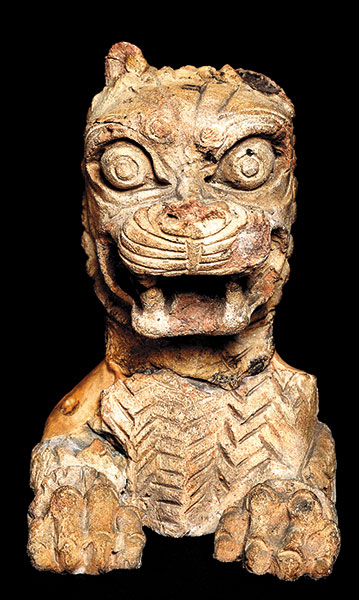
Though it may not capture the most adorable qualities of man’s best friend, this 2,500-year-old depiction of a seated canine was nonetheless a cherished symbol within Babylonian society. Standing only 6 inches tall, the clay figurine, which shows the head, torso and front paws of a ferocious, wide-eyed hound baring its teeth, likely adorned a larger statue of Gula, the Mesopotamian goddess of medicine and healing whose divine symbol was the dog. Babylonian seals and boundary stelae often show a dog seated beside the enthroned goddess.

While it is unknown exactly why the dog became associated with healing in Mesopotamian lore, the connection dates back to at least the early second millennium B.C.E., when dog figurines were deposited in the main temple to Gula at Isin in southern Babylonia. More than a thousand years later, Babylonian history recorded that Nebuchadnezzar II, who destroyed Jerusalem and took Judah’s population into exile in 586 B.C.E., dedicated dog statues made of gold, silver and bronze to the goddess and placed them in the gates of her temple. Some have suggested that such canine imagery intended to guard against rabies, which was apparently rampant in second- and first-millennium B.C.E. Mesopotamia.
WorldWide

A bejeweled winged Nike resolutely pulls on the reins of her rearing chariot horses in this elegant gold earring from Greece.
At nearly 2 inches tall and formed in the round, this small vignette of the goddess of Victory must have made an elegant sight with its partner adorning the ears of a wealthy Greek noblewoman in the mid- to late fourth century B.C.E.
The earring is composed of more than a hundred elements intricately soldered together. Gold sheet embellished with wirework and gold balls form the figures of Nike and her team. The goddess wears a belted chiton, or tunic, with a long skirt and several pieces of jewelry, while her wings unfurl behind her as though in flight. Her horses appear frightened as they rear up on their hind legs with eyes wide and muscles tensed.
The Nike group is attached to a disc in the shape of an exquisitely decorated honeysuckle palmette with a teardrop-shaped fruit at its center. Several of the stamens bear remnants of enamel. A loop on the back of the palmette likely attached to an ear wire so it could be worn.

Although not found in a controlled excavation, the piece was discovered in the Greek Peloponnese and sold to the Museum of Fine Arts, Boston, in 1898 from a private collection.
WorldWide

In this intricately detailed 6-inch-tall clay model dating to the late fourth century B.C.E., two young women crouch down to play knucklebones (Greek, astragaloi), a game of chance in which the oddly shaped knucklebones of sheep or goats were thrown to reveal one’s fate. The elegantly dressed woman on the right sets out her hand to cast the first throw, while the woman on the left, whose striking red hair is still preserved, waits patiently for her turn, her left hand clutching the knucklebones she will play next. In the Greco-Roman world, young, unmarried women played knucklebones to divine their romantic fortunes, with a perfect cast (one where all the bones landed on different sides) being called an “Aphrodite throw.”

But there were myriad variations of knucklebones played by other segments of Greco-Roman society. Among men, knucklebones were used for a gambling game in which each player cast the bones nearly three dozen times, with each “roll” of the bones given a certain value determined by the different faces upon which the bones landed. Children, on the other hand, simply tossed the pieces into the air and tried to catch as many of the bones as possible before they hit the ground, in a game similar to the modern game of jacks.
WorldWide

This 3-foot-tall sandstone stela, discovered near the desert town of Ha’il in northern Saudi Arabia and dating to the fourth millennium B.C.E., depicts the stylized features of a man, possibly a warrior. The outlines of the figure’s head, shoulders and body have been reduced to simple blockish but artistic forms. Carved in relief, the man’s eyes, nose and the curving outline of his face and chin are carefully defined. Below is the collar of his garment, and across his chest are two straps leading down to a belt. Tucked neatly inside the belt is a weapon, possibly a split-blade dagger.

Most scholars believe that such anthropomorphic standing stones, found widely across Arabia and the deserts of the southern Levant, were thought to contain the spirits of deceased ancestors and were thus set up as memorials where families could worship and perform rituals. Elements of such practices may have eventually evolved into the idea that the stones represented the abodes of gods, reflected in the Bible’s many references to the worship of masseboth, or standing stones.
This stela will be on display as part of the Roads of Arabia exhibit at the Museum of Fine Arts, Houston, from December 22, 2013, to March 9, 2014.
WordWide

A Scandinavian silversmith worked with painstaking detail to craft this small, intricate crucifix pendant in the ninth century A.D.
Excavated at the ancient Viking site of Birka on the island of Björkö, less than 20 miles west of Stockholm in Lake Mälaren, it is the earliest known depiction of the crucifixion from Scandinavia. It was found in a woman’s grave.

The details of the Christ figure are formed with tiny strings of silver beads and a few larger silver balls that represent the eyes and inverted-teardrop face, torso, bound arms and legs, and even individual fingers.
The pendant is on display at the National Museums, Scotland, as part of their Vikings! exhibit running through May 12, 2013. A major theme of the exhibit is exploring the gradual transition that took place throughout the Viking Age (c. 750–1100 A.D.) from the Old Norse pantheistic religion to Christianity.
WorldWide

The snowy white body of a sphinx regally supports the ebony-colored cup of this ceramic rhyton, or drinking horn, found in a tomb in Capua, Campania, Italy. The sphinx, a mythical human-lion-eagle hybrid believed by Greeks to be a guardian of the dead, was carefully molded and coated in a fine white slip and painted with gold and brown accents. The wheel-made cup attached to the sphinx’s back is covered in black slip with red-figure decorations featuring Kekrops (or Cecrops), the legendary snake-bodied king of Athens (at upper left), and his children.
This 11.5-inch-high rhyton was made in Athens in the mid-fifth century B.C. by the potter Sotades, who signed his work. It and other vessels found in the Italian tomb likely identify the dead person as an Athenian migrant to the west.

Illustrated scenes on other ancient Greek vases indicate that the small hole between the sphinx’s front legs would have been closed (possibly by a finger) while wine was poured into the cup on top and then reopened to allow the wine to flow into a bowl or cup set some distance below. In addition to the entertainment value of such a display, this function also had the added benefit of aerating the wine and making it frothy before consumption.