
WorldWide
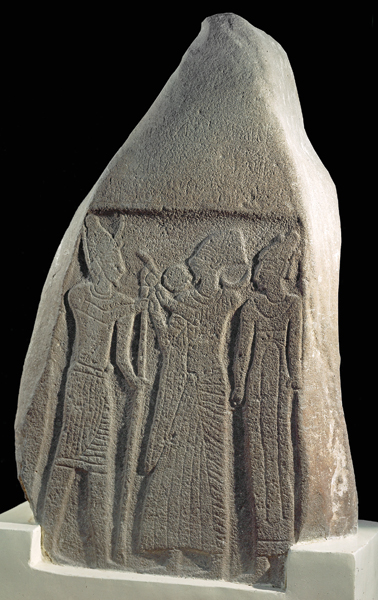
This roughly shaped, 5-foot-tall black basalt stela from the Late Bronze Age (1550–1200 B.C.E.) was discovered at Balu‘a in central Jordan. Carefully etched into the stela are three figures in distinctively Egyptian style. The central figure, cloaked in a patterned full-length gown and wearing a bag-shaped headdress, is likely a local king or chieftain of Moab. He is being presented on the left with a scepter held by a god who wears a simplified form of the double crown of Upper and Lower Egypt. Looking on behind the king is a female figure dressed in a sleek, fitted gown and wearing the plumed atef crown typical of the Egyptian god Osiris. Above the scene are the faint and now largely illegible traces of a four-to-six-line inscription that remains undeciphered.
Although the tribes of Moab were largely beyond the reach of Egypt’s New Kingdom empire, this stela shows that these groups were still well acquainted with symbols of Egyptian power. Mimicking Egyptian royal iconography, the stela appears to show a male god, possibly the Canaanite god Baal, investing the Moabite chief with divine authority to rule. The female figure probably represents the Canaanite goddess Anat.

WorldWide

This tiny yet delicately crafted gold amulet less than 2 inches high depicts an enthroned Hittite goddess. A large disk-shaped halo representing the sun surrounds her deeply furrowed, mature face. She is dressed in a full, body-length gown, her only adornment a pair of large loop earrings and a simple necklace. Seated on the goddess’s lap and nestled safely between her arms is a small child, firmly posed with back upright and arms crossed. The two are regally seated on a throne decorated with four lion paws.
Although many aspects of Hittite religion remain mysterious, this amulet, which dates to the Late Bronze Age (1550–1200 B.C.E.) and the height of the Hittite empire, likely represents the traditional Anatolian sun goddess, sometimes called Wurusemu, holding an infant child, presumably one of her divine children. In Hittite mythology and royal inscriptions, the sun goddess was the guardian of the land of Hatti and served as protectress and champion of the Hittite kings. In a dedicatory hymn, the Hittite king Hattushili IV (c. 1267–1237 B.C.E.) calls the sun goddess “the queen of heaven and earth” and “the light of the country of Hatti.” Her major cultic sanctuary was located at Arinna, a place many identify with the modern-day site of Alacahöyük, about 15 miles northeast of the Hittite capital of Hattusha.

WorldWide

These three finely carved stone figurines, depicting female musicians dressed in flowing, high-waisted gowns and wearing flat-topped chignon headdresses, were unearthed from the tomb of General Zhang Sheng of the Sui Dynasty (581–618 A.D.) near the city of Anyang in China’s Honan province. The figure on the left is shown holding a pair of cymbals, while the musician on the right gently strums the strings of a traditional Chinese lute, or pipa. The elegantly poised woman behind them focuses intently on finding the correct note on her flute.
These three figures, each about 7 inches tall, were among a group of 13 figurines of musicians and dancers buried as offerings in the general’s tomb. Such musical ensembles were often composed of women of lower status in Chinese society and were regularly used for entertainment by elite and wealthy households of the Sui Dynasty. This set of stoneware musicians may have been buried with the general as a token of his status or as an eternal reminder of the pleasant joys of his earthly life. It is also possible that the ensemble was intended to convey the ritualized music and chanting of Buddhism, a religion that had become increasingly popular in China during the Sui Dynasty.

WorldWide

Even after nearly 2,000 years, the colors on this painted glass goblet are still brilliant. Donning an aureole-type headdress, the woman on the glass is harvesting dates. Another female figure and two male figures of lesser social standing— judging by their dress—are also depicted reaping the sweet bounty as the scene extends around the goblet.
The 5-inch-tall goblet was found in the ruins of a palatial building in ancient Kapisa (modern-day Bagram, Afghanistan), a city that was, by the first century A.D., a summer capital of the Kushan people, whose empire had its roots in China.
Chemical analyses of the glass have revealed typological and mineralogical parallels to ancient glassware in Egypt, Mesopotamia, Rome and Arabia. Other glass goblets found nearby depict images of warriors that some scholars identify with scenes from Homeric epics; still other goblets portray scenes indicating a possible Egyptian or African connection. The goblet is probably an import from somewhere to the west, evidence of ancient Kapisa’s role as a crossroads between the empires of East and West.

The goblet is part of the exhibit Afghanistan: Hidden Treasures from the National Museum, Kabul, which is on view until October 12 at the Bonn Museum in Germany, the final stop on its two-year world tour.
WorldWide

This grotesque and deeply furrowed clay mask from the ancient city of Sippar (modern Tell Abu Habbah in Iraq) in southern Mesopotamia portrays the face of the mythical demon Humbaba, the ferocious, unsightly creature of the Epic of Gilgamesh who guarded the fabled Cedar Forest and was ultimately slain by the hero Gilgamesh and his partner Enkidu. In Mesopotamian lore, Humbaba’s contorted face was often thought to resemble the twisted, sinuous path of coiled entrails, depicted in this mask as a single, continuous line that twists and turns to form and define all of the demon’s horrifying facial features. Amazingly, this quite-detailed coiled portrait of the ancient demon measures only 3.25 inches wide, about the width of a standard business card.

Masks of Humbaba were often used in Mesopotamian divination rituals where the will of the deity was sought by examining and “reading” the exposed intestines of slaughtered animals. If the face of the demon appeared in the entrails, it was a clear sign that revolution was about to take hold in the kingdom. Indeed, the cuneiform inscription written by a diviner named Warad-Marduk on the opposite side of this 3,700-year-old mask reports that just such a divination had been revealed in the intestines he examined.
WorldWide

Heavy must be the crown that dons the head of this seated king in an intimate portrait recovered from the beaches of the Isle of Lewis in Scotland. The bearded king, dressed in a flowing robe with his hands clinching a sword and scabbard, stares hauntingly out into space, his thoughts no doubt lingering on the enormous responsibilities that confront him at home and abroad.
This 4-inch-tall figurine, however, does not depict an actual king. It is one of the famous Lewis Chessmen, a collection of 93 ivory chess pieces—including kings, queens, bishops, knights, rooks and pawns—that were made in the last of the Scandinavian Viking kingdoms and then shipped to the British Isles sometime in the 12th century C.E. The number of pieces—way too many for a standard chess set of 32—indicates that three or even four sets were buried together, possibly by a Scandinavian merchant who hoped to sell the pieces to European elites who were increasingly interested in this exotic game that had been invented in India.

WorldWide
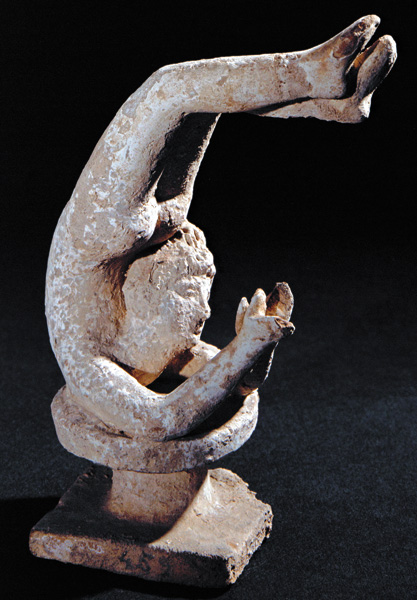
This fourth-century B.C. terra-cotta figurine discovered in Greece and measuring only 6 inches tall depicts the contorted body of a nude female acrobat as she sails through the air in a somersault. Despite the amazing strength required to hurl her small frame through the air, the acrobat seems to handle the vault with ease. Indeed, she appears perfectly calm as her back and legs arch gracefully into the apex of the vault.
In ancient Greece, as today, acrobats and tumblers were considered not so much athletes as entertainers. Often accompanied by singers and dancers, they performed their death-defying leaps and impressive feats of strength in front of enthralled crowds at weddings, banquets and even funerals. Often, the performances were preceded by ritual sacrifices to local gods.
Such ritual acrobatics may hearken back to Minoan practices known from Bronze Age Greece. At the palace of Knossos on Crete, several frescoes were found that depict acrobats vaulting over the backs of charging bulls, imagery that is repeatedly found in Aegean art of the period. It is often presumed that such scenes had religious or ritual significance.
WorldWide

The beady eyes of seven resting ibex peer out of this small, 5-by-8-inch alabaster frieze from ancient Yemen. When viewed from the front, the figures of the ibex seem at first shapeless and ill-defined, their long muzzles and protruding horns offering the only clues to their identity. From the side, however, the full spiral of the ibex’s characteristic back-turned horns comes into view, while its reclining pose is artfully depicted with the front and hind legs tucked neatly beneath the body.
This ibex frieze, dating to the late first millennium B.C., is characteristic of much of the art of ancient South Arabia—the home of the Biblical Queen of Sheba and the ancient world’s emporium for exotic goods and fragrances. Although little is known about South Arabian religion, the ibex motif appears frequently in temple reliefs and friezes and also decorates the borders of numerous cultic steles. In antiquity, ibex abounded in the hills and mountains of South Arabia’s rocky highlands, and many scholars believe these sacred animals were ritually hunted and slaughtered in honor of the gods as a guarantee against drought and famine.

WorldWide

Delicately carved into this basalt rock from the ancient lava fields of eastern Jordan is a seemingly whimsical depiction of music and revelry dating to about 2,000 years ago. A nude female figure with spindly legs and wild flowing hair plays a long flute-like instrument, while a male figure is shown dancing, the position of his hands and feet evoking the playful tunes of the flute’s melody. Below the fanciful scene, an inscription written in the so-called Safaitic script of the ancient Arabian tribes of the region records the name of the artist, the name of his father and grandfather, and an all-too-brief description of the subject of the drawing itself: “By Aqrab son of Kaset son of Sa‘ed is this songstress.”

This intriguing scene, however, is only one of thousands of such drawings and inscriptions that can be found decorating the myriad stones of Jordan’s deserts. During the Hellenistic and Roman periods (fourth century B.C. to fourth century A.D.), numerous Arab tribes moved through and occupied the vast stretches of rocky desert that bordered the more-settled, urban regions of Syria and Palestine. These Arab tribesmen, many of whom were literate in the languages and scripts of ancient Arabia, carved their names and simple messages into the desert rocks, as well as intimate artistic portraits of their daily lives, from scenes of dancing and revelry to realistic depictions of the wild and domestic animals that were so essential to their desert existence. Unfortunately, the artists rarely inform us of the meaning or significance of their drawings, thereby leading most scholars to see such depictions as simple graffiti.
WorldWide

More than 2,000 years ago, six Bactrian nomads built their tombs atop the small mound of Tillya Tepe (“Mound of Gold”) in the barren plains of northern Afghanistan. While their tombs were relatively simple affairs, the nomads wore burial garments adorned with intricately carved gold and jewelry. Upon their discovery in 1978, it became known as the “Bactrian Hoard.”
One of the more remarkable finds from the tombs is a pair of bejeweled pendants depicting the so-called “Dragon Master,” one of which is shown here. The pendant is topped by a crowned man wearing a traditional central-Asian tunic who grasps two winged dragons by their legs. Dangling below the scene is an intricate lattice of gold medallions, carnelian beads and lotus-inspired floral elements inlaid with turquoise and lapis lazuli. Remarkably, this incredibly intricate piece of ancient jewelry is only 5 inches tall. The pendants were probably worn from a woman’s headdress.
Unfortunately, very little is known about the Bactrian nomadic culture that crafted the pendant, or the significance of the “Dragon Master” motif. Like so many of the pieces from the Tillya Tepe hoard, however, the pendant offers brilliant testimony to the wealth and status of these nomads, who grew rich from their protection and taxation of the great Silk Road leading from China to Rome and beyond.
