
WorldWide

With lavish painted ornamentation and a dramatic pose, this female figurine commands attention. The bird perched atop her head announces her divine status, as birds such as doves and pigeons were symbols of a goddess throughout the ancient Mediterranean world. Found at the center of a small communal shrine at Knossos, on the island of Crete, this 8.5-inch, clay figurine from the 14th century B.C. represents a Minoan goddess. According to scholar Giorgos Rethemiotakis, the goddess’s oversized arms and accentuated eyes “vividly bring to life the message and content of the prayer, the immediate visual and mental contact of the goddess with the praying faithful.”
Minoan religion centered around goddess worship; there also is evidence of a powerful female priesthood. Since the language of the Minoans has never been deciphered, most of what we know of the civilization comes from Greek and other neighboring cultures.

WorldWide

On this intriguing stone vessel thought to be from northern Syria and now on display in the Louvre, a rather awkward and not-so-fierce-looking lion with eyes of shell and red carnelian wraps its jaws and front paws around a shallow basin. Such vessels were common to the royal courts and temples of Syria and Palestine during the Iron Age (1200–586 B.C.). Their basins are often adorned with potent symbols of life and power, including lions, human hands and various floral patterns.

The basin, which measures only 2 inches in diameter, was the business end of this cultic vessel, which originally would have had a much longer wooden or metal tube affixed to the hollowed-out protrusion behind the lion’s head. Some have suggested the cup held incense that burned when air was blown through the tube, but it is more likely that the entire vessel was meant for the pouring of ritual libations. The liquid was held in the cylindrical container and then gradually dispensed into the cup as needed, perhaps to be used for ceremonial anointing or sprinkling.
WorldWide

BIBLICAL BEAST OF BURDEN. This small bronze figurine, recovered from the island of Rhodes and now on display at the British Museum, depicts a bearded man seated firmly atop a kneeling camel. Both the camel and its Mesopotamian-style rider would certainly have been foreign to Iron Age Greece and it is therefore likely that the figurine was brought from the east, perhaps from Assyria.
Despite its small size (it stands only 3 inches tall), the figurine offers clear evidence of the growing importance of the dromedary (one-humped) camel in the Iron Age Near East (1200–586 B.C.). As a beast of burden highly adapted to desert life and travel, the camel could go for weeks at a time without water and could carry loads of more than 150 pounds. Such qualities quickly made the animal—and its nomadic Arab breeders—indispensable to the flow of trade and traffic across vast stretches of the Fertile Crescent.
Although the date of the camel’s domestication remains a mystery, the Bible tells us that camels were already used during the reign of King Solomon to ferry exotic goods (and a beautiful queen) between distant South Arabia and Jerusalem (1 Kings 10:1–10). Afterward, camels appear regularly in the annals and reliefs of the Assyrian kings, often in association with the vanquished Arab tribesmen who had become wealthy from the overland trade.

WorldWide

Lined up like soldiers, these gilded bronze figurines from Lebanon bear a strong resemblance to the Phoenician divinity Resheph, the god of war and plague.
The figurines, which measure only a few inches tall, were discovered at the Phoenician “Temple of the Obelisks” in Byblos, Lebanon. The temple where the figurines were found is also known as the Temple of Resheph—after the god who was worshiped there—and was built around 1600 B.C. The temple featured a courtyard with a giant obelisk at the center, thought to represent the god, surrounded by smaller shrines and obelisks.
The male figures are believed to be votives, or offerings to Rephesh, and were likely constructed in local workshops. Each one wears a conical helmet or headdress that resembles the Egyptian crowns of the time, a detail that demonstrates a cultural link between Egypt and Byblos. Some scholars believe that the figurines are connected to the worship of the goddess Astarte.

WorldWide

Interred in the precise manner of human burial, this iron figurine was found near a sacred structure in ancient Vani, a major city of Colchis (present-day Georgia). At 9.5 inches long, the figurine was designed to lie flat, apparently created for the purpose of burial. Like many of Vani’s human inhabitants, this figurine was laid to rest bedecked in ornate jewelry. The figurine’s gold earrings, neck ring and bracelets suggest that it might also have been clothed in rich garments. Although its precise use has never been determined, the evidence points to a ritual, funerary function.

The figurine’s tiny jewelry, which is reminiscent of crafts produced in Colchis, helps date the figure to the third century B.C. Ancient Colchis, located on the eastern coast of the Black Sea, is best known from Greek mythology as the land where Jason and the Argonauts went in search of the Golden Fleece.
WorldWide

The ancient city of Kapisa—modern Bagram, Afghanistan—has always straddled the East-West divide. The city was destroyed by Cyrus, rebuilt by Darius and fortified by Alexander the Great, earning it the distinction of “Alexandria of the Caucasus.” By the first century A.D., it was the summer capital of the Kushans, whose empire had its roots to the east, in China.

Bagram’s archaeological record reflects the city’s role as an important trading post between the Roman, Persian, Chinese and Indian peoples. One of 22 such items discovered in the ruins of a monumental building in Bagram, this first-century glass, fish-shaped flask is possibly of Roman origin and is believed to have been blown in the legendary glass workshops of the Phoenician coast.
Although its exact use is not known, the flask, which measures 3 by 4 by 8 inches, might have held water, wine or perfume and served as an offering to the dead. The fish was a Roman symbol of fertility. Some scholars believe that it is a rhyton, a ritual drinking cup of Eastern cultures, whose special attribute is that it cannot be set down.
The fish flask was recovered in 2003 among many glass wares and other treasures in a vault beneath the presidential palace in Kabul, Afghanistan. These treasures are now on display at the National Gallery of Art in Washington, D.C., until September.
WorldWide

Built into the soft limestone hills near Myra, on the southeastern coast of modern-day Turkey, these Lycian tombs (fifth–fourth century B.C.) emulate the look of wooden Lycian homes.
This is not an accident. The Lycians, departing from neighboring Greek traditions, integrated their burial sites directly into their settlements, keeping the dead as close to home as possible. There is evidence of cults of ancestor veneration surrounding these tombs. When Lycian tombs were not integrated into cities, they were placed along the coast and at the top of cliffs so that the souls of the deceased would be well positioned for transport to the afterlife by a winged creature who resided on the rocky shore.

Over a thousand Lycian tombs of this variety have been discovered.
WorldWide

Stunning and elegant, this cameo features the portrait of a Roman noblewoman. Cameos were often used to immortalize or profile important personalities. Dating to the reign of Emperor Caligula (37–41 C.E.), the piece portrays either Livilla (Caligula’s aunt) or Drusilla (Caligula’s beloved sister).

The woman is wearing oval drop earrings and a laurel wreath. The wreath appears to tie at the back of her head with a ribbon. In Roman times, laurel was often worn on the head as a crown of victory and success.
Measuring 3.4 inches long and 4.2 inches high, the gem is made of sardonyx (from Greek, “sard,” meaning reddish brown, and “onyx,” meaning veined gem). The cameo is on display at the British Museum.
WorldWide

Feline ferocity is apparent in the stance of this figure of a female lion found in modern-day Iran. She stands on her hind legs and pushes her menacing claws together in front of her wide chest. Her shoulders and head are turned opposing her torso, giving her face a fierce profile look. The lioness’s torso is made of magnesite or crystalline limestone, while it is hypothesized that her legs, now missing, were originally made of silver or gold. Four holes in the back of the head and one at the tail were drilled through the figure, most likely to hold colorful streamers or to allow it to be worn as a pendant.
The figurine dates to the proto-Elamite period (c. 3000–2800 B.C.E.), which was the earliest stage of civilization in Iran. Other similar proto-Elamite figures have been found in the region.
The Guennol Lioness (as she is known today) will be auctioned at Sotheby’s in New York on December 5. Though it stands a mere 3.5 inches high and 2.5 inches wide, the figurine is expected to fetch a price of up to $18 million.

WorldWide
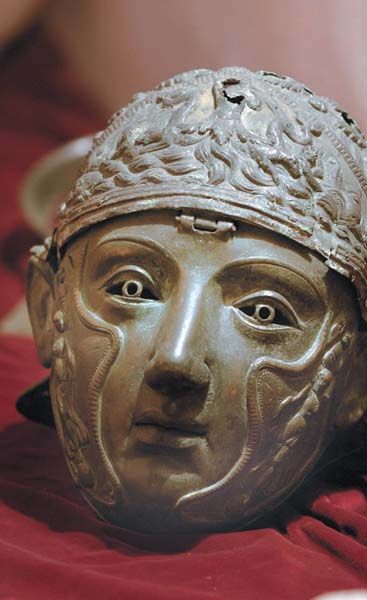
From beyond the grave, the visage of a Roman soldier is captured in this first-century A.D. bronze piece. It was found in a grave tumulus (burial mound) in Vize (ancient Bizye), Turkey. Scylla, the destroyer of Odysseus’s ship, adorns the visor of the helmeted soldier, while Nike, the goddess of victory, graces each of the cheek guards. The two-piece helmet is held together by a hinge at the forehead. The eyes, nostrils and mouth are carved open.
Bizye was home to the mythological Thracian king Tereus, one of the sons of Ares, the god of war. It was also one of the last Thracian capitals before Thrace was annexed by Rome in 44 or 46 B.C. The helmet was part of the horde of grave goods of an obviously wealthy and important person who was buried in the tumulus, quite possibly a member of the royal house of Thrace.
The masked helmet is 10 inches high and 8 inches wide and is in the collection of the Archaeological Museum in Istanbul.