
WorldWide

“Nemesis will have her dues.”1 The goddess Nemesis is depicted in this statue from the early third century A.D. as a griffin with its hand resting on the wheel of fortune. Her name comes from the Greek nemein, “to allot.” She is the Greek and Roman goddess of vengeance who doles out divine retribution for hubris, pride and undeserved good fortune. She was widely worshiped among Roman soldiers, who often saw themselves as avengers, beating down enemies who dared defy the empire, and her cult spread as they marched through Judea in the first century B.C. A courtyard from the second century A.D. is dedicated to Nemesis at the Temple of Zeus near Banyas. Some believe a temple in her name was erected near Ashkelon.
This marble sculpture is 18 by 20 inches and its pedestal is inscribed with a dedication in Greek: “Year 522. I, Mercurios, son of Alexander, dedicate [this statue] during my priesthood.” The year corresponds to 210/211 A.D. It was found near Kibbutz Erez in the northwestern Negev and is in the collection of the Israel Museum.
WorldWide

DOUBLE DOSE OF BEAUTY. Two women—one European, the other African—look out from opposite sides of this Etruscan head vase from the sixth century B.C. The African woman’s hair is painted red, and she wears an earring, while the European woman is unadorned. The lip of the vase is simply decorated with a checkerboard pattern. Measuring 4.5 inches tall and with two large handles, the vessel is a kantharos, or drinking cup for wine, that would have been used at symposia (drinking parties) or funerary feasts.

The “Janiform” style, named after Janus the two-faced god of gates and doorways, was popular among Greek and Etruscan artists in the sixth and fifth centuries B.C. Some scholars argue that the contrasting of an African and a European was an attempt to express the infinite variety of mankind and the geographical and anthropological differences of the people who lived on the shores of the Mediterranean Sea. This vessel is in the collection of the Museo Nationale di Villa Giula in Rome.
WorldWide

Muscular and menacing, though only 4 inches tall, this statuette of a “scar-faced devil” from the Oxus civilization that lived in Bactria in eastern Iran in the third to second millennia B.C. consists of three separate pieces: the torso, the skirt and the legs. It is made of chlorite (black) and calcite (white).
The bearded creature is covered in scales, indicating a serpent-like character, and has a deeply incised scar running the length of his face. A hole in his forehead may have held horns; small holes in his upper and lower lip suggest that his lips may have been bound, making him mute; and a hole at his back suggests he once boasted wings.
The lower lip and one eye have evidence of being encrusted with sea shells, and he holds a vessel under one arm, both of which indicate a connection to water. In fact, it has been suggested that in the pantheon of his civilization, this “devil” is actually a god in control of the subterranean waters that hide in the winter, which he represents, and are released in the spring, which is represented by a countering fertility goddess. His face was more than likely deliberately scarred in antiquity in a destruction ritual aimed at releasing his maleficent power. But he’s not all bad: In the cycle of life he’s only evil for part of the year when winter descends and vegetation dies. Come spring, he must cooperate with the goddess and let the waters once again flow to the fields.
WorldWide

WAITING FOR HIS MASTER’S COMMAND. This fifth-century B.C. “plastic” (from the Greek plasso, or “to mold”) rhyton, or drinking cup, in the shape of a dog’s head is attributed to the Brygos Painter from Athens, Greece. The Brygos Painter was a prolific decorator of pots and cups, with over 200 vessels attributed to him. The rhyton is molded from two separate pieces (the seam runs from the top of the dog’s cranium to below his neck) and is intricately decorated from tendons that bulge at the dog’s throat to the whiskers on his nose. The broad red line circling the neck serves as a collar for the dog and a border for the portrait that’s painted below on the cup’s rim.
The Brygos painter chose to depict a mythological fight between pygmies and cranes, a story well-known from ancient times that was also employed by Homer in his eighth-century B.C. epic, The Iliad. He likened the battle cries of the Trojans to that of the “clamor of cranes,” going up “to the heavens.”
The rhyton most likely belonged to a member of the Athenian elite as domesticated canines in ancient Greece were mostly employed as hunting companions.
WorldWide

“‘O Lord my God,’ cried Jonah from the belly of the great fish … ‘I with the voice of thanksgiving will sacrifice to you; what I have vowed I will fulfill. Deliverance belongs to the Lord!’ Then the Lord spoke to the fish, and it spewed Jonah out upon the dry land” (Jonah 2:6, 9–10). This third-century A.D. marble sculpture depicts Jonah being cast up out of the belly of the beast. Having spent three days inside the fish for his transgressions, Jonah is forgiven by the Lord and released. In Judaism, the story of Jonah is retold on Yom Kippur, the holiest day in the Jewish calendar, as it is the perfect example of sin, repentance and forgiveness. The early Christian society that created the statue equated Jonah’s deliverance with the resurrection of Jesus after three days in the tomb.

Although the story has come down to modern society as Jonah being swallowed by a whale, this artist chose to depict the beast as Ketos, the sea monster that the Greek god of the sea, Poseidon, sent to plague the city of Troy. The 16-inch-tall statue is part of a group of sculptures known as the “Jonah Marbles” that probably came from a tomb. Although the actual location of their discovery is unknown, tests have shown that the marble came from a Roman Imperial quarry at Docimium in Central Turkey. The statue is in the collection of the Cleveland Museum of Art.
WorldWide

In service to the god Thoth, the patron god of writing, an Egyptian scribe sits in a traditional pose with papyrus at the ready on his lap. This greywacke figurine was probably part of a votive offering to Thoth. Dating from the reign of Amenhotep III (1391–1353 B.C.), this 2.5-by-2.5-inch figurine depicts a fortunate and highly valued person in Egyptian history. Scribes were exempt from manual labor and they received a rigorous education few Egyptians experienced.
The hieroglyphs they were taught to write were divine (the Egyptian phrase for hieroglyph translates “Divine Word”), and their job was to record for all eternity the stories and records of the Egyptian people. Being among the literate elite of a mostly illiterate population often allowed scribes to become even more elevated members of society. One scribe even became pharaoh: Horemheb, the last pharaoh of the 18th Dynasty, who was the royal scribe and commander-in-chief to King Tutankhamen.
Figurines such as this have been found throughout Egypt; this one unfortunately is of an unknown provenance. It is currently on display at the Detroit Institute of Arts.
WorldWide

Poised to pounce, this copper lion from Mari (Tell Hariri), Syria, once stood inside the entrance to a sanctuary. Part of a pair found embedded in the walls, the lion is 1 foot high and nearly 2 feet wide. Its mouth is agape as if it were caught in mid-roar, maybe offering a warning to interlopers to stay away from the temple dedicated to an unidentified deity known only as “king of the land.” But since guardian statues are usually found outside of the entrances they guard, the fact that this lion was found in the interior suggests that it served a different function.

The quality of the piece and the craftsmanship of the creator are evident in the details of the flowing mane, the flattened ears and the defined whiskers. It consists of 18 copper sheets placed on a frame and secured with copper rivets. The inlaid eyes are limestone and slate.
Mari was inhabited from the fourth millennium B.C. and flourished during the Middle Bronze Age until 1759 B.C., when it was destroyed by Hammurabi. Because of Mari’s cultural similarities to the Biblical patriarchs, it is often said that Abraham traveled through Mari, on the banks of the Euphrates, on his way from Ur to Harran. Mari is best known for its archive of cuneiform tablets that cover a span of almost 500 years.
The lion stood his ground for nearly 4,000 years until it was discovered in situ by French archaeologist André Parrot in 1937. It is currently on display at the Louvre in Paris. Its companion is in the museum in Aleppo, Syria.
WorldWide

On his knees, a silver bull holds a spouted vessel. His bovine head and neck end at human-like shoulders that taper into cloven hooves. A jig-saw design decorates the skirted legs of this six-inch silver figurine that was found near Susa in Southwestern Iran.
The so-called “Table of Nations” lists the descendants of Noah (Genesis 10). In it, Elam was the son of Shem and became the ancestor of the Elamites.
Elamite civilization, from the area of modern Shiraz in Iran, is considered the earliest civilization in Iran and lasted from approximately the fourth to the first millennia B.C. Aspects of Elamite culture and language were absorbed into Achaemenid Persia in the mid-first millennium B.C.
The bull dates to the earliest Elamite culture, known as proto-Elamite. Its purpose is unknown, but scholars speculate that it may have been part of a religious ritual or ceremonial burial.

WorldWide
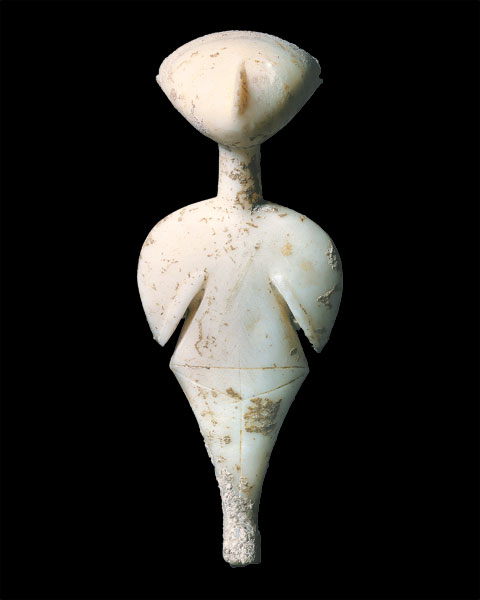
For millennia, man has looked to the heavens for inspiration and guidance. In ancient Anatolia (the Asian part of modern-day Turkey), someone in the third millennium B.C. sculpted this marble stargazer, so called because her head and eyes are turned upward toward the divine. The 6-inch-tall statuette of a woman is carved of white marble. Her face is similar to the contemporary Cycladic figurines from Greek isles bordering Anatolia.
The stargazer was sculpted by a civilization that left no written record. But, because her eyes and head are purposefully designed to look up, scholars speculate that she was either a cultic figure or represented funerary art with a specific role in the religion of her people. Approximately 15 “stargazer” figurines and numerous fragments are known. Many have been separated at the neck, suggesting a ritual beheading.

WorldWide

Frozen in mid-gallop, with undulating antlers that seem caught in the wind, this intricately carved golden stag plaque displays the impressive workmanship of a people known to history, ironically, as barbarians—the Scythians (seventh century B.C.-first century A.D.) Herodotus, in one of the few written descriptions of the tribe, told of their penchant for scalping their victims and sometimes sewing coats out of the scalps; blinding their slaves; drinking the blood of their victims; practicing human sacrifice and smoking marijuana. Nomads and accomplished equestrians who were among the first to tame horses and wear trousers, the Scythians preferred to chase game rather than engage in battle; they were, however, fierce warriors when the need arose. They ranged widely from an area north of the Black Sea from the Carpathian mountains to Mongolia, including the Eurasian steppe of what is now Kazakhstan and southern Russia, and at one time, according to Herodotus, they “occupied the whole of Asia” (Histories 1:103-105). The Holy Land was no stranger to the Scythians either; Herodotus tells us they sacked the Philistine city of Ashkelon in the fifth century B.C.

The plaque is 2 inches wide and dates to 400-300 B.C. Pieces of animal art similar to this have been found in ancient burial mounds (called kurgans) in Ukraine, Siberia and the Crimea. The Scythians believed in an afterlife where you can take it with you, and their graves were elaborate affairs that they cherished and protected, even threatening Darius I, king of Persia (521-486 B.C.), that desecration of the graves would be the one thing that would get them to fight when the Persian army invaded (Histories 4:127). Precious objects were buried with kings and other royalty, along with sacrificed warriors on horseback, wives and servants. The stag shown here was probably a personal piece of jewelry to be worn as protection for the bearer.