
Luke and John: A Different Supper Setting
THE PICTURE ART COLLECTION / ALAMY STOCK PHOTO
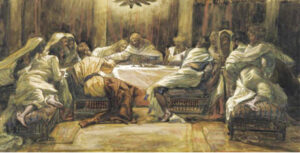
Although Mark and Matthew—widely believed to be the two earliest gospel accounts—appear to place Jesus’s Last Supper within a more modest domestic setting, Luke and John (likely written several decades later) may have imagined the scene differently. Luke, for instance, is the only account of the Last Supper to insert a table into the narrative (22:21), while John includes intriguing references to group foot washing (13:1–17), the beloved disciple leaning “into the bosom of Jesus” during the meal (13:23, 25), and Jesus dipping bread into his personal serving vessel (13:26). Both gospels use language that alludes to a Hellenistic-style “banquet” (deipnon; Luke 22:20; John 13:2–4), and both change the verb for the group’s action from “sitting” (anakeimai; used in Mark and Matthew) to a word that could equally mean “sitting,” “reclining,” or “lying” (anapiptó; Luke 22:14; John 13:12).
Such details have led many to assume that Luke and John imagined Jesus’s group reclining in a triclinium with hierarchical seating for a Roman-style feast. And it may indeed be the case that these two gospel writers envisioned the event this way, particularly given Luke’s inclination to recast scenes from Jesus’s life with a more Greco-Roman urban texture (e.g., Luke’s description of village homes in Capernaum as having ceramic-tiled roofs [5:19] rather than ones made of branches and plaster [Mark 2:4]). If Luke and John do envision the Last Supper in this way, though, it would seem that their reframing represents a later expansion of the tradition, whereas the parallel accounts in Mark and Matthew represent the tradition in its earliest written form. In other words, as the Jesus movement spread throughout the eastern Mediterranean, early Christians may have gradually come to imagine the Last Supper not as a common Judean meal but as a more elaborate dining experience that reflected Greco-Roman customs.