
Menahem’s Daughter?
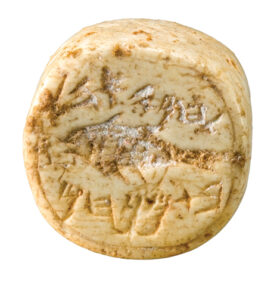
PHOTO: MIKI KOREN / COURTESY OF THE ISRAEL ANTIQUITIES AUTHORITY
Scribes learned through apprenticeship. Masters took on apprentices from their own family as well as others from outside. Women scribes are known from ancient inscriptions, and most were probably trained by their fathers. The seal of a certain Hami’ohel, daughter of Menahem, was excavated in a tomb on the eastern slope of Jerusalem’s Hinnom Valley. Judging by the location and quality of the tomb, Hami’ohel belonged to an important scribal family. Could this be the family of Menahem, son of Yawbanah? Let’s take a closer look.
The seal reads, lḥmy’hl bt mnḥm (“belonging to Hami’ohel daughter of Menahem”). If this is the same scribal family, as seems likely, then the seal belonged to the granddaughter of Yawbanah.1 Seals belonging to women are relatively rare, and the name of Menahem’s daughter is unusual. The divider used between the seal’s first and second lines is a fish, a symbol not found on any other known seals (most simply have a single or double dividing line). What might be the meaning of this fish?
Fish were an important part of the Jerusalem diet in the late eighth century BCE. In just one excavation in the City of David, more than 10,000 fish bones were collected.2 The use of the fish image, therefore, likely reflects a particular moment in Jerusalem’s history, namely a time when the city’s traders had significant commercial access to the Mediterranean. We might even speculate that the fish trade was boosted by the influx of northern refugees. First, the much larger population created the need for additional food. Second, many of the refugees came from the Northern Kingdom, which had greater access to Mediterranean ports like Akko and Dor.
As such, the seal’s fish divider not only makes for a unique decoration, but it also may connect Hami’ohel to the fishing trade. Indeed, given the number of excavated fish bones, we must imagine there was a “Jaffa Fresh Fish Market” somewhere in Jerusalem. Maybe Hami’ohel worked there. We will never know for sure, of course, but such speculation could help explain how and why this unusual fish image appears on Hami’ohel’s seal.