
Plagued by Defeat?
NIDAY PICTURE LIBRARY / ALAMY
Both the Hebrew Bible and Sennacherib’s annals agree that the Assyrian forces ultimately withdrew from Jerusalem before the city was taken, with Hezekiah remaining on the throne of Judah. So what would have compelled the world’s most powerful army to withdraw?
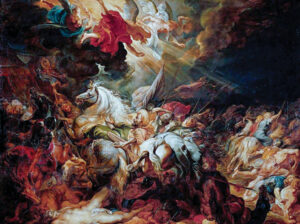
In the first century BC, Josephus cites the earlier Babylonian historian Berosus saying that Sennacherib’s army, while encamped outside Jerusalem, was struck by a “pestilential distemper” (Antiquities 10.21). The biblical account famously attributes the Assyrian disaster to the “angel of the Lord,” who struck down the army during the night (2 Kings 19:35; 2 Chronicles 32:21; Isaiah 37:36). These passages inspired the literal avenging angels of Peter Paul Rubens, Gustave Doré, and Lord Byron.
Yet the biblical language itself points toward the same explanation as the Babylonian tradition. The word translated “angel” in these verses is simply mal’akh, “messenger.” Elsewhere in the Bible, this same term, “messenger/angel of the Lord,” is explicitly associated with plague. In 1 Chronicles 21, King David is given a choice between three divine punishments: three years of famine, three months of the swords of his enemies, or three “days of plague in the land, with the angel of the Lord ravaging every part of Israel.” David chooses the final option. The narrative then explains the result plainly: “So the Lord sent a plague on Israel … and God sent an angel to destroy Jerusalem.” Here, such divine punishment via the “messenger/angel of the Lord” is explicitly defined as a plague.
Thus, the biblical account and the Babylonian tradition appear to describe the same event: a disease that swept through the Assyrian camp, something not uncommon on these western campaigns.