
Siege Archaeology: Machaerus and Masada
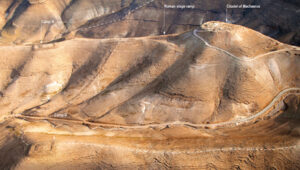
COURTESY OF THE HUNGARIAN ARCHAEOLOGICAL MISSION TO MACHAERUS / PHOTO BY DAVID KENNEDY
Although nothing remains of the Roman siegeworks around Jerusalem, two contemporary Judean fortresses, Masada and Machaerus, both about 30 miles from the capital on opposite sides of the Dead Sea, preserve valuable archaeological traces of the siege tactics used by the Romans. The two sites were both captured by the Romans following the destruction of Jerusalem, with Machaerus falling in AD 72 and Masada in 73. Excavations have revealed a tremendous amount of information about the final moments of the First Jewish Revolt at each site, especially at Machaerus, which was never subsequently inhabited.a
At both sites, the Roman army constructed stone siege walls that were built at a distance of at least two furlongs from the stronghold’s fortifications. As at Jerusalem, garrison camps were built into the line of these siege walls (eight at Masada, 15 at Machaerus), strategically positioned on surrounding hillsides to be at or above the elevation of the fortresses’ outer walls wherever possible. Given that both Masada and Machaerus were built on natural high points, the Romans also constructed massive stone and earthen assault ramps that allowed them to reach and overcome the fortresses’ walls. While the siege ramp was completed at Masada (perhaps culminating in the famous scene of mass Judean suicide known from Josephus; see War 7.389–406), it was left largely unfinished at Machaerus, suggesting the fortress’s defenders may have surrendered when facing the possibility of a final Roman assault (again, as suggested by Josephus; see War 7.195).
Even though Josephus provides few specific measurements or details regarding the Roman sieges of Masada (War 7.275–279) and Machaerus (War 7.190–205), the archaeological evidence from both sites serves as vivid testimony to the reality of Roman siege warfare in the first century. This evidence, in turn, provides firm archaeological support to our reconstruction of the Roman siegeworks erected around Jerusalem.