
The Ataruz Temple in Context
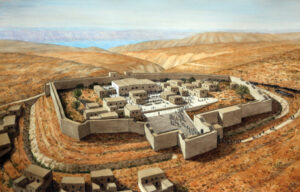
BALAGE BALOGH / ARCHAEOLOGY ILLUSTRATED
Ataruz’s central sanctuary featured a long room divided between a main hall and an inner shrine (or holy of holies). It may also have had a small rectangular entry space or forecourt (though clear evidence is still lacking), meaning Ataruz was likely similar in some respects to other celebrated Iron Age sanctuaries, including Solomon’s Temple in Jerusalem, the Ain Dara temple in Syria, and the Tell Tayinat temple in Turkey.a
But Ataruz also diverged significantly from its peers. Unlike those long-room temples, the main Ataruz sanctuary was flanked by two parallel chambers, forming a tripartite complex of three sacred rooms built side by side. Similar Iron Age tripartite shrines were excavated at Horvat Qitmit in the Negev and a small site near Wadi ath-Thamad in central Jordan, but the Ataruz temple complex far exceeds both in scale and complexity.
What is more, the entire Ataruz complex, which spans about 450 by 650 feet, was enclosed by a massive retaining wall and reinforced by a deep dry moat, which together demarcated a large, flat area for the temple and its courtyards. Indeed, nearly every structure excavated thus far, including the monumental staircase linking the site’s main gate to the sanctuary above, is related to the temple complex. To date, no houses or domestic features have been found.
In this sense, Ataruz evokes Jerusalem’s Temple Mount and the great sanctuaries of Greece, such as Delphi and the Athenian Acropolis—sacred landscapes where the entire area was devoted to religious rather than domestic or administrative purposes.